I read the news today. Oh boy. The BBC’s article “Why we need to rethink what causes depression”, by Christian Jarrett, October 14, 2026″ by Christian Jarret, (a cognitive neuroscientist, science writer and author) outlines the opinion that we need to think about depression as not caused by some kind of chemical imbalance, and that we need to rethink ‘what causes depression’. This click bait title leads us through category errors, pop psych theory, pseudoscience and ultimately further disables people who are experiencing depression by undermining the understanding of what is really going on, stigmatising real solutions and results in victim blaming.
Let’s break it down.
TLDR
- Answer the Freaking Question:
- Jarrett fails to explain that he wrote this article to answer someone’s question, then failed to answer that question.
- Jarrett may not have written the title, but either way, he doesn’t answer the title’s question either.
- Jarrett fails to define if he means Major Depressive Disorder or non-clinical depression, polluting the entire discussion in further uncertainty for a complex topic.
- Extraordinary Claim Failure: Jarrett provides no evidence for his extraordinary claims (title or first few paragraphs).
- Soft Back peddle: Jarrett concludes, softly, that he standard model is pretty accurate, but way past where 75% of people would have read, and in a way that would mean that most people who did read it wouldn’t understand that he back peddled.
- Victim Blaming: By misleading people and adding to the erroneous pop psych, people who struggle with depression will feel that they have failed to ‘fix their lives‘.
You may also like

Misleading Concerning Article is BAD
The Point: The language in the first paragraph is very concerning, undermining medical science and setting up a question he never addresses.
“The most popular idea for what causes depression in the brain is some kind of chemical imbalance. Many pharmaceutical companies have claimed in their advertising that their antidepressant drugs work by correcting this imbalance.“
Jarrett, the author, uses language like ‘popular’ to describe the most accurate scientific medical understanding for why people experience clinical depression. Of course, Jarrett doesn’t bother to distinguish the difference between intermittently but rarely feeling a bit down (I’ll refer to this as ‘Casual Depression‘), and Major Depressive Disorders (MDD) where you find your life impacted by a combination of several symptoms over a long period of time.
The second sentence, the implication that pharmaceutical companies claim a result that isn’t true, that it is advertising not researched results, and that they “work by correcting this imbalance“. This sentence draws in big pharma conspiracy concepts, pushes the idea that via the word ‘claimed’ and ‘advertising’ that this is a lie, and undermine the biology of MDD, reinforcing the first sentences raising of doubt.
Fair if it turns out that decades of published research by both pharmaceutical companies and independent researchers have been either accidentally wrong, or lying.
“Extraordinary Claims require Extraordinary Evidence.”
Carl Sagan, Broca’s Brain, 1979
First we will address the potential category error, Casual Depression versus Major Depressive Disorder, to ensure we are addressing the correct ‘depression’ (more about the different forms and experiences of Depression), and then we will see if the extraordinary claim is met with extraordinary evidence.
Category of Depression
The Point: This is the discussion Jarrett should have made clear – does he refer to casual non-clinical depression or Major Depressive Disorder, and why that is important.
Casual Depression Primer
Casual Depression is most likely caused by fatigue and lifestyle. That is, you are tired and not recovering well. Lifestyle can include poor diet leading to an insufficiency of nutrition, poor sleep leading to poor recovery and lack of daily personal resources, and over demand of actions and productivity leading to general fatigue and exhaustion. The next most common cause for Casual Depression is momentary personal conflict, which could be an intimate partner, family member or friend, or longer term personal conflict due to an abusive person within those circles or at work. Another common factor for Casual Depression is dealing with change – such as job loss, social upheaval, a breakup, or death.
While medication can help these, most people just need time, support and to understand what is happening and what they can do about it. That is, talking therapy.
Major Depressive Disorder Primer
What is MDD?
Major Depressive Disorder (MDD) means that you have met the diagnostic criteria for MDD. That is, 5 criteria or more of 9 possible experiences, which must include at least the top 2 criterion. There is more to the diagnosis than just this step, but this help you quickly understand that there is more to MDD than just feeling like you are struggling for a few days or a couple of months, out of the blue which then goes away.
Part 1, Diagnosing MDD
Five or more of the following A Criteria (at least one includes A1 or A2)
- A1 Depressed mood—indicated by subjective report or observation by others (in children and adolescents, can be irritable mood).
- A2 Loss of interest or pleasure in almost all activities—indicated by subjective report or observation by others.
- A3 Significant (more than 5 percent in a month) unintentional weight loss/gain or decrease/increase in appetite
- (in children, failure to make expected weight gains).
- A4 Sleep disturbance (insomnia or hypersomnia).
- A5 Psychomotor changes (agitation or retardation) severe enough to be observable by others.
- A6 Tiredness, fatigue, or low energy, or decreased efficiency with which routine tasks are completed.
- A7 A sense of worthlessness or excessive, inappropriate, or delusional guilt (not merely self-reproach or guilt about being sick).
- A8 Impaired ability to think, concentrate, or make decisions—indicated by subjective report or observation by others.
- A9 Recurrent thoughts of death (not just fear of dying), suicidal ideation, or suicide attempts.
Treatment for MDD
MDD needs to be treated by a combination of medication to address the chemical imbalance causing the MDD, and talking therapy to help address the lifestyle effect of MDD.
Caveats
Mental health is complicated. As such, here are some important caveats to the above simplification that are REALLY IMPORTANT.
- MDD may not be the right primary diagnosis, or the only factor.
- MDD may be a misdiagnosis, or secondary to another conditions, such as ADHD. ADHD is currently defined as a condition where the receiving dopamine receptors in the prefrontal cortex (PFC) synaptic gaps is under stimulated, impairing the PFC function, often experienced as problems with Executive Function and Executive Dysfunction (yes, they are different). More modern understanding is showing that this is more of a general problem with the neuronal Dopaminergic System, which leads to a host of conditions, which include Chronic Fatigue and MDD.
- Talking therapists and techniques are not equal.
- Not all Talking Therapies are the same, and many are Pseudoscientific. Not all therapists are good.
- MDD is a category of diagnosis for a collection of conditions, diagnosed by diagnostician observations and subjective feedback. Some of this is done via clinical assessment tools. That has 2 major issues:
- Subjective experience is hard to quantify and compare. For example, do you like pear more than me? How would we test that?
- This tells us that you fit the criteria for MDD, is not better explained by another condition. But what actually causes MDD? We assume it is biological (due to lots of evidence), but that evidence points at a collection of biological causes that all lead to behaviours and experiences that match the definition of MDD. Yet, researchers often test 1 treatment on the collection and are surprised it only works on 1 cluster within the collective…
Jarrett’s Argument
Jarrett argues that no one really know what the brain chemicals (neurotransmitters) should be. To support this argument, he cites an article, that he immediately admits is controversial and is critiqued as having “gone too far”. Not solid.
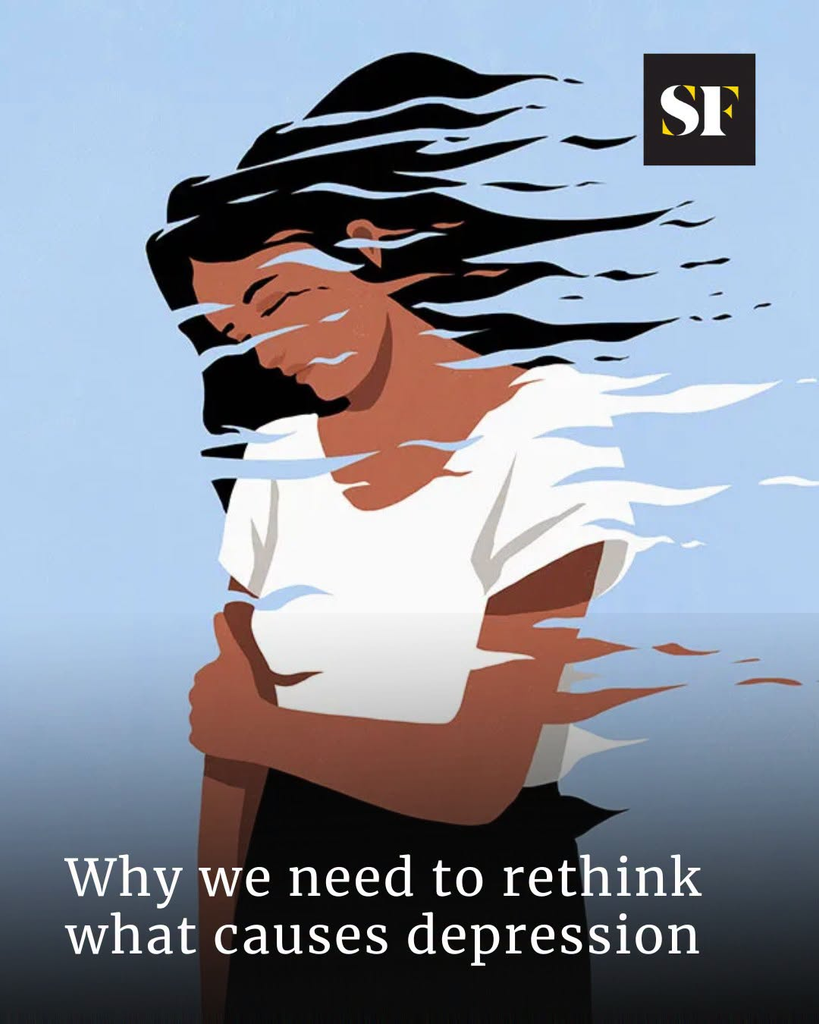
Jarrett includes a picture, and in the caption states “Some studies have declared no link between biochemicals and depression suggesting a more complicated situation. – Credit: Mary Long”. No links to these studies to review if they are respected, thorough, crack pot or made up.
Jarrett argues that there is no “one cause” for ‘Depression‘, as it may be due to a range of biological issues (HPA-axis, cortisol, serotonin and the immune system) and that “stressful life experiences” can lead to heightened cortisol levels and suppressed immune systems.
Fundamentally, this agrees with my gripe about MDD being simplified by many practitioners as “1 condition”, instead of a collective term for many with a similar-ish profile.
Jarrett offers a framework for ‘Depression‘, chronic stress interferes with Neuroplasticity (flexibility in the brains structure to accommodate change) could be what ‘Depression‘ is really about, as you are “stuck with a highly negative bias in your memories and thinking.” Jarrett does admit that perhaps those possible biological factors stated earlier, overactive HPA-axis and neuroinflammation, might be causing that decrease in Neuroplasticity.
Finally, the article states, after the article break, that this was written to answer Chloe Reynolds’ question “‘What actually causes depression in the brain?” I don’t think the Reynolds’ question was answered well.
Worse, the article strongly implies that ‘medical science has got it all wrong‘, that ‘big pharma lied to us‘, but ultimately softly admits, ‘it is the neurological chemicals’, likely affected by ‘chronic stress‘ and ‘life experiences‘ aka ‘medical science got it right‘ without explaining that this misleading click bait article, written by a cognitive neuroscientist was trying to answer a question but didn’t.
Jarrett’s Evidence – what evidence?
I would like to discuss the evidence that Jarret provided to make their click bait article, but there isn’t any.
The only evidence that Jarrett actually provided for his opinion has been widely critiqued as misleading, which Jarrett commendably did admit to, but then failed to provide any actual clear evidence to support his earlier claims. Jarrett then finished the article by offering another way to think about Depression, that relies on the same claims that Jarrett tried to undermine without any evidence.
Pseudoscience Marker
Pseudoscience or crank theories often suffer from some common errors.
Extraordinary Claim Lacks Extraordinary Evidence by the Claimant
- Both:
- Burden of Proof Problem (the claimant has the burden of proof, not the examiner),
- Best / Only Evidence Provided is Poor (Extraordinary claim followed by nothing burger evidence).
When you make an argument that ‘X is true despite the general scientific consensus that X is false’, then you would expect to have some extraordinary evidence that demonstrates that everyone is wrong. Surely, if you had good evidence that your argument was correct, you would present it.
Think of it like this. If you had 100 pieces of excellent evidence to support your argument, why would you start at the worse and weakest bit of evidence in your collection? Sure, you might be restricted by space and time for you to make your argument, but that would suggest that the person who has good evidence would start at their strongest evidence, not the weakest nothing burger in their collection.
Effectively, when the claimant either fails to give extraordinary evidence for their extraordinary claim, then that strongly implies they have no good evidence for their claim.
If Jarrett’s article has said “What if we are wrong about the medical science? Here’s is a new hypothesis to consider, it makes sense, perhaps we should examine it?” then we could examine his proposal to see if it has merit.
Instead Jarrett makes extraordinary claims that are presented as facts (‘medical science got it wrong‘), then undermines his own argument (‘stress causes biological changes‘) to propose a mechanism for his claim, never stating his claim is a proposal, so doesn’t need evidence, but then a proposal isn’t a statement of ‘truth’ either.
“The amount of energy needed to refute bullsh!t is an order of magnitude bigger than that needed to produce it.”
Alberto Brandolini, 2013
So, Rethink ‘Depression‘? Yes, but…
Yes, but not because of what Jarrett said, but because too many people think that MDD is a single thing, ultimately caused by ‘trauma’ and ignoring the fundamental biological causes, leading to gas lighting talking therapy instead of useful talking therapy, and the wrong medication often being prescribed due to a fundamental lack of understanding about which biological system is the cause for the individual’s particular variant of MDD.
Why Victim Blaming?
What this article does is not answer Reynolds’ question. Instead, it undermines what we do know about ‘Depression‘.
A large percentage of people share a news article without reading it (59% according to here, 51% according to here), and of those who do read the articles, most don’t read past the first few paragraphs (48% according to here).
Consider the title and contents of the first few paragraphs. Half of the people shared the article without reading more than the title, and half of those who click on the article only read the first few paragraphs. That’s about 75% of people left with the ideas, as facts, of the title and the first few paragraphs arguments. What impression was that?
Since only 25% of people read the whole thing, a minority got to the end of the article. Consider that the back peddling that Jarrett did was softly done, most people who did get to the end wouldn’t have recognised that Jarrett contradicted his own title and first few paragraphs. Most people are not aware that ‘Depression‘ is not a diagnosable term per se, as it describes both ‘Casual Depression‘ and ‘Major Depressive Disorder‘, and that MDD is a category for a number of conditions caused by various biological conditions, on a background of likely life driven contributors.
Most people are poorly aware of what the causes for ‘Depression‘ are, and therefore what the better treatments are. Dangerously, many medical professionals only have the zeitgeist understanding for ‘Depression‘ too. The zeitgeist for the non medical approach for treating ‘Depression‘ is ‘fixing your life‘, reliant on the trauma model aetiology, which completely ignores the biological causes.
The take away message from this article is “medical science is wrong about depression – drugs don’t work”. That undermines what people can do about their experience of ‘Depression‘ and implies that ‘fixing your life is the real solution‘, due to the poor pop psych zeitgeist around actual depression.
When people try ‘fix their life‘ to ‘fix their depression‘, thinking that they are correct, especially since articles like Jarrett’s are so profoundly wrong and misleading, feeding the pop psych zeitgeist, it fails.
People who fail to fix their life after being mislead will think that it is all their fault, and their friends and families are generally equally misinformed. That leads to everyone blaming the victim for failing, when the fault is with people like Jarrett and the BBC for publishing this crap.
Stop concocting new ways to Victim Blame.
References
Jarrett, C. (2026) Why we need to rethink what causes depression, BBC Science Focus Magazine. Available at: https://www.sciencefocus.com/wellbeing/the-depression-myth-2 (Accessed: October 22, 2026).
BBC Science Focus Magazine – Christian Jarrett (2025) Sciencefocus.com. Available at: https://www.sciencefocus.com/author/christian-jarrett (Accessed: October 22, 2026).
Moncrieff, J. et al. (2022) “The serotonin theory of depression: A systematic umbrella review of the evidence,” Molecular Psychiatry, 28(3243–3256), pp. 1–14. Available at: https://doi.org/10.1038/s41380-022-01661-0.
Gabielkov, M. et al. (2016) Social clicks: What and who gets read on Twitter?, inria.hal.science. Available at: https://inria.hal.science/hal-01281190 (Accessed: October 22, 2026).
Digital news report 2017 (no date) Reuters Institute for the Study of Journalism. Available at: https://reutersinstitute.politics.ox.ac.uk/our-research/digital-news-report-2017 (Accessed: October 22, 2026).