Acupuncture is claimed to be an ancient Chinese medicine, allegedly dating back thousands of years, where piercing the skin in key locations will change the flow of ki energy in humans, which can either harm or heal a person.
Part of the Pseudoscience Therapies Series
- Pseudoscience: a system of beliefs, theories, or practices that are presented as scientific but do not use the real scientific method. (‘pseudo‘ = ‘false‘).
You may also like
- Developing the Self
- Knowledge
- Pseudoscience
- Acupuncture
- Chiropractic
- EFT Emotional Freedom Technique
- EMDR Eye Movement Desensitisation Realisation
- Homeopathy
- Schema Therapy
- BioPsychoSocial Model Plus
- Retraining the Brain
- Solving Problems
- Spoon Theory
Red Flags
The warning signs that identify likely pseudoscience.
- Spirit Energy
- Ancient
- Alternative Medicine
- Buzzwords
- Mechanism is nonsense
- Quality Research shows “doesn’t work”
Origins
Practitioners often claim that acupuncture is over 4,000 years old. This is not true. At most, the basic Chinese theory is around 2,000 years old, and was inspired by the ancient Greek, Egyptian and Arabic ideas. The history of Acupuncture is murky due to the continually changed practice of what is called Acupuncture, and the broadening definition of what is included so that the term “ancient” and “traditional” can be applied. This would be akin to claiming that Western Medicine is ancient and traditional because it still recognised blood as an essential component of modern health, and blood blood is one of the four core bodily fluids in ancient humorism, a medical theory developed in Ancient Greece (https://en.wikipedia.org/wiki/Humorism).
Western History
‘Needling‘ was first demonstrated to the western observer Willem Ten Rhijne, who worked for the East India Company, demonstrated in 1680 by a Japanese practitioners (Acupuncture, Past, Present, and Future). Ten Rhijne described in a book he wrote and published 3 years later how the practitioner would hammer the ivory handle of a metal spike (The Western World’s First Detailed Treatise on Acupuncture: Willem Ten Thijne’s ‘De Acupunctura’). The earliest that an actual process referred to as “needling” found in China is from around 90 CE, but is talking about creating a sufficient puncture to blood let or to lance abscesses, using a large needle. (Science Based Medicine 1)
Rhijne observed that the placements of the punctures chosen by the practitioner were in accord to the humoural medicine theories of Greek origin. What Rhijne described did not involve qi et al, or any specific theory described to explain why the needles were placed where they were. He states that the gold needles were implanted deep into the skull or “bomb” and left in place for 30 respirations. Rhijne, 1683.
Indeed, Chinese scholar Paul Unschuld (Forgotten Traditions of Ancient Chinese Medicine) suspects that the practice likely originated with the Greek Hippocrates of Cos. Many of the Chinese practices such as burning and bleeding are adaptations of the ancient Greek, Egyptian and Arabic sources, which were recorded long before they were in China. The Silk Road spread ideas across Southern Europe, Northern Africa and Southern West to East Asia (Science Based Medicine 2). The earliest these ideas could get to China was round 200 BCE. Chinese medicinal texts often refer to practices that cause an incision or other skin penetration using the word zhen, which in modern times seems to always be translated to mean “acupuncture”, despite the context, and this was mostly in animal medicinal texts (A True History of Acupuncture).
Ancient Chinese History
The earliest account of Chinese Medical practices in Europe is dates to the 13th Century CE, in the travelogue of William of Rubruck (A True History of Acupuncture). It held no description of acupuncture. Escorial in Madrid, Spain, has a description of “needling” from the 16th Century CE, and shortly after a few more descriptions of what might be recognisable as acupuncture. The earliest record of Acupuncture in the West was 1826 in USA, based on claims from Europe of success in resuscitating drowned kittens by sticking needles into the kittens hearts. The Philadelphian physicians were unable to duplicate the results and “gave up in disgust”.
What we recognise to be acupuncture now is fairly new, as the technology to make thin needles is only around 400 hundred years old, so what we recognise to be acupuncture logically cannot be thousands of years old, it just refers to ideas that are thousands of years old (Science Based Medicine 2). That would be like referring to modern western medicine as being thousands of years old, because doctors swear by the hippocratic oath, which is thousands of years old.
The earliest discovered descriptions of qi et al energy lines were discovered at the Mawangdui graves, sealed in 168 BCE and the Zhangjiashan burial site, closed between 186 and 156 BCE. These discuss mai, the imaginary ‘channels’ of energy that were associated with diagnosis and treatment. There is no needle or pressure involved in treatment (A True History of Acupuncture). The first mention of needling zhen (meaning to puncture to draw out fluid) dates 90 CE (A True History of Acupuncture).
In the 5th or 8th Century CE Huang Di neijing introduced some theoretical underpinnings of what likely became human acupuncture, that is the manipulation of qi flowing in vessels by means of needling – the reason for the uncertainty is that the texts themselves refer to the dynasties they were written in ambiguously. The copies written in the 11th Century CE were revised and so don’t actually give a fair reflection of the first editions history. It is speculated that in the Song Times, circa 960 to 1279 CE, the first prototype of what we would recognise as Acupuncture was described in the work of Wang Weiyi, re the acupuncture bronze man. However, the fine steel needles were not developed until the Qing times (1644-1911 CE). Throughout this time, acupuncture was a minor tradition, with most medical practitioners preferring herbal remedies (A True History of Acupuncture).

Modern Chinese History
Writing in 1757 lamented the “loss of acupuncture tradition” where P. U Unschuld noted that the acupuncture points, channels and practices in use were very different from those described in the “ancient texts”. This shows that both the practice from its theoretical earliest time of using thin needs was poor, and that the actual practice of those who did do it was poorly adherent to what was supposedly supposed to work. China attempted to ban the use of acupuncture in 1822, and several times afterwards by the Qing government who banned the teaching of acupuncture since it was shown to not work. Japan prohibited the practice in 1876. (Forgotten Traditions of Ancient Chinese Medicine).
Chairman Mao Zedong promoted acupuncture and other forgotten and abandoned traditional medical techniques in the 1950s as part of his Great Leap Forward, as a pragmatic solution to providing health care of the vast Chinese population by the undersupplied medical doctors, who were at the time predominantly using the Western Medicine style since it was shown to be effective, while most of the traditional herbal and other traditional Eastern medicine was not. Chairman Mao knew he couldn’t afford the Western Medicine supplies and so needed something home grown to appease the population. Chairman Mao refused to receive any of these traditional remedies, which I feel is quite telling. (Forgotten Traditions of Ancient Chinese Medicine).
Does it work? (No)
Options: No / Mostly no / Purple hat (usual practice, but pretending to be more), Yes.
To determine if a model works, you need to test it. With different versions of acupuncture having different acupoints and different meridians, with the depth and duration determined by the practitioner, it is hard to tell if the reason why it does not work better than a placebo in trials is because the wrong acupoints were used or some other vague error. Papers have been released on how well acupuncture works, however the quality of these studies is poor and they are published by practitioners who promote acupuncture.
Many scientific examinations of this have been performed. A few of these tests have shown that acupuncture works better than chance and better than the placebo effect. Acupuncturists state, therefore, that acupuncture is Evidence Based Medicine. The problem with this claim of ‘Evidence Based‘, is that it misrepresents the science – most of the scientific evidence says it doesn’t work (see Quality Research below).
TLDR: No, it doesn’t work.

Mechanism
How Acupuncture Says it Works
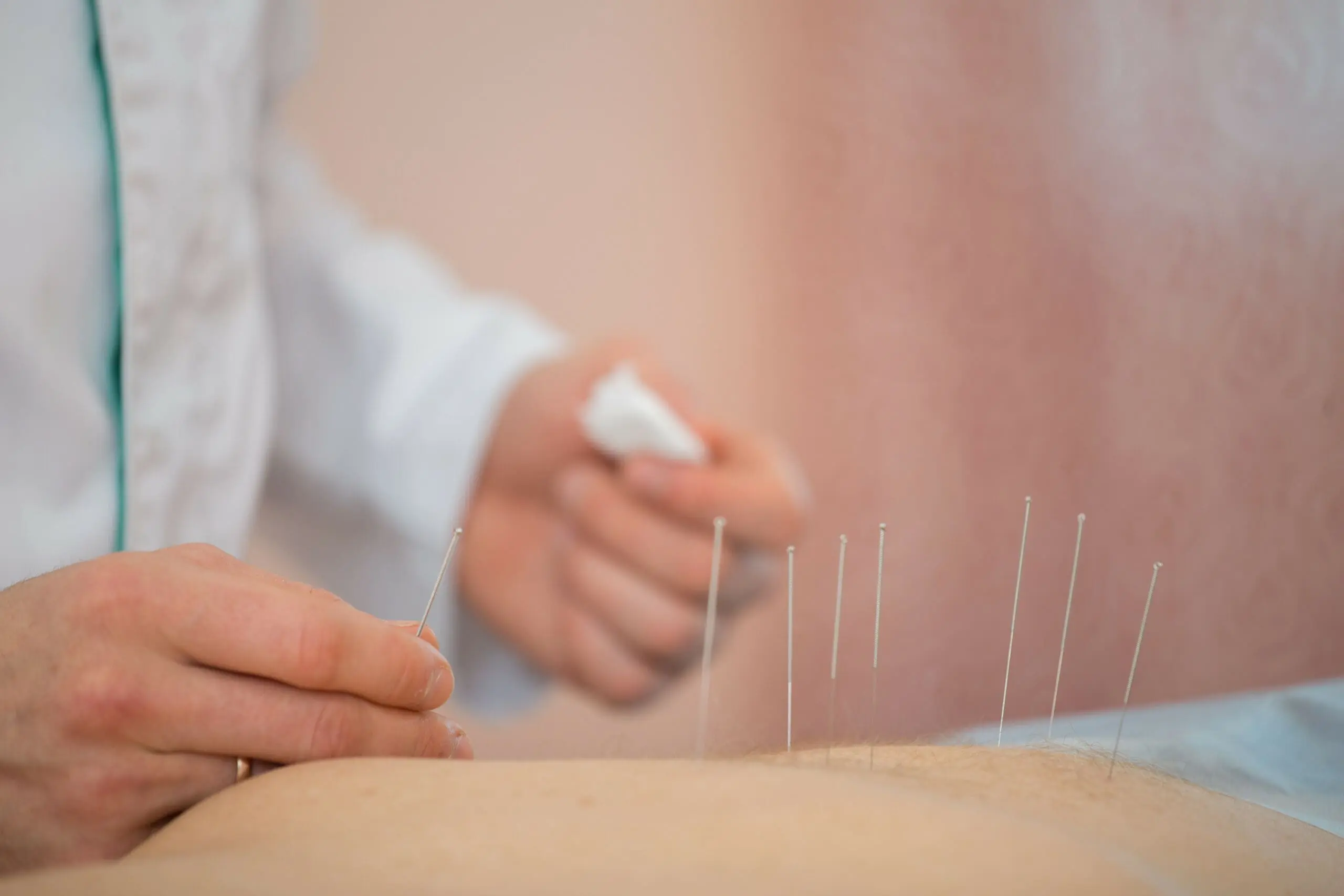
The Acupuncturist will insert needles into specific Acupoints, allegedly triggering a physiological effect particular to that point. Three methods may be used to locate acupuncture points – the anatomical landmark method, the proportional bone (B-cun or skeletal) method, and the finger–cun (F-cun) method (aka the directional method). The anatomical landmark method is considered to be the most accurate method, but can only locate 361 acupuncture points along 14 [meridian] channels. (Accuracy and Precision in Acupuncture Point Location: A Critical Systematic Review, 3 November 2018).
Meridian is a term for where the spirit energy called chi, ki, qi, mai or other various names, flows. The idea is that free flowing spirit energy is what gives a person health, and when this spirit energy doesn’t flow freely, it will cause discomfort and disease. Georges Soulie de Morant, was the first to use the term “meridian” and to equate qi with energy – in 1939. Auricular (ear) acupuncture was invented by a Frenchman in 1957. Prior to this, acupuncture attempts in the West inserted needles close to the point of pain. (Puncturing the Acupuncture Myth, 21 October 2008)
Originally there were 360 acupuncture points, based on the days of the year), effectively linking the points to Chinese Astrology. There are now over 2,000 points due to additional “discoveries”, with the specific number depending on which kind of acupuncture you subscribe to – Chinese, Korean, Japanese or some variant. There are between 9 to 11 meridians or channels that the spirit energy travels, with potentially hundreds of sub channels, again depending on which variant you subscribe to. It has been quipped by some skeptics that it is hard to insert a needle into someone without hitting an acupuncture point, making sham treatments in tests difficult. (Puncturing the Acupuncture Myth, 21 October 2008)
The Actual Science
There is no specific explanation given to why the acupuncturists claims would or could work.
- No meaningful ‘qi‘ or similar kind of ‘life energy‘ has been scientifically found.
- There is no consistent definition for where the needles need to be inserted for which desired effect, how far to push the needles, how long to leave the needles in, or any other aspect that is claimed to be ‘vital‘.
- If these things are vital, how can there be different versions of acupuncture that all claim to work?
- There is no mechanisms that explains why pushing needles into skin would have any positive medical benefit.
metal needles would free up the spirit energy, how deep to push the needles, or how long to keep them there. Each practitioner defines that for themselves.
Quality Research
Acupuncturists refuted scientific assessments of acupuncture by asserting that the unbiased scientist didn’t compare sham acupuncture (random placement of the needles) with real acupuncture points. In an American study, recognised acupuncture specialists were brought in to instruct the testers on where the real acupuncture points were. These leading practitioners disagree with each other about where these acupuncture points are, yet state that there version consistently works and is the only model that is true. (Accuracy and Precision in Acupuncture Point Location: A Critical Systematic Review)
Even so, scientists have tested most of the leading versions of ‘real acupuncture‘ and found that they consistently give the same result as the sham, which is often no greater than the placebo effect (where you think you are better because you got treated, regardless of whether the treatment was real or not).
Acupuncture Non-sense
- ‘Sham‘ vs ‘Real‘: In an effort to avoid ‘accidentally providing acupuncture‘ instead of the ‘sham needling‘:
- Scientists asked 3 well recognised lead acupuncture practitioners to verify where the real points were;
- They significantly disagreed with each other;
- While asserting that the exact point is important, as the acupuncture won’t give that effect if the needle is inserted anywhere else.
- Logical errors resulting:
- If the practitioners are right, that the point of insertion is vitally important to get the desired effect:
- Then two of the practitioners should not be getting any positive effect, yet didn’t seem to know that their acupuncture was ineffective.
- Then how can there be many systems of ‘real‘ with the statement that the other expert’s location is a sham? (Chinese, Japanese, Korean, Taiwanese – each with various sub-styles).
- If the practitioners are wrong and where you insert the needle doesn’t matter, then:
- If acupuncture actually gives consistent positive effects regardless (it doesn’t), why is it called ‘traditional medicine‘ or ‘alternative medicine‘ and costs so much;
- OR, acupuncture gives no consistent positive effect beyond that of placebo (quality research indicates this is correct).
- If the practitioners are right, that the point of insertion is vitally important to get the desired effect:
- Discrediting the denial of science: When setting up a trial for acupuncture, trying to compare ‘real‘ versus ‘sham‘ puncturing is impossible when there is no agreed upon definition for ‘real‘, so the claims that the scientists were ‘doing it wrong‘ and that this is ‘why the results didn’t match the research done by acupuncturists‘ is meaningless.
Furthermore, medical scientists have attempted to look for ‘qi‘, ‘meridians‘ or any other potential physiological mechanism that may exist without any success. With so many potential acupoints, some do overlap with actual medically interesting points on the body, however this is like spraying paint on a map of the world and being astounded that some of the drops overlap cities. There are many acupoints that hit nothing of medical interest, and when a needle is applied to these, no consistent noticeable medical change occurs.
Where is the Harm?
There is a risk of direct harm if the needles are not properly cleaned between uses, as it is possible to spread disease. Another direct physical harm can occur if the skin that the needs is going to be applied to is not properly cleaned – the microbiome that covers us is farmed to protect our skin, but can be harmful if pushed inside our body. This is quite a bit of risk with no consistent medical evidence of gain.
The less direct harm is that you are spending money on a treatment that has failed to demonstrate any evidence of consistent benefit when tested against a control better than a placebo. If you’d like to try a placebo treatment, eat a few grains of sugar. This fake treatment can delay you seeking proper medical attention if your condition is serious, which can lead to poor results including death. If your condition is serious, why are you paying a sham practitioner to perform a sham treatment on you?
Summary
- Acupuncture relies on unblocking spirit energy that is supposed to flow through your body. No scientific study has ever found this spirit energy.
- Acupuncture and its relatives (acupressure, acupoints etc) has been thoroughly studied. The studies have gone out of their way to factor in the criticisms from acupuncturists. They found no consistent positive effect.
- Acupuncturist leaders disagree with each other about where the acupoints are, while at the same time stating that their system is the only system that actually works.
References
Wikipedia. (2004, January 22). Humorism. Wikipedia, Inc. https://en.wikipedia.org/wiki/Humorism
Jishun, J., & Mittelman, M. (2014). Acupuncture: Past, Present, and Future. Global Advances in Health and Medicine, 3(4), 6–8. https://doi.org/10.7453/gahmj.2014.042
CARRUBBA, R. W., & BOWERS, J. Z. (1974). The Western World’s First Detailed Treatise on Acupuncture: Willem Ten Rhijne’s De Acupunctura. Journal of the History of Medicine and Allied Sciences, XXIX(4), 371–398. https://doi.org/10.1093/jhmas/xxix.4.371
Puncturing the Acupuncture Myth | Science-Based Medicine. (2008, October 21). Sciencebasedmedicine.Org. https://sciencebasedmedicine.org/puncturing-the-acupuncture-myth/
Acupuncture and history: The “ancient” therapy that’s been around for several decades. (2010, October 18). Science-Based Medicine. https://sciencebasedmedicine.org/acupuncture-and-history-the-ancient-therapy-thats-been-around-for-several-decades/
Ramey, D., & Buell, P. D. (2004). A true history of acupuncture. Focus on Alternative and Complementary Therapies, 9(4), 269–273. https://doi.org/10.1211/fact.2004.00244
Qin, H. (2018). The Bronze Acupuncture Model Produced by Emperor Qianlong’s Order in 1744 A.D. Chinese Medicine and Culture, 1(1), 21–24. https://doi.org/10.4103/cmac.cmac_12_18
Xu, D. (1990). Forgotten traditions of ancient Chinese medicine. Paradigm Publications. https://archive.org/details/forgottentraditi0000xuda
Alban, J. (2018, July 22). An Overview of Acupuncture. Learnskin.Com; LearnSkin. https://www.learnskin.com/articles/an-overview-of-acupuncture/
Godson, D. R., & Wardle, J. L. (2019). Accuracy and Precision in Acupuncture Point Location: A Critical Systematic Review. Journal of Acupuncture and Meridian Studies, 12(2), 52–66. https://doi.org/10.1016/j.jams.2018.10.009