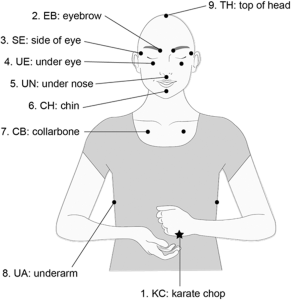
EFT, aka tapping, is a method that combines tapping on acupuncture (acupressure) points with focusing on a specific mood issue. The process creating a “setup statement” or self-acceptance for a problem, rating distress before, during and after, and then repeating the statement while gently tapping on a sequence of points on the face and body until the distress level decreases.
Part of the Pseudoscience Therapies Series
- Pseudoscience: a system of beliefs, theories, or practices that are presented as scientific but do not use the real scientific method. (‘pseudo‘ = ‘false‘).
You may also like
- Developing the Self
Red Flags
EFT’s pseudoscience Ref Flags:
- Alternative Medicine,
- Ancient Technique claims,
- Panacea: Claims that homeopathy cures or treats everything,
- Spirit energy,
- Mechanism: is nonsense,
- Quality Research: shows EFT doesn’t work.
Origins
In the 1970s and 1980s, several doctors, Dr George Goodheart, Dr John Diamond and Dr Roger Callahan, independently began stimulating acupressure points of peopled who verbalised their stress, fear and phobias, and found that their stress decreased. Dr Roger Callahan patented one of these methods, Thought Field Therapy (TFT). Dr Callahan’s processes evolved and became quite complex, leading to people finding it difficult to remember what to do to get good effects. Gary Craig, a student of Dr Callahan and engineer, simplified the process and introduced it to the public as Emotional Freedom Technique (EFT) in the late 1990s. (Source 1, Source 2)
Does it work? (No)
Options: No / Mostly no / Purple hat (usual practice, but pretending to be more), Yes.
Mechanism
How EFT Says it Works
The stated mechanism for EFT is to tap on acupuncture points to stimulate the bodies natural spirit energy field which will heal your mind and body without the use of medications. Some EFT websites claim that this makes EFT an ancient technique.
The Actual Science
As covered in acupuncture, these energy fields and channels don’t exist. These ideas have been thoroughly debunked.
Apologists for EFT try to cite that tapping on these points has been measured to release biological chemicals that are good for relieving distress, but there is zero evidence of this being true either. Even if they do release some good biological chemicals, that is not evidence of a mechanism that leads to a predictable result. That is a claim in the absence of positive evidence. (Source 3, Source 2)
Quality Research
Research into EFT has often been very poorly done.
For example, this meta analysis compared 7 EFT trials to RCT (Randomised Control Treatment), in this case the control was EMDR (1 study) or CBT (1 study), and waitlist (5), and found that all three were equally helpful. While that sounds good, the devil is in the details.
We have covered that EMDR is a sham, unless it incorporates TF-CBT, in which case it is TF-CBT with a Purple Hat.
This study did make it clear whether the comparison CBT study was regular CBT or Trauma Focused CBT (TF-CBT).
There were 7 EFT studies used in this meta review, as they met the criteria for comparison to an established PTSD treatment (according to APA Division 12 Task Force), EMDR and CBT. Since only two trials included these two treatments, the other 5 were compared to waitlist (which is no treatment). This isn’t a robust comparison, risking any noise or other oddity to significantly bias the outcome. It is also concerning that this meta study could only find 5 studies of EFT that met the standards of he APA Division 12 Task Force, which despite the body of evidence showing that EMDR is a sham or purple hat version of TF-CBT, still listed EMDR as a good treatment for PTSD. We do not know how many EFT studies were discarded, and that is a detail that should have been reported.
Summary of the Meta Analysis for EFT
- Lack of Specificity makes the results useless:
- This meta analysis does not indicate whether the EMDR trial was recent or old, so we don’t know if we are comparing EFT to modern EMDR (a rebadged Purple Hat TF-CBT) or a sham.
- TF-CBT means Trauma Focused Cognitive Behavioural Therapy, the gold standard for treating Trauma / PTSD.
- This meta analysis does not indicate whether it compares to “TF-CBT” or regular “CBT”.
- The lack of TF implies it is likely regular CBT.
- Regular CBT is still helpful for treating Trauma / PTSD, but isn’t as effective as TF-CBT.
- This meta analysis does not indicate whether the EMDR trial was recent or old, so we don’t know if we are comparing EFT to modern EMDR (a rebadged Purple Hat TF-CBT) or a sham.
- The meta study states that no adverse effects were noted by EFT during the trials.
- It did not make it clear if the people were followed up in 3 months, 6 months and 2 years to see what had worked, since an initial boost to feeling good is part of the “treatment effect”.
- The lack of inclusion of this information implies it likely didn’t. Nor did it make it clear if the people also received medication treatment as well (which should be part of standard treatment).
- A meta study that only includes 2 actual trials (versus EMDR and CBT) is not really an effective meta study
- That wasn’t made very clear in the brief, I had to hunt for it.
- If you have to hide key information, that isn’t a good look.
- A large treatment effect was noted compared to those on the waitlist, which is likely just the “treatment effect“.
- Treatment Effect: Where people feel better because they think something is being done.
- Therefore, the study’s conclusion ‘that EFT was as effective as EMDR and CBT when supplied with 4-10 sessions of EFT‘ is not actually a result that I have confidence with.
If EFT was an effective treatment, we wouldn’t have low quality studies being massaged to look like a positive effect.
Further, consider that this study was affiliated with the Transcendence Institute, which is interesting. While it is usually bad form to judge a book by its cover, the ‘transcendence‘ in the institutes title suggests that these people are likely pro ‘alternative medicines‘, so they were highly motivated to show that their treatment has merit over regular medical standards.
That is, they were unlikely to be trying to sabotage EFT, rather they were motivated to show EFT at its best.
Unfortunately, the best they could do to show that EFT was good was to create this awful flawed study:
- Comparing:
- EFT to people on the waitlist (5 studies),
- EFT to EMDR (unspecified if just a sham or the modern TF-CBT clone), and
- EFT to CBT (unspecified if regular CBT or TF-CBT)
- No specification of if the participants were given medication to help treat symptoms or not,
- No follow up on whether participants had continued positive results after 3 months, 6 months and 2 years.
- If EFT works as claimed, why not use a robust good quality, replicable study instead of this use this awful flawed study?
- If quality good studies existed, why didn’t the Transcendence Institute use these?
- If EFT has a real positive effect, it shouldn’t be hard to show some quality studies with positive effects, and the lack of this is generally a red flag of pseudoscience.
When you have to lie to make your point, you don’t have a point.
Where is the Harm?
EFT may be useful to distract someone from a mild anxiety or panic attack. It has no actual therapeutic value beyond this, which can delay proper diagnosis and treatment. EFT is mostly used for anxiety, phobia and PTSD. Anxiety and PTSD is a high risk group for self harm and death by suicide.
A delay in treatment can risk misdiagnosis, poor medical treatment and exacerbate instability. Instability in a high risk population can lead to serious harm and death. EFT increases risk without providing any realistic relief or improvement.
Summary
EFT is a sham.
- EFT can bring more temporary relief than being on a wait list, but has yet to show efficacy in any quality research.
- EFT is an alternative method of using acupuncture, which is pseudoscience.
- Relying on EFT as the basis for therapy for Trauma and PTSD is very risky in a high risk group.
References
What is EFT Tapping? Using EFT for yourself or with a trained practitioner. (n.d.). EFT International. Retrieved October 5, 2026, from https://eftinternational.org/discover-eft-tapping/what-is-eft-tapping/
WebMD Editorial Contributors. (2021, October 25). What is EFT tapping? WebMD. https://www.webmd.com/balance/what-is-eft-tapping
Bedosky, L. (2022, November 9). EFT Tapping: What Is Emotional Freedom Technique? EverydayHealth.Com. https://www.everydayhealth.com/wellness/eft-tapping/guide/
Sebastian, B., & Nelms, J. (2017). The Effectiveness of Emotional Freedom Techniques in the Treatment of Posttraumatic Stress Disorder: A Meta-Analysis. Explore, 13(1), 16–25. https://doi.org/10.1016/j.explore.2016.10.001