Pseudoscience

Pseudoscience is the term given for any belief or practice that is mistakenly based on the scientific method. The scientific method is an iterative process that includes systematic observations, measurements and experiments to test an idea / hypothesis for its accuracy. When an idea is considered accurate enough, it is considered to be scientific. People who attempt to pass ideas and practices as scientific which have yet to show rigorous evidence of accuracy via the scientific method are pushing pseudoscience. These people may be naïve, true believers or charlatans. Pseudoscience is harmful as at the least it parts people from their money, and at worst can lead to people’s untimely death. Unfortunately, in the health industry, people are often looking for simple solutions to complex problems and so are prone to falling for pseudoscience. This can be both the person seeking to resolve their own health issue, or practitioners offering solutions.

Scientific Method Versus Pseudoscience Claims

Science is not an ideology, religion or set of facts.

Science is a process for trying to determine a more accurate Truth of what is Real.

I have capitalised the T in Truth as a reference to an ideal philosophical objective Reality Truth, which relies on their being a consistent set of fundamental rules to the entire universe for all time. When I use a small t truth, then I am referring to an approximation of that fundamental Truth, that is more accurate than the previous idea.

The capitalisation of Real is similar, referring to that ideal philosophical objective Reality Truth.

Science is done by scientists, that is people, thus it isn’t perfect.

Even though science is a good process, it is a process that is done by people, so we do have to contend with the flawed human factor. While there are problems with how we implement the scientific process, it is still the best method we humans have developed for understanding the difference between an idea that is false and an idea that is accurate.

Science is Making a Model of the World, explained by an idea (hypothesis)

As part of the scientific method, we construct a model for how we think something in the real world works. This will, by necessity, be a simplification of how it truly works, as we are trying to construct a rule that explains a range of similar phenomena in such a way as to predict what is going to happen next. In science, we are looking for the most accurate model that is the most useful (accurate).

  • More accurate is sometimes less useful, eg General Relativity versus Newton’s Laws of Gravity for solar system rocket science.
  • The model is trying to create a scientific principle that is testable, repeatable, and predictive (accurate/useful).

“Essentially, all models are wrong, but some are useful”,
George E.P. Box, Empirical Model-Building and Response Surfaces

George Box, a British statistician, working on quality control, time-series analysis, design of experiments, and Bayesian inference. Box’s helpfully points out that what we want is a useful model, even though we know it isn’t 100% correct.

Don’t settle for models that are useless, and don’t be fooled by models that have yet to be fairly tested.

Good Science Involves Formulating a Hypothesis to Explain the Phenomena

  • Hypothesis = idea
  • Explain = mechanism for how
  • Phenomena = observable (what we think is really happening)

A good hypothesis will try to explain a mechanism for what is happening such that you can make predictions for what should happen next, and what would happen if you changed a certain something in that process. This leads to testable predictions. The scientist (person who tests these ideas using the scientific method) will then perform experiments to test the predictions, ideally for both “is it true” and “is it false”. If the hypothesis is not accurate enough, modifications will be made to try to improve the accuracy of the hypothesis. If the hypothesis is inaccurate enough, then it will be discarded and replaced by a new hypothesis. Often there are several models that are being pitted against each other, and the scientific method is attempting to reveal which of the models are more accurate and more useful.

Science is Repetitive and Adversarial

Adversarial Models

Let us say we have two hypothesis (models) for the observed phenomena, Model A and Model B. We want to test those against each other and see which is more reliable at predicting the phenomena.

Just because an experiment shows that Model A is more accurate than Model B does not mean that Model A wins. That is merely 1 data point.

Good science relies on replication, ideally by someone else, somewhere else, using a similar method to test the same experiment. If their experiment also concludes that Model A is more accurate, we now add a level of credence that Model A is more accurate, and that the experimental result was not a fluke (coincidence rather than a causal chain [cause and effect]).

Adversarial Peers

While each scientists is motivated to be “right” and publish their results, they are also very motivated to point to any scientists who has made a mistake and helpfully (or gleefully) point out the error(s).

You have to prove to your peers that you are right, or they will tell you why you are wrong.

Good Science Tests Plausible Mechanisms

Various experts will also look at the methods that were used to test the models to determine if these were fair tests, a plausible model, and that the results are not flawed. The results could be flawed if the method measures the wrong thing.

For example, if the idea being tested is that people wearing red shirts will run faster, and a running race is held with various runners wearing various coloured shirts, the winner wearing a red shirt may prove the idea correct, or it may be just coincidence. Was there only one runner in the race? How many of the runners were wearing a red shirt? Is there any mechanism proposed for why a red shirt would change the speed of the runner? Is the expected fastest runner always assigned a red shirt prior to the race?

These are all ways that this idea and test may be flawed.

Science is Iterative

Science continues to iterate (test, test, then test again), becoming more accurate and useful.

A model may be shown to be a better predictor, with a reasonable proposed mechanism and it may be replicated, but there is room for even better science. When different fields of science come to a similar conclusion, then we have a convergence of hypothesis pointing to a more fundamental layer of Truth. For example, Einstein’s General Theory of Relativity has been verified from many different lines of enquiry, showing that it is not just a good model for certain predictions, but that it is an excellent model for how the universe seems to work. Even so, we know that it is not complete as it does not describe quantum events. Even though we know it is incomplete, we don’t know what needs to change to make it even better.

Flawed Models: Not losing the baby with the bathwater

A model may be flawed or even wrong, yet it may point to another model that is useful.

For example, blood tests from people diagnosed with Depression found a consistently low presence of Vitamin D. A hypothesis was formed that low Vitamin D causes Depression. Two predictions can be formed from this model. One is that raising the level of Vitamin D will decrease measured Depression, the other is that all people with similarly low levels of Vitamin D will be noticeably Depressed. Experiments showed that supplementing Vitamin D such that the test subjects tested “normal” levels of Vitamin D in their blood did not improve their depression and not all people with low Vitamin D were noticeably Depressed. This effectively destroyed the hypothesis that low Vitamin D causes Depression.

These experiments were replicated (repeated) by various peoples, and the logic of the outcome is sound. Low Vitamin D is a marker for possible depression and their may be a connection that is not direct like the hypothesis first predicted.

A hypothesis that I propose is that since Vitamin D is made out of LDL cholesterol, and LDL cholesterol is also used to regulate the production of Dopaminergic Neurotransmitters (Dopamine, Noradrenaline and Adrenaline) via the hormone Oestradiol (Oestradiol is an end product of LDL cholesterol), then problems in the processing of LDL cholesterol can lead to both low Vitamin D and problems in synthesising sufficient Dopaminergic Neurotransmitters, which is a leading contender for Depression. At this point, this is just a hypothesis since to the best of my knowledge, there is no study to investigate this.

Pseudoscience skips the Science

Pseudoscience skips the Science and pretends the claim is true without proof. It is almost always done for personal motivation (money or power).

If I were to use my hypothesis (about Vitamin D), an untested theory, as a statement of scientific truth, especially if I use that to promote a medical treatment for Depression, then I would be engaging in Pseudoscience.

Just because it makes medical sense does not mean it is correct, nor does it mean it is wrong. I just means it isn’t scientifically tested, and any claim to say “this is how it works” misses the fact of no evidence yet shows it to be so. A more accurate statement is “this is how it may work”. Accurate statements like “this is how it may work” don’t sell many products.

Pseudoscience belief and practices.

“By definition, alternative medicine has either not been proved to work, or been proved not to work.
You know what they call alternative medicine that’s been proved to work?
Medicine.”

By Tim Minchin, from Storm.

For a belief or practice to be considered Pseudoscience, it has either yet to be tested scientifically, or it has been shown to not be scientifically accurate.

Put another way, ideas (hypotheses) that have withstood the scientific method are considered to be in the large space of provisionally passed ideas called ‘scientific‘ or ‘science based‘, while those that have no reliable evidence showing that they are correct, or have been discredited, yet are still being promoted as scientific are called Pseudoscience.

That leaves the dubious term of ‘Evidence Based‘, which we will discuss next.

For a more comprehensive breakdown on good science and its limits, check out Understanding Science.

The Obfuscation of Evidence Based Treatments

TLDR:

  • Evidence Based Medicine‘ and ‘Evidence Based Therapy‘ was supposed to mean ‘scientifically valid’ and ‘proven to be reasonably effective’.
  • Due to poor critical thinking and scientific literacy, too many faulty studies claim ‘scientific validity’ and ‘effectiveness’, and that is used to misrepresent a treatment or medical intervention as proven ‘good’.
  • There is an argument to create a new category called ‘Science Based’ to bring this back on track.

We just talked about how ‘good science’ has ‘good experiments’ to test a reasonable mechanism led hypothesis / model, and that we ‘don’t consider it evidence without replication’. We also noted that scientists are human, and sometimes humans make mistakes – sometimes genuine, sometimes self serving.

Many proposed treatments are thought up to resolve various health problems. To try to distinguish between misleading claims of efficacy and scientific claims of efficacy, the statement of ‘Evidence Based‘ is supposed to mean ‘scientifically tested and shown to be useful/right/accurate’. ‘Evidence Based Therapy‘ is used to show that there is valid evidence behind the claim that ‘this treatment should be expected to work for that condition’.

Not all research is created equal, and too many charlatans have created false or flawed studies to fabricate ‘evidence’ that their therapy works. Studies that have been published in a reputable journal should have been ‘peer reviewed’, where experts in the field try to weed out fraudulent or faulty studies. Unfortunately, far too many poor quality studies sneak in. The good researcher has learned to consider that the idea, question, proposed mechanism, method to test the proposed mechanism, number of data points, results and conclusion, and from there, work out if the study is ‘good’ or ‘flawed’.

It isn’t reasonable for regular people looking for health therapies to be able to do the research themselves and figure out if a particular therapy is legitimate or pseudoscience. That burden should be taken up by the experts that the regular person is seeing. Part of the education for university degrees in applicable fields is supposed to include formal education on both how to write your study to not fail any of the above paragraph, but how to spot when a study you read has. In my opinion, far too few people retain and exercise this critical thinking.

The best lies have a kernel of truth wrapped in a smothering of lies.

Many studies are flawed in common ways:

  • All the positive studies are done by those who promote the therapy.
    • Why: Self interest biases the results, either knowingly, or because of faith in the idea ‘that must be true’.
  • Only a few studies show that it may work.
    • Lack of replication means that errors haven’t been found.
    • The more decades a treatment has existed for, the more quality research should have been done on that treatment. It is a concern when it doesn’t exist.
  • The study design is flawed. That is:
    • No via mechanism for the claim.
    • Testing the wrong thing.
    • Biased set up.
    • Inadequate or too many participants.
      • Reasonable constraints can address this.
  • Unstated premise. EG:
    • The study assumes that the treatment works and is just finding the mechanism.
    • The mechanism relies on a prior mechanism to be true, but we don’t have good evidence that it is.
  • Failure to check if the idea is wrong.
    • That is, if my idea is true, I’d expect to see this result, AND if my idea is wrong, then I’d expect to see that result.

“It doesn’t matter how beautiful your theory is, it doesn’t matter how smart you are. If it doesn’t agree with experiment, it’s wrong.”

by Richard Feynman.

An argument is rising to create a new standard, called ‘Science Based’ medicine or therapy [source]. This acknowledges that to fix ‘evidence based’ is now too hard and we need to effectively start again. While I think this will work for a little while, it won’t be long before those who broke the ‘evidence based’ model will do the same thing to ‘science based’. I anticipate that the AI revolution is going to make this a lot worse.

To save you some time, I have compiled a list of common therapies that are pseudoscience, and why they are regarded as such. Reading through the why will help you figure out how to tell if a treatment falls more into ‘scientific’ or ‘pseudoscience’.

Quick Red Flag Tests for Pseudoscience Treatment

  • Anecdotes and testimonials instead of quality research evidence.
  • Appeal to nature eg: ‘it’s natural’.
  • Buzzwords:
    • Ancient / Traditional / Native / Folk Treatment / Alternative/ Complementary / CAM / Holistic.
    • Energy (without a description of type).
    • Quantum, Quantum Properties, Quantum Effects, Entanglement, Superposition.
  • ‘Burden of Proof’ is misplaced.
    • It is on the claimant to prove it works, not on you to prove that it doesn’t.
  • Invocation of the mystical:
    • Magic / magik / Rune etc.
    • Spirit / ki / chi / qi.
    • Life energy / Life force.
    • Meridians.
  • Mainstream large organisations don’t use it (other than patented).
  • Panacea:
    • Cures / fixes / prevents everything.
    • Explains everything.
  • Problematic Research:
    • Mostly poor quality.
    • Published quality research shows weak results.
    • Significant disagreement about the results of the research.

Anecdotes and Testimonials

The claims of efficacy rely mostly on anecdotes and testimonials that this treatment really works, rather than testimonials at the professionalism of the therapist.

The plural of anecdote is not data. It can be a beginning point for why a research study should be done for that claim, but it is not evidence that the claim is real without the research to back it up.

Appeal to Nature, Natural

Appeal to Nature is a logical fallacy, where the arrangement is that something is good, valid, or justified simply because it is ‘natural’, or bad because it is ‘unnatural’ / ‘human made’.

The false premise is that ‘natural’ things are inherently safe or morally superior.

This leaves us with the question ‘what does a supernatural thing look like?’, as if it is not supernatural, then it is natural, even if it is man made.

Buzzwords

Ancient / Traditional / Native / Folk Treatment / Alternative/ Complementary / CAM / Holistic

If the words Ancient or Traditional are used to describe the treatment, it is probably pseudoscience.

Medical treatments are updated all of the time as newer and better ways to provide the therapy are discovered. The fact that this treatment is ancient and unchanging is a big red flag. Good scientific medicine progresses and evolves.

Energy

Energy is either

  • Atomic (inside an atom)
  • Chemical (between atoms)
  • Thermal (kinetic of a group of molecules)
  • Potential (kinetic energy that can be released)
  • Kinetic (the movement energy that has been released)

Energy with no type affixed to it is not a scientific concept. If I have spend most of the paragraph referring to kinetic energy, then I might skip the kinetic for that paragraph, since the type was already specified. It is bad practice to refer to energy without specifying what kind.

If someone is trying to talk about how you get energy, or manipulate energy, but doesn’t specific which kind, then active your critical thinking.

Psycho Babble

Words that sound like they mean things, but either:

  • Don’t actually have any useful definition.
  • Ultimately describe a thing that has no proof of existing, without any distinction from that original meaning.

Quantum, Quantum Properties, Quantum Effects, Entanglement, Superposition

Quantum literally means ‘how much’ or ‘as much as’ from the Latin ‘quantus‘. It was used to describe how electron fields and photons had discrete levels, rather than an endless spectrum of levels. When referring to how subatomic particles interact at basic building blocks of the universe, it is a useful term. However, outside of that very specific layer of nanoscopic interactions, quantum is not used in mainstream science.

If, somewhere in the description for the layperson (pamphlet / flyer / packaging) the word ‘quantum’, ‘entanglement’, ‘superposition’ or some other quantum physics term is used to describe why this treatment works is a huge pseudoscience red flag.

Technically, everything is quantum. When you want to get really low down in the details of how something does what it does, eventually you will hit the quantum level. That just isn’t necessary for most people.

It is a pseudoscience red flag for general lay person level information to start talking about quantum effects. Quantum effects is fine for discussion in expert papers, from experts, to experts.

If a person is trying to talk to you about how ‘quantum’ or ‘quantum properties’ allows this thing to do something, and they can’t outline the specific fundamental building block that they are referring to, it is time to activate critical thinking.
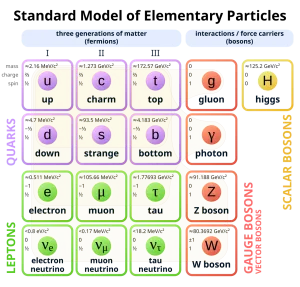
By Cush – Fermilab, Office of Science, Wikipedia Commons

There are only a few fundamental quantum particles.

Burden of Proof is Misplaced

If I make a truth claim, it is my burden of proof to show that it is true or acknowledge that I cannot.

Pseudoscience will often shift the burden of proof to show that their claims are false, rather than showing evidence that their claims are true.

Not all evidence is weighted equally. See Understanding Science for more.

“Extraordinary Claims require Extraordinary Evidence.”

by Carl Sagan

Invocation of the Mystical

Magic Energy, Ki / Spirit / Chi / Qi / Life Energy / Life Force / Meridian

No scientific investigation has found this energy (the name changes often).

Scientific tools can measure the ripple of gravitational waves that chance space time as little as 1/10,000 of the width of a proton, can measure the movement of water inside of a body, can look at bones without surgery and so on, can detect electromagnetic signals that are vast in range, but can’t seem to find the spirit energy that many pseudoscience treatments claim to treat with magnets, bone manipulation and needle points.

Mainstream Large Organisations Don’t Use it

Western Hospitals provide the best recommended treatments for health conditions.

While a new therapy may not be available yet in a specific hospital, that same treatment is not likely to be available in a small private hospital either.

  • If a health expert is claiming that their new treatment works but hospitals aren’t providing it, be careful and check for further signs of pseudoscience.
  • If a health expert is claiming that this ancient or old treatment works, but hospitals aren’t providing it, it’s a scam.

There are treatments that exist that are not suitable for large hospitals for certain conditions. When this is the case, these treatments provided in clinics are considered to be ‘The Standard of Care‘ for that condition, or is listed as a common treatment for that condition.

Unfortunately, many pseudoscience treatments have manage to weasel their way in to ‘Standards of Care’. Check our list below to see if the treatment or type of practitioner is listed in Pseudoscience Therapies.

Panacea: Cures / Treats / Prevents / Explains Everything

No single treatment treats everything. If it did, it would be a part of everyone’s required daily existence actions – like breathing both in and out, eating, having your heart beat.

When a treatment is claimed to treat many different unconnected or poorly connected conditions, it is time to get suspicious. A good test question is “does this treatment also treat …” and list something not connected to any of the conditions listed on the promotional material. Better acceptable answers are “no”, or “I don’t know, let me go and check”.

If there answer is a quick “yes”, then get very, very suspicious and activate your critical thinking.

Problematic Research

For the layperson, the terms “research, studies, trial, experiment, case study, field study, evaluation and white paper” are interchangeable. These all have specific meanings which approximately align in various fields of scientific enquiry (different fields have slightly different expectations of what the term means, but it is generally close enough).

What we are referring to is an intentional formal study into whether a claim is accurate or not, generally with an experiment that adheres to certain levels of quality.

Click to expand: Rating single and multiple papers for quality guide.

The basic criteria for good research is:

  • Quality: Rating an individual research Paper;
    • Is the paper listed in a good (scientifically respected, peer reviewed) journal?
    • Is the paper relatively recent
      • Last 5-10 years preferred
      • Additional scepticism should be applied for every decade added.
    • Introduction:
      • Is the hypothesis clearly stated:
        • What is the idea that this research is testing?
        • Why is this idea important.?
        • What should we see:
          • If the idea is true?
          • If the idea is false?
        • What does the experimenter expect the outcome to be?
      • Inclusions / Exclusion:
        • Clear exclusion criteria, which defines the boundary of the hypothesis
        • Inclusion numbers are sufficient for the type of research (which can vary from a few to thousdands+)
    • Method of the experiment:
      • How will the hypothesis be tested?
        • If it is true.
        • If it is false.
      • How other possible confounding variables will be mitigated or addressed.
      • What confounding variables couldn’t be mitigated or addressed.
      • Negative credit:
        • Not double blinded (if testing people) without a good explanation for how they excluded participant bias.
        • Test group isn’t compared to a placebo.
        • The study is performed by those who benefit from a positive outcome.
        • Extra credit:
          • The method is published prior to the study being done (this is a new standard, studies older than 2020 aren’t held to this standard).
          • Minimal assumptions are made to prior to the study (avoiding begging the question logical fallacy).
    • Results:
      • What was the raw data.
      • What statistics were applied to the data, and why?
      • What does the statistics show? (raw data is meaningless on its own.)
      • Is this result significant?
        • What is the chance of getting these results by chance?
        • If this result is unlikely a fluke, then does it support or contradict the hypothesis?
        • Is the results clear and strong, or ambiguous, or weak?
    • Conclusion (and optional Discussion):
      • What do the authors think may have confounded their results? What would they suggest needs specific further research?
      • What does this study mean?
        • If the results are significant and meaningful, what might this result affect?
        • Does the speculation match the hypothesis and results? Does it seem reasonable to conclude that?
      • Does this match the results and the abstract?
  • Comparing Papers / Multiple papers;
    • Manual or Experts:
      • This can be done manually, by separating quality and poor papers. See the next bit to get an idea of how to do that.
      • This can be a meta review / meta analysis or systematic review (they do the assessment of quality and will explain what ‘inclusion’ looks like).
    • Good signs:
      • If it has been released in the last 5-10 years, then you can likely trust it.
      • Excluded papers are due to not meeting the specific criteria questions rather than remarked consistent poor quality.
      • It agrees with other recent meta reviews, or has a good reason why it doesn’t.
      • Extra Credit:
        • Large sample size:
          • Either in each experiment, or overall combined numbers recalculated from the raw data.
          • Large number of ‘good papers’ to compare.
        • Intelligent design avoiding confounding factors.
        • Clear signal.
    • Concerning:
      • The ratio of papers rejected for inclusion was over 50% due to issues with quality, yet the meta analysis finds the proposed ideas plausible.
      • The number of included papers is lower than 40%, yet the meta analysis is glowing of the outcome.
      • Number of participants is low.
      • Lots of self report.
      • No discussion about excluding confounding factors and steps to avoid including or factoring in those.
      • Method does not seem to lead to the conclusion.
    • Assessing the papers:
      • Do the papers agree with each other (approximately)?
      • If they disagree with each other, is it 2-3 factions (camps of view), or more than 3?
        • If 2-3 factions, are the authors being polite and fair to each other, or unfair?
        • More than 3 factions is a warning that this field is in flux, and so there are no solid leads to truth yet.
      • If they agree, does that agreement include:
        • A plausible explanation?
        • A plausible mechanism?
        • Consistent outcomes?
      • Comparing ‘good’ and ‘poor’ papers:
        • What is the ratio of ‘good papers’ to ‘poor papers’?
        • Do the ‘good papers’ report a strong effect, a weak effect size, or a inconsistent (between papers) effect size?
        • Do the ‘poor papers’ report a strong effect, despite the average result of the ‘good papers’?

Pseudoscience red flags:

  • Not published in a quality journal.
  • The ratio of ‘good papers’ to ‘poor papers’ less than 40% good? (total papers / in the last 5 years).
  • The ‘good papers’ have low to no effect size, but the ‘poor papers’ claim a strong effect size.
  • If the ‘good papers’ have wildly inconsistent reports on the effect size, or the effect size and strength is weak.

For More: See ‘How to read a paper‘ in Understanding Science.

Pseudoscience Therapy Types

Pseudoscience therapies may be:

  • Untested therapies.
    • Without the transparency of it being untested and therefore a trial (as discussed above).
  • Purple Hat Therapy.
    • Where real treatments are snuck in, but you are paying a fortune for the purple hat.
  • Complete nonsense.
    • Literally not sensible, without a real mechanism for why it would work and certainly no good evidence that it does.
  • Disproven therapies.
    • Where it has been well established that this treatment does not meet the claims and therefore is not a viable treatment.
  • Combinations of the above.

Pseudoscience is almost always harmful, from wasting your money and time, complicating the condition with other problems, delayed treatment, and or directly harmful / deadly.

Acupuncture

TLDR: Acupuncture is said to be an ancient Chinese medicine, allegedly dating back thousands of years, where piercing the skin in key locations will change the flow of ki energy in humans, which can either harm or heal a person.

Red Flags

  • Spirit Energy
  • Ancient
  • Alternative Medicine
  • Buzzwords
  • Mechanism is nonsense
  • Quality Research shows “doesn’t work”

Origins

Practitioners often claim that acupuncture is over 4,000 years old. This is not true. At most, the basic Chinese theory is around 2,000 years old, and was inspired by the ancient Greek, Egyptian and Arabic ideas.

“Needling” was first demonstrated to the Wesetrn observer Willem Ten Rhijne, who worked for the East India Company, in 1680 by a Japanese practitioners (Acupuncture, Past, Present, and Future). Ten Rhijne described in a book he wrote and published 3 years later how the practitioner would hammer the ivory handle of a metal spike (The Western World’s First Detailed Treatise on Acupuncture: Willem Ten Thijne’s ‘De Acupunctura’). The earliest that an actual process referred to as “needling” found in China is from around 90 CE, but is talking about creating a sufficient puncture to blood let or to lance abscesses, using a large needle. (Science Based Medicine 1)

Rhijne observed that the placements of the punctures chosen by the practitioner were in accord to the humoural medicine theories of Greek origin. What Rhijne described did not involve qi et al, or any specific theory described to explain why the needles were placed where they were. He states that the gold needles were implanted deep into the skull or “bomb” and left in place for 30 respirations. Rhijne, 1683.

Indeed, Chinese scholar Paul Unschuld suspects that the practice likely originated with the Greek Hippocrates of Cos. Many of the Chinese practices such as burning and bleeding are adaptations of the ancient Greek, Egyptian and Arabic sources, which were recorded long before they were in China. The Silk Road spread ideas across Southern Europe, Northern Africa and Souther West to East Asia (Science Based Medicine 2). The earliest these ideas could get to China was round 200 BCE. Chinese medicinal texts often refer to practices that cause an incision or other skin penetration using the word zhen, which in modern times seems to always be translated to mean “acupuncture”, despite the context, and this was mostly in animal medicinal texts (A True History of Acupuncture).

The earliest account of Chinese Medical practices in Europe is dates to the 13th Century CE, in the travelogue of William of Rubruck (A True History of Acupuncture). It held no description of acupuncture. Escorial in Madrid, Spain, has a decription of “needling” from teh 16th Century CE, and shorlty after a few more descriptions of what might be recognisable as acupuncture. The earliest record of Acupuncture in the West was 1826 in USA, based on claims from Europe of success in resusitating drowned kittens by sticking needles into the kittens hearts. The Philadelphian physicians were unable to duplicate the results and “gave up in disgust”.

What we recognise to be acupuncture now is fairly new, as the technology to make thin needles is only around 400 hundred years old, so what we recognise to be acupuncture logically cannot be thousands of years old, it just refers to ideas that are thousands of years old (Science Based Medicine 2). That would be like referring to mondern western medicine as being thousands of years old, because doctors swear by the hypcratic oath, which is thousands of years old.

The earliest discovered descriptions of qi et al energy lines were discovered at the Mawangdui graves, sealed in 168 BCE and the Zhangjiashan burial site, closed between 186 and 156 BCE. These discuss mai, the imaginary ‘channels’ of energy that were associated with diagnosis and treatment. There is no needle or pressure involved in treatment (A True History of Acupuncture). The first mention of needling zhen (meaning to puncture to draw out fluid) dates 90 CE (A True History of Acupuncture).

In the 5th or 8th Century CE Huang Di neijing introduced some theoretical underpinnings of what likely became human acupuncture, that is the manipulation of qi flowing in vessels by means of needling – the reason for the uncertainty is that the texts themselves refer to the dynasties they were written in ambiguously. The copies written in the 11th Century CE were revised and so don’t actually give a fair reflection of the first editions history. It is speculated that in the Song Times, circa 960 to 1279 CE, the first prototype of what we would recognise as Acupuncture was described in the work of Wang Weiyi, re the acupuncture bronze man. However, the fine steel needles were not developed until the Qing times (1644-1911 CE). Throughout this time, acupuncture was a minor tradition, with most medical practitioners preferring herbal remedies (A True History of Acupuncture).

Source: The Bronze Acupuncture Model Produced by Emperor Qianlong’s Order in 1744 A.D.

Writing in 1757 lamented the “loss of acupuncture tradition” and noted that the acupuncture points, channels and practices in use were very different from those described in the “ancient texts”. This shows that both the practice from its theoretical earliest time of using thin needs was poor, and that the actual practice of those who did do it was poorly adherent to what was supposedly supposed to work. China attempted to ban the use of acupuncture in 1822, and several times afterwards by the Qing government who banned the teaching of acupuncture since it was shown to not work. Japan prohibited hte practice in 1876. (Forgotten Traditions of Ancient Chinese Medicine).

Chairman Mao Zedong promoted acupuncture and other forgoten and abandoned traiditional medical techniques in the 1950s as part ofhis Great Leap Forward, as a pragmatic solution to providing health care of the vast Chinese populatin by the undersupplied medical doctors, who were at the time predominantly using the Western Medicine style since it was shown to be effective, while most of the traditional herbal and other traditional Eastern medicine was not. Chairman Mao knew he couldn’t afford the Western Medicine supplies and so needed something home grown to appease the population. Chariman Mao refused to receive any of these traditional remedies, which I feel is quite telling. (Forgotten Traditions of Ancient Chinese Medicine).

Mechanism

The Acupuncturist will insert needles into specific Acupoints, allegedly triggering a physiological effect particular to that point. Three methods may be used to locate acupuncture points – the anatomical landmark method, the proportional bone (B-cun or skeletal) method, and the finger–cun (F-cun) method (aka the directional method). The anatomical landmark method is considered to be the most accurate method, but can only locate 361 acupuncture points along 14 [meridian] channels. (Accuracy and Precision in Acupuncture Point Location: A Critical Systematic Review, 3 November 2018).

Meridian is a term for where the spirit energy called chi, ki, qi, mai or other various names, flows. The idea is that free flowing spririt energy is what gives a person health, and when this spirit energy doesn’t flow freely, it will cause discomfort and disease. Georges Soulie de Morant, was the first to use the term “meridian” and to equate qi with energy – in 1939. Auricular (ear) acupuncture was invented by a Frenchman in 1957. Prior to this, acupuncture attempst in the West inserted needles close to the point of pain. (Puncturing the Acupuncture Myth, 21 October 2008)

Originally there were 360 acupuncture points, based on the days of the year), effectively linking the points to Chinese Astrology. There are now over 2,000 points due to additional “discoveries”, with the specific number depending on which kind of acupuncture you subscribe to – Chinese, Korean, Japanese or some variant. There are between 9 to 11 meridians or channels that the spririt energy travels, with potentially hundreds of sub channels, again depending on which variant you subscribe to. It has been quipped by some skeptics that it is hard to insert a needle into someone without hitting an acupuncture point, making sham treatments in tests difficult. (Puncturing the Acupuncture Myth, 21 October 2008)

There is no specific explanation given to why metal needles would free up the spirit energy, how deep to push the needles, or how long to keep them there. Each practicioner defines that for themselves.

Does it work? (No)

To determine if a model works, you need to test it. With different versions of acupuncture having different acupoints and different meridians, with the depth and duration determined by the practicioiner, it is hard to tell if the reason why it does not work better than a placebo in trials is because the wrong acupoints were used or some other vague error. Papers have been released on how well acupuncture workds, however the quality of these studies is poor and they are published by practitioners who promote acupuncture.

Many scientific examinations of this have been performed. A few of these tests have shown that acupuncture works better than chance and better than the placebo effect. Acupuncturists state, therefore, that acupuncture is Evidence Based Medicine.

The problem with this claim of Evidence Based, is that most of the evidence says it doesn’t work.

Acupuncture diagram showing "Points of Pericardium Meridian, PC".
Attribution: Christina Kung
Attribution: Natural Life, 2025

Acupuncturists refuted scientific assessments of acupuncture by asserting that the unbiased scientist didn’t compare sham acupuncture (random placement of the needles) with real acupuncture points. In an American study, recognised acupuncture specialists were brought in to instruct the testers on where the real acupuncture points were. These leading practitioners disagree with each other about where these acupuncture points are, yet state that there version consistently works and is the only model that is true. (Accuracy and Precision in Acupuncture Point Location: A Critical Systematic Review)

  • If where you insert the needle doesn’t matter, then it isn’t acupuncture, it is just stabbing you and why do we call it “traditional medicine” or “alternative medicine”.
  • If it does matter, then how can there be many systems of “real” with the statement that the other expert’s location is a sham?
  • When setting up a trial for acupuncture, trying to compare “real” versus “sham” puncturing is impossible when there is no agreed upon definition for “real”.

Even so, scientists have tested most of the leading versions of “real” and found that they consistently give the same result as the sham, which is often no greater than the placebo effect (where you think you are better because you got treated, regardless of whether the treatment was real or not).

Medical scientists have attempted to look for qi, meridians or any other potential physiological mechanism that may exist without any success. With so many potential acupoints, some do overlap actual medically interesting points on the body, however this is like spraying paint on a map of the world and being astounded that some of the drops overlap cities. There are many acupoints that hit nothing of medical interest, and when a needle is applied, not noticeable medical change occurs.

That is, no, it doesn’t work.

Where is the Harm?

There is a risk of direct harm if the needles are not properly cleaned between uses, as it is possible to spread disease. Another direct physical harm can occur if the skin that the needs is going to be applied to is not properly cleaned – the microbiome that covers us is farmed to protect our skin, but can be harmful if pushed inside our body. This is quite a bit of risk with no consistent medical evidence of gain.

The less direct harm is that you are spending money on a treatment that has failed to demonstrate any evidence of consistent benefit when tested against a control better than a placebo. If you’d like to try a placebo treatment, eat a few grains of sugar. This fake treatment can delay you seeking proper medical attention if your condition is serious, which can lead to poor results including death. If your condition is serious, why are you paying a sham practitioner to perform a sham treatment on you?

Summary

  • Acupuncture relies on unblocking spirit energy that is supposed to flow through your body. No scientific study has ever found this spirit energy.
  • Acupuncture and its relatives (acupressure, acupoints etc) has been thoroughly studied. The studies have gone out of their way to factor in the criticisms from acupuncturists. They found no consistent positive effect.
  • Acupuncturist leaders disagree with each other about where the acupoints are, while at the same time stating that their system is the only system that actually works.

Chiropractic

Chiropractic is faith healing through bone manipulation, invented by D. D. Palmer, Sep 18, 1895. He claims that he adjusted the spine of a deaf man and allegedly restored his hearing. From what we know of from modern medicine, this is a very implausible claim.

Red Flags

  • Purple Hat Therapy
  • Spirit Energy [Innate Force / Life Force]
  • Mechanism is nonsense
  • Alternative Medicine
  • Quality Research shows “core Chiropractic doesn’t work”

Origins

Daniel David Palmer performed a spinal adjustment on a partially deaf janitor, Harvey Lillard in 1895. Palmer alleges that he noticed that when Lillard bent over to empty a trash can (without his shirt on), Palmer noticed that a vertebra was out of position. Palmer queried Lillard on this, and Lillard allegedly stated “I moved the wrong way, and I heard a ‘pop’ in my back, and that’s when I lost my hearing” (Source). Palmer was involved with many “natural” healing philosophies, asked Lillard to lie face down on the floor and adjusted the vertebra back into place. Allegedly Lillard informed Palmer the following day that he “can hear that rackets on the streets”. This led to Palmer to open a school of chiropractic 2 years later. The term Chiropractic was coined by Samuel H. Weed, from a portmanteau of the ancient Greek words cheiro (hand) and praktikos (action, to do). (Source)

Palmer explained his method as part of vitalism (life energy), naturalism, magnetism and spiritualism. As science improved and showed that none of these health ideas were valid, Palmer did try to merge the new science with metaphysics with a key phrase “a science of healing without drugs”. The original Principles of Chiropractic mimicked Andrew Still’s Principles of Osteopathy (established a decade earlier). Palmer’s Chiropractic was mostly a copy of Osteopathy, with Still referring to chiropractic as a “bastardized form of osteopathy”. Still suceeded in passing a law for licensure, which resulted in Palmer and other chiropractors being jailed for practicing medicine without a license (Source).

The modern Principles of Chiropractic have 33 statements, most of which are nonsense and still rely on vitalism, which was shown to be medically and scientifically invalid even in Palmer’s era.

Does it work? (Mostly no).

When studying the efficacy of chiropractic, the chiropractors that show consistent positive results are in the third category, those who mix in physiotherapy treatments (Purple Hat Physiotherapy).

  • Chiropractors rarely have a degree in Physiotherapy and so are not qualified to do provide Physiotherapy treatments.

When studying the efficacy of the pure chiropractic interventions, no reliable positive results occur, indicating that it is an ineffective treatment.

Mechanism

Chiropractic (that is the right grammar) relies on the 33 Principles of Chiropractic. These are nonsensical statements that approximately equate to faith healing, attempting to reverse the interreferences of life forces by adjusting dislocated bones along the spine.

Chiropractic is founded on the ‘33 Principles of Chiropractic‘, reproduced below.

None of this is medicine, or makes scientific sense. Many scientists have tested the claims of ‘energy channels‘ (see above Magic Energy), and none have been found. The dot points under each entry is commentary on why this principle is either meaningless, nonsensical, or faulty.

Click to show: The 33 Principles of Chiropractic
  1. The Major Premise – A Universal Intelligence is in all matter and continually gives to it all its properties and actions, thus maintaining it in existence.
    • This appeals to panpsychism, which is an interesting philosophical concept with zero evidence of truth.
  2. The Chiropractic Meaning of Life – The expression of this intelligence through matter is the Chiropractic meaning of life.
    • This makes no actual sense. How does all things having a mind (if true) give Chiropractic Meaning of Life? Do Chiropractic’s treat rocks?
  3. The Union of Intelligence and Matter – Life is necessarily the union of intelligence and matter.
    • This also makes no sense. If The Major Premise above it true (regardless of lack of evidence), then this statement makes no sense, as all matter is intelligent, so all matter is alive.
  4. The Triune of Life – Life is a triunity having three necessary united factors, namely: Intelligence, Force and Matter.
    • First all matter is intelligent, then life is any matter that is intelligent (so all matter is life), and now life is matter, intelligence and force. Pick one?
  5. The Perfection of the Triune – In order to have 100% Life, there must be 100% Intelligence, 100% Force, 100% Matter.
    • 100% Life is 300%? This is not how math works. 100 % Life can’t be made of 100% intelligence and 100% force and 100% matter.
  6. The Principle of Time – There is no process that does not require time.
    • This is actually accurate.
  7. The Amount of Intelligence in Matter – The amount of intelligence for any given amount of matter is 100% and is always proportional to its requirements.
    • This doesn’t make sense.
    • According to the Major Premise, all matter is intelligent. All of it.
    • So how can any matter have less than 100% intelligence?
    • If that is the case, and any amount of intelligence is 100%, then how can it now be proportional to its requirements?
    • This is not how math works.
  8. The Function of Intelligence – The function of intelligence is to create force.
    • This is a hypothesis and while I think it is wrong, let us let it stand.
    • By “force”, they mean “sprit energy”, but they never actually state that.
  9. The Amount of Force Created by Intelligence – The amount of force created by intelligence is always 100%.
    • This is another nonsense.
    • The amount of force is always 100%, so that means that all matter, which is intelligent, is always 100% intelligent, and always creates 100% force.
    • Which force, in what direction, with what effect?
    • This proposes that intelligence can not have no force effect.
  10. The Function of Force – The function of force is to unite intelligence and matter.
    • The force is to unite intelligence and matter, in contradiction to the Major Premise which states the universal intelligence is in all matter.
  11. The Character of Universal Forces – The forces of Universal Intelligence are manifested by physical laws; are unswerving and unadapted and have no solicitude for the structures in which they work.
    • This is just non sensical. It uses many fancy words which mean nothing when combined like this.
  12. Interference with Transmission of Universal Forces – There can be interference with transmission of universal forces.
    • This contradicts the little meaning of 11, the Charact of Universal Forces. If the Universal Intelligence is manifested by unswerving and unadapted physical laws, then these unswerving and unadapted physical laws cannot be interfered with.
  13. The Function of Matter – The function of matter is to express force.
    • This makes no real sense in relation to the rest.
  14. Universal Life – Force is manifested by motion in matter; all matter has motion, therefore there is universal life in all matter.
    • This is non sense again.
    • All matter has intelligence. Some matter has innate intelligence. All matter has motion, so all matter has force. Therefore all matter has life. If all matter has intelligence, force and life, then why have a differentiation between matter, intelligence, force and life?
    • Which contradicts innate intelligence, the purpose of life, the purpose of matter etc.
  15. No Motion without the Effort of Force – Matter can have no motion without the application of force by intelligence.
    • Physics would like to disagree with this statement. The four forces are all without the application of intelligence.
    • However, this is where we get a hint that they mean “spirit”.
  16. Intelligence in both Organic and Inorganic Matter – Universal Intelligence gives force to both organic and inorganic matter.
    • This is the same as the first statement, the Major Premise.
  17. Cause and Effect – Every effect has a cause, and every cause has effects.
    • This is a tautology. A = B because B = A.
  18. Evidence of Life – The signs of life are evidence of the intelligence of life.
    • This is a misleading statement, and is in conflict with the statement 1 and statement 14.
  19. Organic Matter – The material of the body of a “living thing” is organized matter.
    • Ok, and?
    • As stated in 18 and 14, all matter is life, so organic matter is all matter.
  20. Innate Intelligence – A “living thing” has an inborn intelligence within its body, called Innate Intelligence.
    • This makes no sense if statement 1, the Major Premise is true – all things have intelligence, all matter has intelligence.
    • Why would a “living thing” have innate intelligence, and how is that different to the intelligence that all things have?
    • It seems that with the statements that all matter is life, intelligent and contains force, the principles have left no way to differentiate humans from everything else, so now they have added innate intelligence and organic matter to try to separate out humans.
  21. The Mission of Innate Intelligence – The mission of Innate Intelligence is to maintain the material of the body of a “living thing” in active organization.
    • That makes no sense without assuming spirit and human difference in intelligence.
  22. The Amount of Innate intelligence – There is 100% of Innate Intelligence in every “living thing,” the requisite amount, proportional to its organization.
    • We still don’t know what innate intelligence is compared to intelligence
    • Based on previous statements, all matter has intelligence, which is always 100%.
    • So why is it proportional?
  23. The Function of Innate Intelligence – The function of Innate Intelligence is to adapt universal forces and matter for use in the body, so that all parts of the body will have coordinated action for mutual benefit.
    • This makes no sense.
    • It seems to be trying to imply that “being an alive human means biology”, but doesn’t say that.
  24. The Limits of Adaptation – Innate Intelligence adapts forces and matter for the body as long as it can do so without breaking a universal law, or Innate Intelligence is limited by the limitations of matter.
    • Innate Intelligence, still not defined, adapts forces and matter so long as it doesn’t break the physics laws.
    • If the Universal Law is the “laws of physics”, then most matter has no intelligence, and force exists outside of intelligence, contradicting earlier statements.
    • If the Universal Law is something else, Chiropractic never states what it is.
  25. The Character of Innate Forces – The forces of Innate Intelligence never injure or destroy the structures in which they work.
    • This is in contradiction to excellent evidence of cancer, viruses and bacteria.
  26. Comparison of Universal and Innate Forces – In order to carry on the universal cycle of life, Universal forces are destructive, and Innate forces constructive, as regards structural matter.
    • This seems contradictory.
    • What is structural matter?
  27. The Normality of Innate Intelligence – Innate Intelligence is always normal, and its function is always normal.
    • This contradicts conditions such as psychosis
    • There is a lot of evidence that psychosis is real, and therefore this is wrong.
  28. The Conductors of Innate Forces – The forces of Innate Intelligence operate through or over the nerve system in animal bodies.
    • Ok, sure. That is compatible with the idea of medicine, where signals from the brain travel over the nerve system.
    • Chiropractic is trying to imply that the signal is spiritual in nature, via the “force” rather than biochemical.
  29. Interference with Transmission of Innate Forces – There can be interference with the transmission of Innate forces.
    • This contradicts point 11.
  30. The Causes of Dis-ease – Interference with the transmission of Innate forces causes incoordination or dis-ease.
    • This contradicts point 11, 25 and 27.
    • Since Innate forces haven’t been defined, we don’t know how that is different to any force.
  31. Subluxations – Interference with transmission in the body is always directly or indirectly due to subluxations in the spinal column.
    • There is zero evidence that this is true.
    • Since all matter has life, intelligence and force, then why is the [human] body different? If it is not different, then where is the spinal column of an intelligent rock whose force transmission has been interfered with? How is that spinal column subluxed?
    • A subluxation is chiropractic speak for a dislocation, which can easily be seen in various scans and are still defined as diseased by chiropractors.
    • People who have clearly no dislocations of any bones in the spinal column still seem to get “adjustments” made by chiropractors to fix their disease.
  32. The Principle of Coordination – Coordination is the principle of harmonious action of all the parts of an organism, in fulfilling their offices and purposes.
    • This can be defined like this, but what does it mean, and how do they know it to be true? This statement is a nothing burger.
  33. The Law of Demand and Supply – The Law of Demand and Supply is existent in the body in its ideal state; wherein the “clearing house,” is the brain, Innate the virtuous “banker,” brain cells “clerks,” and nerve cells “messenge
    • Ok? Just like in statement 32, you can define anything as anything I guess, but what does that mean?

Source: International Chiropractors Association, (copied here in 2025)

TLDR:

  • These are the 33 Principles of Chiropractic.
  • They are all about defining the world in a very weird, often self contradicting, way.
  • The only part of the principles that refer to ‘healing‘ are in clauses 28, 29, 30 and 31.
    • Effectively these say that “disease is caused by an interference in the transmission of innate force [chi type energy] from subluxation [dislocation] of the spinal column”.
  • Zero evidence exists to demonstrate:
    • any form of Magic Energy, let alone that altering this thing that has never been shown to exist somehow heals anyone beyond a placebo.
    • that any bones along the spinal column for the vast majority of people who receive a spinal adjustment from a chiropractor are dislocated.

Science Based Medicine reports that there is no credible evidence to support the claims of the above principles for their practice, and no evidence that adjusting the bones of the spine, or anywhere else, give any reliable medical therapeutic treatment to the vast majority of the diseases that Chiropractors claim to treat.

We can divide Chiropractic practitioners into 3 categories:

  1. Straight practitioners, who only adjust the spine
  2. Mixed alternative medicine practitioners, who include other pseudoscience treatments like acupuncture, kinesiology etc
  3. Mixed with physiotherapy (and probably the pseudoscience treatments)

Quality Research

TLDR:

  • Most of the Chiropractic Research that was considered for this article should not have passed peer review.
  • No quality evidence shows that Chiropractic consistently works in the absences of physiotherapy or some other legitimate treatment.
Click to expand: Examples of poor articles that should have failed legitimate peer review.

2 examples of research hell, trying to find some actual data instead of assurances or assumptions that chiropractic works.

  • Conservative Approaches for the Management of Temporomandibular Disorders: A Narrative Review, by Tiwari, Aakanksha; Dangore-Khasbage, Suwarna
    • Why it is bad:
      • This document offers to be an introduction to a type of pain in people’s jaws called Temporomandibular disorders, and a summary of treatments for it.
      • The article does a non critical review of “Chiropractic Technique“:
        • “It has been demonstrated that chiropractic therapy is an effective noninvasive way to treat TMD symptoms.”
          • Has it?
        • “Moreover, manual mandibular therapy and spinal manipulation were the most successful chiropractic methods for treating TMD”.
        • I followed the rabbit hole of references.
          • TLDR: no, it is not been demonstrated to any level of trust.
          • Conservative management of temporomandibular dysfunction: A literature review with implications for clinical practice guidelines (Narrative review part 2), Raymond Butts, James Dunning, et al. [source (pdf)]
            • “High-velocity low-amplitude (HVLA) thrust manipulation has been shown to increase afferent discharge rates of mechanoreceptors” p3 … HVLA is a stealth way of saying ‘chiropractic’. That is, this paper didn’t want to admit to including chiropractic techniques.
            • However, “the most recent systematic review of only 2 medium quality studies on HVLA thrust manipulation of the TMJ by Alves et al. found insufficient evidence to support using the technique for patients with TMD (Alves et al., 2013).” p3.
            • Mandibular manipulation for the treatment of temporomandibular disorder, Betania Mara Franco Alves, Cristiane Rufino Macedo, et al. [source].
              • “research question: Is the mandibular manipulation technique an effective and safe technique for the treatment of the temporomandibular joint disk displacement without reduction?”
                • 7 major generally high quality research repositories were searched, language not a barrier (very open).
                • Only randomized and controlled clinical studies were included.
                  • To calculate effectiveness, “randomized” and “controlled clinical studies” are a good base line.
                • “Two studies of medium quality fulfilled all the inclusion criteria.”
                  • Only 2?
                • “There is no sufficient evidence to support the effectiveness of the mandibular manipulation therapy, and therefore its use remains questionable”.
          • The article that is referenced quickly pivots and tries to make this all about the spine.
            • “Interestingly, there is considerably more evidence for manipulating the cervical spine (i.e. HVLA thrust manipulation) to treat symptoms associated with TMD.”
              • If this is true, then this is very important information.
              • Yet, each time I followed a statement like this down to its source, I would end up with a blatant contradiction.
                • For example:
                  • “… manual therapy, including manipulation and/or mobilization to the orofacial and C-spine, was effective when administered alone or in combination with exercise (Armijo Olivo et al., 2016).”
                  • Here is the article referenced: Effectiveness of Manual Therapy and Therapeutic Exercise for Temporomandibular Disorders: Systematic review and Meta-Analysis, Susan Armijo-Olivo 1, Laurent Pitance et al, [source], which says:
                    • Data synthesis: “The overall evidence for this systematic review was considered low. The trials included in this review had unclear or high risk of bias.
                    • Conclusion: “No high-quality evidence was found, indicating that there is great uncertainty about the effectiveness of exercise and MT for treatment of TMD.”
    • The article did not check to see if the claims were backed by evidence. When you follow the links to see what the evidence says, it says “no evidence was found” or “no sufficient evidence to support”.
    • Thus the Peer Review should have stopped this from being published.

The problem here is, you don’t ask dentists to review the quality of an astrophysics paper on black holes. You ask black hole astrophysicists to do that. The journals therefore ask chiropractors to review the papers on chiropractic, and as the one of the misquoted sources * states “The trials included in this review had unclear or high risk of bias”. Thus, if you don’t know how to check the quality of a meta review or paper, you will assume that the writer has done their diligent work, is being honest, and that the peer reviewer will maintain the quality of the journal. Unfortunately, because chiropractic has been ‘assumed to be science’, the peer review is left to the same experts that are either in on it, or have been conned into thinking it is true.

* miquoted, because the article I began to review, simplified an article that reluctantly and passingly admitted that evidence was a bit light, but surely it is there, and when I looked at that source, it said “no it isn’t.”

Where is the Harm?

The risk is high for very little reward.

There is a slight chance that with a spinal adjustment you can be paralysed or have a stroke. Many people have had strokes after a spinal adjustment. As many countries now allow chiropractic as a health treatment, the investigation and punishment of malpractice is generally handled by a chiropractic board of chiropractors, who somehow find that the larger than average number of post treatment strokes (when compared to the background number) were all due to pre-existing problems, or from some incident that occurred after that adjustment. (Source)

This is a serious risk of injury for no consistent proven benefit for the adjustment – all risk with no gain.

Summary

  • This risk analysis effectively says “pay money for a treatment that can kill you with zero reliable evidence that this treatment will help you”.
    • Purely chiropractic treatment is faith healing with zero evidence that it works.
    • The only reliable treatment that Chiropractors give is physiotherapy, which most are not qualified to give. If you want physiotherapy, go and see a physiotherapist.
    • There is a risk of paralysis or stroke, which is a serious consequence, without any evidence of reliable positive results.

Emotional Freedom Technique (EFT)

EFT, aka tapping, is a method that combines tapping on acupuncture (acupressure) points with focusing on a specific mood issue. The process creating a “setup statement” or self-acceptance for a problem, rating distress before, during and after, and then repeating the statement while gently tapping on a sequence of points on the face and body until the distress level decreases.

Red Flags

  • Spirit energy
  • Ancient Technique claims
  • Mechanism is nonsense
  • Quality Research shows “core EMDR doesn’t work”

Origin Story

In the 1970s and 1980s, several doctors, Dr George Goodheart, Dr John Diamond and Dr Roger Callahan, independently began stimulating acupressure points of peopled who verbalised their stress, fear and phobias, and found that their stress decreased. Dr Roger Callahan patented one of these methods, Thought Field Therapy (TFT). Dr Callahan’s processes evolved and became quite complex, leading to people finding it difficult to remember what to do to get good effects. Gary Craig, a student of Dr Callahan and engineer, simplified the process and introduced it to the public as Emotional Freedom Technique (EFT) in the late 1990s. (Source 1, Source 2)

Does it work? (No)

Mechanism

How EFT Says it Works

The stated mechanism for EFT is to tap on acupuncture points to stimulate the bodies natural spirit energy field which will heal your mind and body without the use of medications. Some EFT websites claim that this makes EFT an ancient technique.

The Actual Science

As covered in acupuncture, these energy fields and channels doesn’t exist. These ideas have been thoroughly debunked.

Apologists for EFT try to cite that tapping on these points has been measured to release biological chemicals that are good for relieving distress, but there is zero evidence of this being true either. Even if they do release some good biological chemicals, that is not evidence of a mechanism that leads to a predictable result. That is a claim in the absence of positive evidence. (Source 1, Source 2)

Quality Research

Research into EFT has often been very poorly done.

If EFT has a real positive effect, it shouldn’t be hard to show some quality studies with positive effects, and the lack of this is generally a red flag of pseudoscience.

Click to expand: What do you mean, poor quality?

For example, this meta analysis compared 7 EFT trials to RCT (Randomised Control Treatment), in this case the control was EMDR (1 study) or CBT (1 study), and waitlist (5), and found that all three were equally helpful. While that sounds good, the devil is in the details.

We have covered that EMDR is a sham, unless it incorporates TF CBT, in which case it is TF CBT with a Purple Hat. This study did make it clear whether the comparison CBT study was regular CBT or Trauma Focused CBT (TF CBT).

There were 7 EFT studies used in this meta review, as they met the criteria for comparison to an established PTSD treatment (according to APA Division 12 Task Force), EMDR and CBT. Since only two trials included these two treatments, the other 5 were compared to waitlist (which is no treatment). This isn’t a robust comparison, risking any noise or other oddity to significantly bias the outcome. It is also concerning that this meta study could only find 5 studies of EFT that met the standards of he APA Division 12 Task Force, which despite the body of evidence showing that EMDR is a sham or purple hat version of TF CBT, still listed EMDR as a good treatment for PTSD. We do not know how many EFT studies were discarded, and that is a detail that should have been reported.

This meta analysis does not indicate whether the EMDR trial was recent or old, so we don’t know if we are comparing EFT to a rebadged TF CBT or a sham. It also doesn’t clarify if the “CBT” was “TF CBT” or just regular CBT, which is not the gold standard. The lack of TF implies it is likely regular CBT.

The lack of specificity and the unstated number of trials discarded makes this meta analysis useless.

The meta study states that no adverse effects were noted by EFT during the trials. It did not make it clear if the people were followed up in 3 months, 6 months and 2 years to see what had worked, since an initial boost to feeling good is part of the “treatment effect”. The lack of inclusion of this information implies it likely didn’t. Nor did it make it clear if the people also received medication treatment as well (which should be part of standard treatment).

A meta study that only includes 2 actual trials (versus EMDR and CBT) is not really an effective meta study, and that wasn’t made very clear in the brief. A large treatment effect was noted compared to those on the waitlist, which is likely just the “treatment effect”. Therefore, the study’s conclusion that EFT was as effective as EMDR and CBT when supplied with 4-10 sessions of EFT is not actually a result that I have confidence with.

If EFT was an effective treatment, we wouldn’t have low quality studies being massaged to look like a positive effect.

This study was affiliated with the Transcendence Institute, which is interesting. While it is usually bad form to judge a book by its cover, the transcendence in the institutes title suggests that these people are likely pro alternative medicines, so they were highly motivated to show that their treatment has merit. That is, they were unlikely to be trying to sabotage EFT, rather they were motivated to show EFT at its best. Unfortunately, the best they could do was to create this awful flawed study, comparing EFT to people on the waitlist (5 studies), EFT to EMDR (unspecified if just a sham or the modern TF CBT clone) and CBT (unspecified if regular CBT or TF CBT), no specification of if the participants were given medication to help treat symptoms or not, with no follow up on whether participants had continued positive results after 3 months, 6 months and 2 years. The best evidence the the Transcendence Institute could present was a terrible flawed study. If quality good studies existed, why didn’t the Transcendence Institute use these?

When you have to lie to make your point, you don’t have a point.

Where is the Harm?

EFT may be useful to distract someone from a mild anxiety or panic attack. It has no actual therapeutic value beyond this, which can delay proper diagnosis and treatment. EFT is mostly used for anxiety, phobia and PTSD. Anxiety and PTSD is a high risk group for self harm and death by suicide.

A delay in treatment can risk misdiagnosis, poor medical treatment and exacerbate instability. Instability in a high risk population can lead to serious harm and death. EFT increases risk without providing any realistic relief or improvement.

Summary

  • EFT can bring more temporary relief than being on a wait list, but has yet to show efficacy in any quality research
  • Relying on EFT as the basis for therapy is risky in a high risk group.

Eye Movement Desensitisation Realisation (EMDR)

TLDR: EMDR, started as pure pseudoscience and has now become an expensive Purple Hat Therapy. The unique thing about EMDR from TF CBT is the eye movement while talking about trauma, and this has failed to show any improvements alone on the gold standard treatment, TF CBT (for Trauma).

EMDR is supposedly a method of managing traumatic or disturbing thoughts via saccadic eye movement. An alternative to saccadic eye movement is tapping your hand (aka Emotional Freedom Technique, another pseudoscience). Proponents cite that a benefit of EMDR is that you don’t have to discuss or disclose your traumatic memories and experiences, while the Australian Guidelines for PTSD state that now that modern EMDR incorporates CBT elements in its therapy, it has now got about as good as TF CBT, and is effectively no different to Trauma Focused Cognitive Behaviour Therapy (TF CBT) where you do actually explore memories, while wiggling your eyes, however the Eye Movement component has zero evidence of effectiveness.

Red Flags

  • Purple Hat Therapy
  • Buzzwords / Psycho babble
  • Mechanism is nonsense
  • Quality Research shows “core EMDR doesn’t work”

Origin story

The usual origin story is that EMDR was invented by Francine Shapiro in 1987 while she was taking a walk in a park [Revisiting the Origins of EMDR, 2023]. Shapiro states that she realised that she was able to cope better with disturbing thoughts when she used saccadic eye movement. Saccadic means to rapidly move your eye to different points. Shapiro noted that she was looking at the trees on either side of the path, disturbing thoughts rose and disappeared without intentional effort. Shapiro states that when she specifically considered those thoughts, they seemed to be no longer upsetting.

However:

In 1985 during Shapiro’s fourth year of studying Psychology, two years prior to her stated origin story, Shapiro published a paper in Holistic Life Magazine discussing theories on various topics about NLP (Neuro-Linguistic Programming – another pseudoscience), and the importance of eye movement patterns. In this, Shapiro makes it clear that despite her fourth year studying of psychology, she does not understand the concepts of “scientific” and reliable. She states “In other words, Neuro-Linguistic Programming is scientifically rather than merely theoretically based.” Publications at the time showed the NLP was not consistently replicable – a cornerstone of “scientific”. Additionally, the claims made by NLP practitioners is wild, clear signs of pseudoscience.

It was revealed in 2014 by B. Grimley in his article Origins of EMDR- a question of integrity? that while she worked for Grinder in administration, John Grinder had asked Shapiro to use an NLP technique to assist a friend who had been sexually assaulted, to put them into a “resourceful state” via asking her to “systematically move her eyes through the various accessing positions typical of the major representational systems”. “You may imagine my surprise when I later learned that she had apparently turned these suggestions into a pattern presented in an extended training, with no reference to source, with a copyright and a rather rigorous set of documents essentially restricting anyone trained in this from offering it to the rest of the world” stated Grinder.

Does it work? (Mostly No)

TLDR:

  • The unique aspects of EMDR are the eye movement or some other left right laterality kinesthetic action, which shows no evidence of having any effect on trauma.
    • Much of the older and mid generation research on EMDR compared it to “no intervention”, or “placebo”. It should have been compared to the gold standard for talking therapy: CBT. That means, the ‘positive results’ of those studies are worthless.
      • The few that did, showed it was inferior.
  • When Trauma Focused CBT was included in the course to learn how to be a provider of EMDR, then EMDR became as effective as Trauma Focused CBT.
    • Therefore, Purple Hat Therapy.
    • Therefore, dishonest.

Mechanism

How EMDR Says it Works

Early EMDR had patients think about their distressing thoughts while doing the saccadic eye movements, latter with tapping or finger clicking (see also EFT / Emotional Freedom Technique on this page). EMDR proponents claim that EMDR works by using bilateral stimulation (saccadic eye movements, tapping, etc), while a person recalls a traumatic memory. This allegedly helps the brain to reprocess the memory similar to REM sleep, with the expectation that this can reduce the memory’s emotional intensity; transform negative beliefs about the trauma; and help integrate the experience into a more adaptive, less distressing memory. This riffs off the ideas of NLP which have also been discredited.

What Science Says

There is zero evidence that any of the mechanisms (eye movement, tapping, clicking) have any scientific credibility. That is, in the absence of CBT, people do not actually improve. Consider that unbiased, rigorous research into the unique aspects of EMDR has not supported the claims in unbiased, rigorous studies, the proposed mechanism is both nonsensical and likely false.

The EMDR syllabus for new practitioners has begun to include TF CBT (Trauma Focused Cognitive Behavioural Therapy) elements. These are either completely copied from TF CBT (not a crime to include quality content), or a rebranded clones of the techniques (different names, similar method). As a result, research into the effectiveness of EMDR began to get better results.

That means, the unique aspects of EMDR are ineffective, despite the claims, and the good results of EMDR in modern times is probably due to the inclusion of TF CBT. The good results in those studies are not better than TF CBT *.

* EMDR proponents are quick to point out the occasional study that shows that EMDR outperformed the average result of TF CBT (and sometimes just CBT). This is disingenuous and misleading statistics. That is like saying “I once scored a touch on my martial arts instructor, so I’m better at martial arts than them”.

No buddy, you got lucky once or twice. When you can beat them on average, then you can claim to be better.

Quality Research

Shapiro’s explanation for why EMDR works is filled with neurology babble, words that sound like science, but don’t mean anything or make any actual neurological sense – often a red flag for pseudoscience [see above, explaining about Quick Red Flag Test].

Many of the research papers for EMDR should not have passed peer review. For example, many of them have  no control group (like this one), is unblinded (therapy versus medication) or is compared to no treatment (like this relaxation or therapy one). These faults effectively mean that this is not evidence that EMDR works, so much as people did studies of EMDR and said “it placed” in the therapy race. Great. Did it place first, in the middle, or last?

Modern EMDR research is confounded due to the recent inclusion of Trauma Focused CBT style practices in the EMDR training, effectively comparing EMDR+TF CBT with TF CBT, and finding them about the same level of effectiveness. That is the very definition of a Purple Hat Therapy– you pay extra for the purple hat, it does nothing, but at least you got a purple hat while you got your regular treatment. (It was totally the purple hat that did the work though, trust me…)

In my opinion the these two particular paragraphs from the Australian Guidelines for the Treatment of Acute Stress Disorder & Posttraumatic Stress Disorder, 2013 are very pertinent.

Under Psychological intervention for ASD and PTSD (where ASD means Acute Stress Disorder, not Autism), page 70:

“Over time, EMDR has increasingly included more treatment components that are comparable with the cognitive behaviour therapy (CBT) interventions… These include cognitive interweaving (analogous to cognitive therapy), image templating (rehearsal of mastery or coping responses to anticipated stressors) , and standard in vivo exposure. Combined with its initial inclusion of imaginal focus on traumatic images, EMDR now includes most of the core elements of standard trauma-focussed CBT (TF-CBT). In addition, the protocol has shifted from a single session treatment to eight phases of treatment with the above elements included, comparable in length to standard trauma-focussed CBT. The unique feature of EMDR is the use of eye movements as a core and fundamental component throughout treatment.”

That is, EMDR now effectively includes enough of TF CBT that it is now comparable to receiving TF CBT. It notes that the unique feature of EMDR is the use of eye movements.

Under the section Development of the Guidelines, Process, page 18:

“A member of the multidisciplinary panel objected to the inclusion of a good practice point (GPP) that indicated that eye movements per se had not been proven to have any active effect in the efficacy of eye movement desensitisation and reprocessing(DMR). A vote was taken within the working party in relation to this issue and it was agreed that this GPP should be removed as the question of mechanisms of treatment had not been specifically addressed in the evidence review nor addressed in the recommendations pertaining to any other intervention. One member of the working party dissented from this view given the purported centrality of the eye movement to EMDR as reflected in its title.”

That is, eye movement (or left right switching), the only unique feature of modern EMDR from TF CBT, after 40 years of quality research, has zero evidence of efficacy.

All that is not unique to EMDR is either directly copied tCBT, or a ‘technique’ that is a clone of tCBT, but with different names.

Where is the Harm?

The most direct harm is financial. Here in Western Australia, EMDR typically costs $5000 for 10 sessions, with some Medicare Rebate available. This is despite there being no actual evidence that any core aspect of EMDR is effective, and that the only effective part of EMDR is the inclusion of principles from TF CBT (Trauma Focused Cognitive Behavioural Therapy), which you can get for much cheaper from a regular therapist (like us). Even then, because EMDR is focused on Purple Hat Therapies, practitioners often do not follow the basic principles of Trauma Therapy.

Indirectly, the harm is delayed treatment and often misdiagnosis. Most people turn to EMDR because they have been told it is a quick, easier, less invasive treatment for Trauma. Most people who seek EMDR don’t have PTSD or a Trauma led condition, we cover Trauma Myths here. If you really are experiencing PTSD, then you will need to come to terms with your experience rather than just pushing them under the carpet, and if that is the case, then you really should use the proper treatment for it, not a cheap knock off TF CBT.

Delayed treatment for your actual condition, or erroneous therapy for PTSD, can cause severe instability, which risks self harm and death by suicide. That is quite substantial consequences, far worse than the loss of your finances in seeking treatment that is often wrong and a poor imitation.

Summary

  • The risk analysis is that EMDR is an expensive Purple Hat Therapy for actual TF CBT
    • EMDR delays quality treatment, which is TF CBT + Medication
  • Risks
    • High risk of misdiagnosis
    • Risk of unstable results, leading to self harm and or suicide

It is cheaper and wiser to put your dollars to proper TF CBT than to pay for the premium Purple Hat + second rate TF CBT.

Homeopathy

TLDR: Homeopathy is a system of alternative medicine based on the principles of “like cures like” aka ‘similia similibus curentur‘ and dilution aka the Law of Infinitesimals. Homeopathists prepare their concoctions in what they call remedies, which is a process of dilution and shaking the herb in the belief that the harmful properties are removed and yet the therapeutic properties are magnified.

Red Flags

  • Buzzwords / psycho babble.
  • Anecdotes and Testimonials are the best positive evidence.
  • Panacea: Claims that homeopathy cures or treats everything.
  • Hospitals don’t use it.
  • Magic: magical energy claims, ‘water remembers’ via an ‘imprint’.
  • Mechanism:
    • The mechanism for homeopathy has no modern sensible supportive evidence.
  • Quality Research shows “indistinguishable from placebo”.

Origin Story

Homeopathy was created by a German Physician, Samuel Hahnemann, in 1796. He was translating medical treatise by William Cullen, a Scottish physician and chemist, into German. He was skeptical of Cullen’s theory about how cinchona could cure malaria, so he tried injesting cinchona. He found that the plant tasted bitter when he ingested some of the bark, and he experienced fever, shivering and joint pain – symptoms in common to malaria. It was very common, in that era, to trial treatments on yourself, so you could find out what it does). This similarity of symptoms to the disease it was supposed to treat led Hahnemann to propose that effective drugs would produce similar symptoms to the disease, hence his term ‘homeopathy’ from homeo, Ancient Greek for ‘same’ and ‘pathos’ for ‘disease / suffering’. [Source: Wikipedia – Homeopathy].

Modern science and medical practice was in its infancy in 1796, so many of the ideas about what was ‘true’ at that time turned out to be very wrong. Hahnemann recognised that medicine was ill advised as it was largely ineffective and often harmful. Hahnemann was an early adopted about the idea that concocted medication was the future of medicine, however her believed that single drugs at lower doses promoted health through an immaterial vitalistic way. Hahnemann named his method ‘homeopathy’ in 1807, and contrasted it to ‘allopathic medicine’, the rest of Western Medicine. [“allo” lit “other”, pathos lit “disease or suffering”, Etymology Online – Allopathy]. [Source: Wikipedia – Homeopathy].

Hahnemann’s ideas were approximately in line with scientists and doctors of his day. While early modern ‘western medicine’ had begun, the evidence for it working was still poor, and it could easily have been found that it was going down the wrong path and that Hahnemann’s ideas were sound.

Unfortunately, history shows that Hahnemann was wrong.

Hahnemann believed that large doses of drugs that caused similar symptoms would dangerously compound with the disease, thus he advocated for diluting the medicine component to reduce the harmful effects and increase its potency. He created a method to serially dilute the remedy multiple times, while retaining and enhancing the “spirit-lie medicinal powers of the crude substances”.

Dr Samuel Hahnemann gathered and published an overview of his new medical system in his book, The Organon of the Healing Art (1810). Modern Homeopaths use the 6th revision of this book, published 1921, as the core of their system.

Does it work? (No)

TLDR:

  • With what we know about how the world works (which underlies pretty much every technology you use regularly), mechanistically, homeopathy cannot work.
  • Zero quality evidence shows that homeopathy reliably works beyond a placebo.

Mechanism

How Homeopathy Says it Works

The basic idea of homeopathy comes down to two major concepts:

  1. Like cures like (similia similibus curentur).
  2. Law of Infinitesimals (Dilution makes the remedy safer and more potent).

Like Cures Like

As noted in Origin Story above, Hahnemann began his belief that medication needs to be able to create the same symptoms as the disease to treat the disease when he was experimenting with a ‘cure’ for malaria by the Scottish physician William Cullen.

The concept of “like for like” mimics some paganistic ideas about the law of similarities, and sympathetic magic. As a concept, at the time, it was not uncommon. However, even in this early era of medical science, there were those who did not blindly trust Hahnemann’s account. Oliver Holmes published in 1861 that when he tried mimicking Hahnemann by eating cinchona bark, he couldn’t even produce the same symptoms that Hahnemann described – fever, shivering and joint pain. In this case, the first treatment using the homeopathic idea of ‘like cures like’ failed to even be ‘like’.

Future research into cinchona showed that the chemical quinine contained in the plant kills the Plasmodium falciparum parasite that causes the disease. If you have ever enjoyed tonic water, you’ll probably have noticed a lack of fever, shivering and joint pain. Tonic water happens to have quinine in it. That is, the active ingredient in cinchona that treats malaria, the quinene, doesn’t adhere to this concept of ‘producing the same symptoms’.

After 230 years of very effective modern western medicine, almost no ‘medicine’ works because ‘like cures like’. The only serious proponents of this are alternative medicine practitioners, especially the homeopaths.

Law of Infinitesimals (dilution)

As noted in Origin Story above, Hahnemann wisely decided that compounding symptoms could be a problem. His solution to this was to dilute the medical ingredient down so that it wouldn’t cause strong enough symptoms to compound. So far, if we assume that the proposed medicine does cause similar symptoms, this is reasonable logic. What is missing, though, is that this also dilutes the effectiveness of the medicine component.

“Alle Dinge sind Gift, und nichts ist ohne Gift; allein die Dosis macht, dass ein Ding kein Gift ist.” [Swiss]
“All things are poison, and nothing is without poison; the dosage alone makes it so a thing is not a poison.” [English], Paracelsus, 1538.

Hahnemann devised a technique for making dilutions called potentization. He claimed this technique would preserve the substance’s ‘therapeutic properties’ while removing its ‘harmful effects’, enhancing ‘the spirit-like medicinal powers of the crude substances’.

The Actual Science

There is no scientific evidence for the ‘spirit’.

Remedies are just water with additives.

  • ‘Potentization’ involves a series of systematic dilutions and ‘succussions’ (lit forceful shaking actions), to allegedly eliminate chemical toxicity and enable the therapeutic effect.
    • Homeopathic potencies are reported via a combination of a letter and number designation such as ‘6X’ or ’30C’. The letter defines the proportion of dilution, using Roman letters (X is 10, C is 100). The number defines how many times this has been done in a row. 30 C means that the medicine has been diluted to 1/100th of its original strength, and then this is done 30 times. [Homeopathy: does a teaspoon of honey help the medicine go down? SM Sagar, 2007].
    • This compounds astronomically fast, meaning that if I use a 30C dilutions of 1 kilogram of gold, I would expect to find no atoms of gold in my final solution. Any homeopathic compound that starts with Avogadro’s number of atoms, after 12C or 24X dilutions, will have 1 atom of the original ingredient left.
  • The ‘law of infinitesimals’ is magical thinking.
    • Homeopathy states that dilution increases the curative power of homeopathic medications. That is, the more it is diluted with the ‘shake’ (each dilution), the stronger the ‘therapeutic properties’ becomes, making a stronger remedy.
    • The belief is that somehow the important components of the medicine are imprinted on the water molecules, which will ‘nudge the vital force in the direction of healing’. [‘The third principle, the minimum dose’, 12 June 2016].
      • There is no ‘vital force’.
      • Modern science has shown that there is no ‘imprinting’ on H20 molecules.
      • Homeopathy gives no mechanism for how the dilution knows which bits are good (therapeutic) and which are bad (compounding symptom).
  • Analysis of homeopathic remedies often finds products other than water in them.
    • Sweeteners (including lactose) and alcohol (ethanol).

Let us put this another way. When you wash your hands, you are diluting whatever is on your hands until it is gone. Let us say you are keen to wash the unwanted item away, so you rub and shake your hands under the water. Homeopathy’s principle of dilutions would mean that whatever you are trying to get off your hands is now much, much stronger. Yet we still use water to wash our hands, because it works.

Quality Research

There are many published articles on homeopathy. All of the “pro” articles are demonstrations of how not do reliable rigorous science.

Click to expand: an example of how not to do science.

In the article Complementary Medicine, Exercise, Meditation, Diet, and Lifestyle Modification for Anxiety Disorders: A Review of Current Evidence, J. Sarris, S. Moylan et al, 2012, this line in the abstract is quite to the point “The breadth of evidence does not support homeopathy for treating anxiety.”

Example:

  • Homeopathy Works for Attention Deficit and Hyperactivity Disorder (ADHD), Prof. Harald Walach, July 2022 (not from a journal)
    • Summary:
      • Walach is upset that German Green Party leader Robert Habeck proclaimed “that homeopathy is no more than placebo”, and that this was “dutifully agreed” by politicians and medical administrators, and thus Health Minister Lauterbach wants to create a set of rules THAT will remove homeopathy completely from all medical books.
      • Walach “still think[s] homeopathy is good”, and wishes to use treating ADHD as evidence that Habeck was wrong.
      • Walach included 6 out of 7 available trials testing homeopathic remedies for ADHD, 1 was excluded as it was too early and too small.
        • We will overlook his claim to ‘600 hundred studies’ in the homeopathic database, of which ‘more than 250 placebo-controlled studies’, but only 7 on ADHD.
        • Walach asserts that “g = 0.542 against all possible forms of control and of g = 0.6 against placebo.”
          • g = 0.2 or lower means small effect size, 0.5 is a medium effect, and 0.8 means a large effect.
        • Walach asserts that “p= 0.03”, indicating that only a 3% chance of seeing these results by coincidence.
        • Walach admits that “the average size of the studies was small, 52 participants”.
          • Walach asserts that while it would be fair to critique these studies for being so small, he also argues that large studies are good for teasing out small effects, and thus, by implication, since the effect size above is average with low chance of coincidence, not needed.
          • This is bad science. Small studies magnify the effect of mistakes into significance.
            • If I have 3 people in a running race, and over 2 trials I show that the tablet I gave the subject prior to the run, the subject was last with the placebo and second place with the agent, that effect size looks huge. When I include 50 runners, going from last place to second place might mean something.
          • According to Walach’s ‘About‘ information, he was a professor at the Medical University of Poznan, and a Professorial Research Fellow at the Next Society Institute – that is, he isn’t a lay person making ignorant mistakes.
        • Walach begins to talk about 2 studies, “pragmatic, unblinded trials conducted in England”, where he assumes the treatment includes “nutritional counselling, i.e. dietary advice and lifestyle counselling (less cola, lots of vitamins, less television, etc.) and also Ritalin or similar substances”. No indication why this is here, but even so, let us examine his statements.
          • Walach states: “Ritalin is an amphetamine-like drug that acts on the dopamine receptor. It is assumed that ADHD is caused by a disturbance in the dopamine balance, and Ritalin intervenes in this. Unfortunately, like all substances with a central nervous effect, it leads to a habituation effect and has strong side effects.” and gives 2 sources for his explanation of ritalin.
          • The above explanation is mostly wrong or grossly misrepresentative.
            • Ritalin is not an ‘amphetamine-like drug’, it is another category (unlike dextroamphetamine, methamphetamine, lisdexamfetamine (Vyvanse), Adderall etc). There are some similarities to the effect ritalin has on the dendritic dopamine receptor, and how it occupies the DAT, which is why it is also used to treat ADHD, but that’s about it.
            • Ritalin is not addictive (if you follow the scripted quantities).
              • I couldn’t find any quality evidence that Ritalin (methylphenidate) is addictive. I found many articles talking as though it is, generally without references. The references that did exist, that I did follow, only talked about amphetamine. Again, Ritalin is not an amphetamine.
        • Why is this bad:
          • I couldn’t find any of the studies that Walach used to demonstrate that homeopathy worked.
            • It may be that these studies do show what Walach asserts, but it is just as possible that they don’t.
            • We don’t know what homeopathic remedy was used. While the philosophy of homeopathy should just mean it was water, often alcohol is added to the remedy. Alcohol has dopamine changing properties. Was it the “water memory” that worked, or the alcohol?
          • Walach doesn’t understand the basic science of how ADHD works, or the ADHD medication. His inflammatory statements about the ADHD medication, which both serves to bias the reader to agree that some other treatment for ADHD should be used on our children, and justify why homeopathy is a worthy consideration.
            • To be charitable: Perhaps Walach only relates what concerned parents are saying, rather than trying to claim these statements are true.
            • To be cynical: If the charitable case is true, Walach has failed to write a clear fact based correction to those views, allowing people to get the wrong impression.

If you have good evidence that your product works, then share the results. If you are trying to make an argument that your product works, but you can’t show the evidence that unambiguously demonstrates that, then you are probably lying or have been deceived.

Far to many claims about what homeopathy can be used for have been made, with little quality research done by homeopathic practitioners or medical practitioners that shows that homeopathy actually does anything positive beyond a placebo.

Where is the Harm?

Risks:

  • Homeopathic remedies rarely list the ingredients. While you would think this is just water (due to the basic tenets of homeopathy), often it includes some kind of sweetener and alcohol. People who are allergic to these may have an unexpected response.
  • People will try homeopathic remedies instead of seeking a proper diagnosis and treatment for their condition, delaying care. This can lead to death (such as cancer, heart and so on).
  • It seems cheap, but it is very expensive water with unknown ingredients.

Summary

When homeopathy was conceived (1796), Hahnemann’s ideas were not that strange, but were already being systematically discredited. His own inspiring experiment failed replication.

Homeopathy combines two faulty ideas: that you can always treat a disease with a herb that causes similar symptoms to the disease, and to make the herb safe, you can dilute and shake it in water, which magically suppresses the dangerous effects of the herb while boosting the strength of some unproven therapeutic effect.

No quality research supports that homeopathy reliably works. Believing that it does is both a waste of money on a product that has zero evidence of effectiveness, and can delay treatment for serious conditions, since homeopaths often claim they can cure anything, making desperate and gullible people their favourite target.

Schema Therapy

Schema Therapy, created by Dr Jeffrey E. Young, is an integrative psychotherapy combining original theoretical concepts and techniques with those from pre-existing models, including Cognitive Behavioural Therapy (CBT), Attachment Theory, Gestalt Therapy, Constructivism, and Psychodynamic Psychotherapy. It has four main concepts: Early maladaptive schemas (aka schemas), Coping styles, Modes and Core emotional needs.

Red Flags

  • Purple Hat Therapy
  • Buzzwords / psycho babble
  • Mechanism:
    • Schema Therapy’s explanation for why ill health exists is now considered false, but they continue to teach it.
    • Schema Therapy is a synthesis of 5 ideas: CBT (which is good) and 4 other dubious or discredited ideas.
  • Quality Research shows “a weak positive effect”
    • … but this is a very weak signal considering how much of the research is not acceptable.
    • and far more expensive than a treatment like CBT that has much better evidence of success.

Origin Story

Schema Therapy was developed by Dr Jeffrey E. Young. According to the AIPC Schema Therapy: Origin, Definition and Characteristics, Dr Young was working at the Centre for Cognitive Therapy at the University of Pennsylvania, when he identified a portion of clients who saw minimal benefit from “the standard approach” of talking therapy. He noted that these clients had long standing patterns or themes in thinking, feeling and behaving / coping that required a different means of intervention. In his research paper “Cognitive therapy for depression”, 2001, the optimistic view for treating Major Depressive Disorder (MDD) with antidepressant medication or CBT is at most 60% during the acute phase, and when followed up 1 year later, 30% of those treated with CBT only had relapsed into major depression and 60% of those treated with antidepressant medication only had relapsed.

Young developed the Schema Therapy paradigm primarily for the treatment of personality disorders and other chronic conditions such as long-term depression, anxiety, and eating disorders. Many therapists consider these disorders to be too complex or resistant to treatment to address, so Young’s therapies that specifically focus these seemed welcome.

Schema therapy is often utilized when patients relapse or fail to respond after having been through other therapies (for example, traditional CBT, medication etc).

Schema has 5 base therapies that inspired it:

  • CBT (Cognitive Behavioural Therapy) is the gold standard therapy and works for pretty much everything if done properly for that condition (where talking therapy can work) and gets best results when used in conjunction with medication
  • Attachment Theory is very useful when working with children before they have good language and cognitive function, and mostly useless for adults
  • Gestalt therapy is lovely in theory, looking at the whole person and their networks, but unfortunately, almost none of that is used by therapists
  • Constructivism is a lovely theory about learning and being active in learning, which is already inherent in CBT.
  • Psychodynamic Psychotherapy is mostly psychobabble. It had an interesting aspect of recognising that not all of our brain’s functions are directly available to our conscious reasoning, but after that is became almost magical thinking with no evidence of fact.

Does it work? (No)

TLDr:

  • The mechanism is effectively psychoanalysis, which we know doesn’t do what it claims.
  • The research doesn’t support the claims, beyond the ‘therapeutic effect’ (positive white coat effect).

Mechanism

How Schema Says it Works

In a nutshell, Schema Therapy proposes this basic model: If your childhood current core emotional needs aren’t met, you will develop maladapted schemas (lit bad habits and views), which lead to poor coping styles (lit bad default actions to perceived adversity), which leads to poor modes (lit ways of being you).

Schema promises that by changing the cognitive patterns connect to the schema, you will diminish the intensity of your emotional memories that compromise you,

Schema Therapy attempts to address this by helping you meet your basic emotional need by helping you while intensifying bodily sensations. This will then replace maladaptive coping styles and responses with adaptive patterns of behaviour. To do this, Schema Therapy uses elements of CBT, attachment theory and experiential approaches, which enable therapists to address deeply rooted maladaptive schemas, leading to improved regulation and interpersonal functioning.

Young proposed that what DSM IV TR called Axis 1 Disorders, such as major depressive episode, schizophrenic episodes, and panic attacks, and Cluster B, the Personality Disorders (especially BPD), were caused by toxic early childhood experiences, aka childhood trauma. He called these “Early Maladaptive Schemas” (EMS) and defined them as:

  • A broad, pervasive theme or pattern
  • Comprised of memories, emotions, cognitions and bodily sensations
  • Regarding oneself and one’s relationships with others
  • Developed during childhood or adolescence
  • “Elaborated” throughout one’s lifetime
  • Dysfunctional to a significant degree
  • [Source: AIPC Schema Therapy: Origin, Definition and Characteristics]

That is, your toxic early childhood experience -> early maladaptive schemas (early poor conceptions of the world) -> maladaptive behaviours -> reinforced throughout your life. Schema Therapy seeks to address the EMS to fix the root problem.

On the surface, this matches what many psychologists think. The traditional epistemology (origin story) of many mental health disorders is thought to be early childhood trauma, and if that is true, fixing the erroneous world view you have that developed from this experience makes sense.

It is a pity that we know that this is mostly false.

The Actual Science

We are now aware that many of the disorders are biological in nature (Therapies, Understanding Mental Health, Neurodivergence). Trauma can be a primary root cause, but this is quite rare despite the ongoing dogma otherwise. Conflict and Toxic People can be an exacerbator of existing issues, a temporary problem on its own or in extremes, the source of trauma.

That is, Schema therapy attempts to explain why people have different neurology or behaviours through bad experience(s) to hypothesises addressing the schemas (world views) generated from trauma with schema focused therapy – but we now know that different neurology is generally congenital (you are born with it), many symptoms are best explained by biology (cardiopulmonary, adrenaline, hormonal), and thus fixing schemas from early childhood trauma is erroneous since most of these conditions aren’t caused by early childhood trauma. What is needed for most people is correctly working out the biological cause and addressing that [biological problems require biological solutions], in parallel to standard or specialised CBT to address the maladapted cognition and behaviour you may have created to survive the biology.

Mechanistically speaking, the hypothesis that these complex conditions are caused, at their root, by childhood trauma is wrong. While the proposed method to address this hypothetical aetiologically cause of complex mental ill health has a level of soundness (CBT), the other concepts brought in to try to correct maladapted schemas, coping styles and modes to address core emotional needs, is founded on defective therapies. The fact that the hypothesis (EMS cause) is wrong means the proposed solution is likely faulty.

Schema Therapy generally fails. The few gains people make are due to the CBT component of Schema Therapy, which puts it in the category of a bad Purple Hat Therapy.

But what if Young happened stumble upon something that worked despite the massive flaw in his hypothesis? What does the evidence show?

Quality Research

I’m going to be quite frank here. It isn’t good. Remember that schema therapy has been around for 25 years. Locally, here in WA, as of 2025, a course of schema therapy costs around $5,000. We need to compare the cost and efficacy (confidence that it will work) with the gold standard, CBT, which has strong evidence of efficacy. CBT costs between free (bulk bill) and $1,650 (assuming 10 sessions and government rebate).

Click to read the breakdown:

methodological inclusion/exclusion criteria. Results showed that schema therapy can lead to beneficial effects in disorder-specific symptoms and early maladaptive schemas. Yet, we also uncovered substantial methodological limitations in most studies.” My bold and italics, not theirs. Despite this, the meta study concluded that “Schema therapy is a promising treatment for anxiety, OCD, and PTSD. Yet, there is a systematic problem in the quality of research despite growing clinical interest and application.”

I am not sure how they concluded that it is a promising treatment from that.

An earlier meta analysis (2015) examined 3200 abstracts published between 2011 to 2015, and discarded most of them. The authors were trying to establish the effectiveness of schema therapy for Personality Disorders, which is what schema therapy was initially created to help.

A total of 31 met all of the inclusion criteria without tripping the exclusion criteria, and of those, 9 addressed the treatment effectiveness of schema therapy. One of these compared schema therapy to CBT for Depression, 1 investigated schema therapies effectiveness in treating chronic depression. “The remaining seven articles evaluated ST in different samples of personality disorders”, [Systematic review of the clinical effectiveness of schema therapy, 2015.]

That is quite a culling of studies, and the inclusion and exclusion criteria were not very demanding – have at least 4 participants, of diagnosed people, that were about schema therapy, in adults, that had enough sessions to measure something. For only 9 to meet this simple criteria to treat PD and be of a high enough standard is damning, considering that PD was one of the primary disorders that inspired Young to develop Schema Therapy.

The conclusion section briefly discussed how bad the excluded studies were and gave recommendations for how to improve Schema Therapy studies moving forwards so that they can be included in a meta analyses – the analysis of quality studies (“empirical support for ST [schema therapy] is growing, RCTs [Randomized Controlled Trial] are still rare, preventing broader generalizations” – double blind Random Control Trials is the gold standard for comparing an intervention, and so far schema therapy is not even doing just the Random Control Trials.

Inclusion to this meta analysis had to meet all of the following criteria:

  1. Studies included evidence of schema therapy,
  2. Published in 1 of 3 languages,
    • English, Portuguese, Spanish
  3. Participants had a diagnosis,
  4. Included either individual and or group treatment

Exclusion criteria were any one of the following:

  1. Participants younger than 18 years of age,
  2. Few than 10 sessions of intervention,
  3. Few than 4 participants.

In the paper’s discussion section, there was a semi positive statement “Although their findings are preliminary, favorable results were reported for the application of ST in a difficult-to-manage population including patients with antisocial personality and high psychopathy scores.” However, consider that this was 7 out of 3,200 papers examined, and 7 of the 9 papers looked at, where the other two were included, I suspect, so that it wasn’t 7 papers.

This is kind of like saying “After the claims of excellent apples from a distributor, we asked for a sample pallet. Of the 3,200 items of fruit in this sample provided (the studies by proponents of schema therapy), we discarded quite a few oranges and strawberries because they clearly weren’t apples (wrong language). We then discarded the rotten ones (poor studies that mean nothing because they didn’t meet the basic criteria for a useful study), we had 9 left. One was a pear, one was a nachie (sort of related, but not really apples). They seemed to taste okay, so we think there is some hope that apples from this provider are a useful fruit.” Based on that ratio of success, I think that I would steer clear of apples from that provider.

Of the apples from a distributor, we asked for a sample pallet. Of the 3,200 items of fruit in this sample provided (the studies by proponents of schema therapy), we discarded quite a few oranges and strawberries because they clearly weren’t apples (wrong language). We then discarded the rotten ones (poor studies that mean nothing because they didn’t meet the basic criteria for a useful study), we had 9 left. One was a pear, one was a nachie (sort of related, but not really apples). They seemed to taste okay, so we think there is some hope that apples from this provider are a useful fruit.” Based on that ratio of success, I think that I would steer clear of apples from that provider.

If meta studies are finding it this difficult to find quality studies, and the ones that pass the criteria only have an indication that there may be some good aspects to the therapy, then it is fair to say that this does not consistently work. That is, the research is very poor, and the results of the few studies that weren’t horrible were weak. If Schema Therapy worked and was effective as claimed by those selling their services, then it should be easy to show in good quality research. Yet, somehow, after 25 years of this very expensive therapy intervention, we have next to no good quality studies showing that it works.

If I were looking to spend $5,000 on therapy, I wouldn’t be spending it on this.

Where is the Harm?

Schema is exploitation of the vulnerable:

  • It victim blames (the vulnerable person) when it doesn’t work.
  • It is often very expensive, especially in comparison to treatments that have good evidence for working.
  • It leaves vulnerable people even more vulnerable.
    • High risk of missery.
    • High risk of mortality.
  • Therapists are often fooled into mistake this as an effective method.

People who have complex mental health, such as major depressive episode, schizophrenic episodes, panic attacks, and ‘Personality Disorders’ do not need a therapy that promises to help them, which not only fails to provide a valid mechanism of why these people struggle, it uses known flawed psychological remedies to try to address it.

Therapists have often been fooled into thinking that this is a valid therapy method and have failed to look at the actual research into how effective Schema Therapy is. Erroneously leaning into the trauma narrative makes it very hard for people to address actual biological problems and relearn better coping and thriving strategies for what remains, while poorly executed trauma therapy can lead to very bad results.

The suicide rate for these conditions is high, the quality of life for those who do not kill themselves is low. They do not need yet another exploitation or false promise of help.

I have had quite a few clients that have come to see me spouting all kinds of strange buzzwords about their modes of operations, their coping styles and their schema types. I have asked what those words actually mean, or at the least, what they mean to them. My clients had no idea, so I would assume these phrases and concepts didn’t help. It took much longer to get to the core problems, causes and useful solutions so that my clients could experience gains that were not dependent on luck. It was much harder to help these clients out of the self blame victim mode that schema left them in.

To be fair, those who schema therapy may have helped didn’t need to come and see me.

Summary

When Young proposed his ideas for addressing what he thought was the root cause of some complex mental ill health, his logic was sound for the time and the therapies he meshed together were also considered somewhat sound at the time. Unfortunately, we now know that his proposed reason for complex mental ill health is wrong, and all of the therapies bar CBT that he meshed together are flawed. Research into Schema Therapy effectiveness shows grossly incompetent studies are the norm, and the tiny percentage that were passable showed only a small, limited, positive gain. If schema therapy worked like they claimed it does, it shouldn’t he hard to find and provide clinical evidence that it works, yet after 25 years, the papers are awful and the few papers that pass basic quality checks are faint positives. If you were investing in product with that kind of record, you would wisely not invest in it.