Autism October Mini Info Dump: Levels of Autism aren’t what people think they are.
“Aren’t we all a little bit autistic?”
“No. That’s not how it works.”
First off, not everyone is a bit autistic. Some people think that “everyone’s a bit autistic”, because they don’t realise that autistic traits are human traits – and everyone’s a bit human. Autism is when a struggles enough is socialising with neurotypicals and has some specific kinds of human trait extremes (high and or low).
You either are autistic, or you aren’t.
That’s it.
Most people aren’t autistic – however, some are.
Much of the world uses the USA’s DSM, currently on version 5, text revision, to diagnose psychiatric and some neurological conditions. It offers an optional table of “Severity Levels for Autism Spectrum Disorder”. There are 3 descriptions for what Level of Support the autistic person might need.
FYI: The ICD (international diagnostic tool we should be using) doesn’t use Levels.
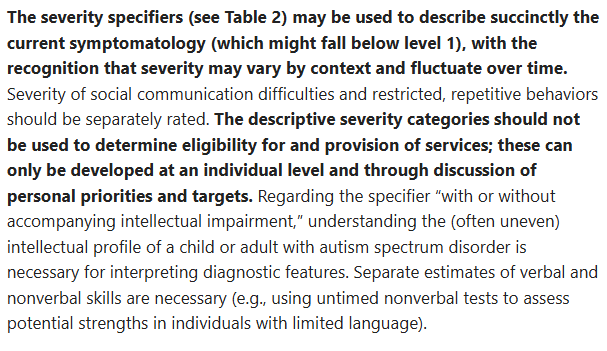
What most people miss is the paragraph just prior to the table that explains how to use, and how to not use, this option. We’ll examine sentences 1 & 3, and summarise the other 3.
Sentence 1
“The severity specifiers (see Table 2) may be used to describe succinctly the current symptomatology (which might fall below level 1), with the recognition that severity may vary by context and fluctuate over time.”
There are 4 important points in this sentence.
- Note needed – Levels are supposed to be optional in an Autism Diagnosis.
- Severity fluctuate over time – tomorrow in the same circumstances may require more or less support.
- Severity varies by context – here you might need more support, there you might need less.
- You can have a Severity Level below level 1
- That is, you don’t need help at this point in time, in this context, and
- You can still be autistic.
Sentence 3
“The descriptive severity categories should not be used to determine eligibility for and provision of services; these can only be developed at an individual level and through discussion of personal priorities and targets.”
There are 2 important points in this sentence.
- The important point here is, the Level you are assigned for this point in time in this context (as per sentence 1), SHOULD NOT BE USED TO DETERMINE FUNDING OR TYPE OF SUPPORT.
- An autistic person’s needs should be developed based on what the individual needs depending where and when.
I’m looking at you NDIS.
Summarising the points of Sentence 2, 4 & 5
Sentence 2 & 5) Summary – Level IS NOT about:
- Social communication difficulties,
- Restricted, repetitive behaviours,
- The effect of verbal skills and nonverbal skills.
Sentence 4) Summary: An Intellectual disability will affect the Level.
- Most autistic people do not have an intellectual disability.
- While intellectual disability is thought to be 5 times more prevalent in autistic people, that is still a small minority of autistic people.
When you understand this paragraph, you’ll hopefully see that the sentence “Jay here is a Level 3 autistic” only tells you that the person who assessed Jay did it wrong and society has really messed up what “Severity Specifier Levels” mean.
For more on this top: Understanding Autism, the Medical Model.