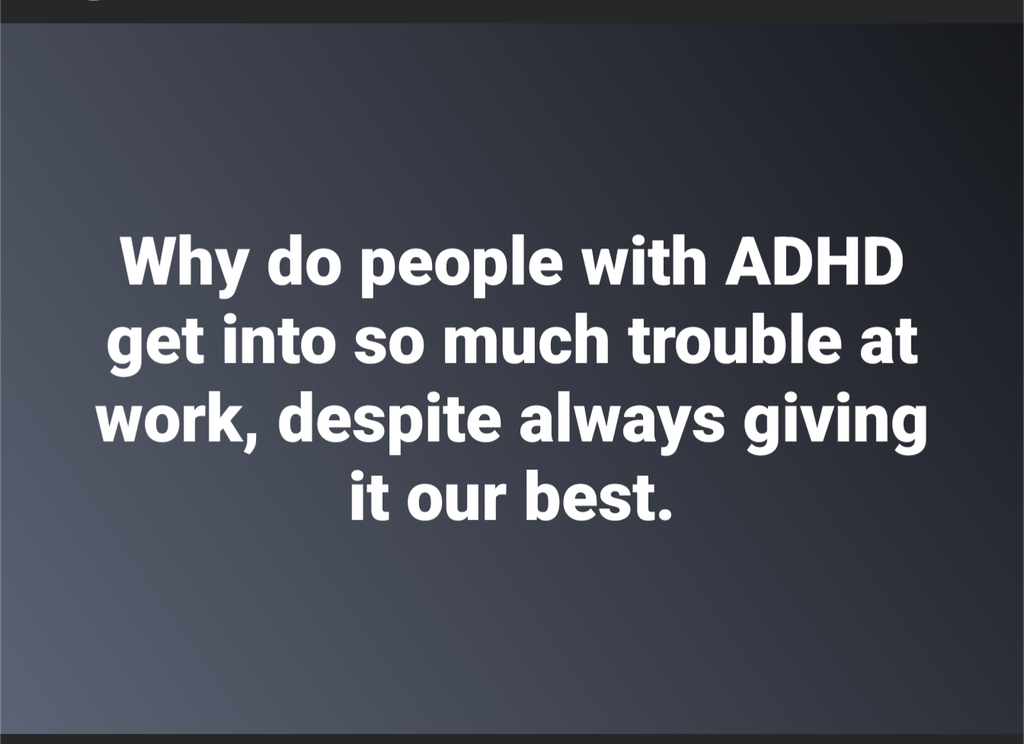
Many ADHDers feel like they get in trouble all of the time, which seems so unfair. We’ll cover the variants of ADHD experience with this, why this may be happening, and what you can do about it.
This is nuanced. Some do, some don’t, some feel they do, some miss it.
Let us break this down.
You may also be interested in
ADHD & Trouble
ADHDers are often struggling with fatigue, focus, time, impulse control and memory. These can lead to a host of problems in a workplace. Not all ADHDers have these problems at work – often due to anxiety compensating, a ‘system’ that compensates, or some other factor.
Rejection Sensitivity
Many ADHDers don’t frequently get told off at work or school. Of these, many likely experience some form of rejection sensitivity as a side effect of ADHD and the anxiousness that comes secondary to ADHD and or the comorbid Autism. That rejection sensitivity can exaggerate your perception of how much trouble you are in, and how often it happens.
Higher Standards
It is true that we are often held to a higher standard. I personally recall being told off for doing things in school class, while the teacher was ignoring the other students doing the exact same thing. Somehow, because I was usually well behaved, me doing these minor things was worse? This can also be true at work, where we are high achieving workaholics (dopamine & adrenaline chasing, perfectionism, feeling secure in our role), that the manager feels they need to keep in line. After all, we do as much work as 2 to 4 other people, for the price of just 1.
ADHD is a Disorder
For some of us, we are frequently messing up, despite our best efforts. That can be due to the aforementioned fatigue, focus, time, impulse control and memory struggles.
ADHD is a medical condition that is listed as a disorder for a reason.
I recall that I was docked 15 minutes of pay every day for turning up to work 5 minutes late, despite only using half of my lunch in compensation, and repairing 4 computers to my colleagues 1 (work ratio was consistent), thus making the company 4 times more money (hyperfocus, boredom relief, quick learner, efficient).
I have frequently completely forgot that a task needed to be done (often because it is outside of my normal routine), or left a thing half done while I did another, only to come back to it later. If that only messes me up a little, no worries. If that messes someone else up, that’s a major problem.
I can lose track of what I needed to say to someone before I get to say it to them.
I didn’t have huge impulse control problems at work or school. That mostly crops up in my hobbies and spending.
If we have mood regulation problems on top of this, that can also be a huge factor. Many jobs require us to have a good public face when working with other colleagues, companies and the public. Not keeping that demeanour can lead to major problems.
All of these can cause friction at work, and all of them can lead to us being told off.
Addressing the Problem
Some of the problem is the ADHD.
Some is because the workplace isn’t optimised for you, it is optimised for neurotypicals. That is, your environment may not be compatible with you.
So may be the way you are perceiving or handling the situation – Rejectin Sensitivity.
Some is because you either aren’t taking ADHD medication, or your medication is not properly suited to your version of ADHD.
ADHD is an umbrella term for many conditions that have the same end result – insufficient sustained dendritic dopamine receptor activation in the prefrontal cortex.
Once you know what causes the problem, you can do something about it.
Incompatible Environment
- If your work is expecting too much from you compared to other people:
- Change workplaces.
- When you do, do less, but not less than the midpoint of everyone else.
- Workplace / School is not compatible with your kind of ADHD
- You might be able to get some accommodations.
- Some workplaces and schools are very compatible with a disclosure of ADHD.
- You don’t have to tell them it is because of ADHD.
- Instead, you can describe the symptom you are having problems with and what you think would help you manage that better.
- Schools usually prefer to know its ADHD and get evidence of a diagnosis as they can get additional funding for staff.
- You might be able to get some accommodations.
- You may need to seek a new workplace or school.
Rejection Sensitivity
RS is also called RSD (rejection sensitivity dysphoria).
- RS is a mostly biological condition, most often tied to the neuronal adrenal system (Dopaminergic System), sometimes to the body’s adrenal system.
- Medication to address this is an important first step.
- Talking therapy can help
- Rebalance how you see others;
- Help you learn cognitive tools to work out where that balance point is;
- Help you learn emotional tools to manage your own mood
- (a bit compared to medication that does a lot).
- See Stress Mountain.
- We can manually shift our mood a step or two on a 10 point scale. It is very hard to maintain a shift beyond that. If you are 3 or more steps out of alignment to your surroundings, it is probably a biological origin. Biological problems need biological solutions.
- RS can also be exacerbated by a history of conflict, and or a current unresolved conflict.
- Sometimes, RS can be caused by conflict and bad experiences
- (but this is actually quite rare).
Medication
If you aren’t taking medication, you probably need to. ADHD is a medical condition that is categorised as a disorder for a reason. While it is possible to have ADHD and manage well, this takes a lot of work in the right environment with the right supports. Many people claim to be doing well with ADHD without medications, but most of them are in denial about the problems that not taking medication has led to.
While not taking ADHD meds won’t immediately kill you, it puts you in a high risk factor for social and workplace conflict, accidental injury and suicide / self harm.
1) If the reason you aren’t taking medication is the cost of diagnosis
- Either shift your priorities to invest in your medical health, or
- Borrow money to get it done.
- Once you are stably medicated, you’ll be more able to pay the loan back.
2) If you are taking medication:
Your medication may need adjusting if you are experiencing:
- Ongoing anxiety
- Ongoing depression
- Ongoing brain fog
- Ongoing mood dysregulation
Most psychiatrists focus on the dopamine element and ignore:
- Neurological noradrenaline
- Body adrenal system
- Hormones (next section)
Frequently this needs addressing by adjusting your ADHD medication, or you may need an additional medication. Here are some to consider:
- Some find that agomelatine helps at night.
- Some need to take a supplementary SSRI (if you are compatible), mostly sertraline (which helps raise dopamine for the day at higher doses).
3) Sex hormones can be a factor
- Mostly oestradiol (in both oestrogen dominant and testosterone dominant people),
- Cortisol,
- Thyroid,
- Adrenal,
- May be another hormone system.
- Some people (active ovary based reproductive system) also struggle with PMDD.
4) Diet and metabolism can be a factor
If you have a nutritional/metabolic insufficiency or deficit in key areas
- Ferritin,
- Tyrosine,
- Vitamin B6,
- Vit C
You may need to adjust your diet, take supplements or consider an infusion (ferritin).
- Talk to your GP about a blood test to check these.
- Once your GP has told you the results, check the pathology report yourself. You want to ensure that your level is above the minimum range, ideally closer to the middle (the number mathematically between the lowest part of the range and the highest part of the range).
- Doctors generally say you are fine, even if your result is at the edge of the “fine range”, which is fine for healthy neurotypicals, but may not be for you.
- You may need a dietetic specialist if your are having difficulties with your diet.
- Generalist nutritionists generally can’t help.
- Doctors usually have very poor information about diet and nutrition, and even worse when it comes to the ADHD diets issues.
5) You should talk to your GP, psychiatrist, paediatrician about your medication if any of the above discussion seemed relevant to you. This is general advice only, aimed at ADHDers, but may not be right for you.
- If you can’t make any progress with your specialist, you may need a new specialist that is willing to engage with the fact that you aren’t happy with the symptoms.
- If you find it hard to talk to your specialist, consider bringing an advocate or writing your concerns down and handing them across.
- If you generally struggle to talk to authority, then that is often a really good sign that you don’t have the right meds, sometimes it is a sign that you have a currently abusive situation.
- If you are struggling with all of this section, book and appointment with us.
- If you find it hard to talk to your specialist, consider bringing an advocate or writing your concerns down and handing them across.
6) If all of the above suggested are sorted, then you may need to learn how to better manage your ADHD.
- If that’s the case, book an appointment with us.
- See the top of the page for the Book Now button.
Useful links
- https://www.jomida.com/adhd-understanding-adhd-essentials/
- Getting a handle on ADHD.
- https://www.jomida.com/adhd-what-medications-are-actually-useful/
- A review of medications that can affect ADHD and why you might try one over another.
- https://www.jomida.com/dopaminergicsystem/
- Understanding the dopaminergic system.
- https://www.jomida.com/rejection-sensitivity/
- Rejection Sensitivity is mostly biological, but not always.