Two key parts of working together cooperatively is acknowledging our own mistakes and constructively pointing out the errors of others. When good people point out errors made by abusive people, this leads to a conflict of persona. The abusive person will often use the tactic DARVO – Deny, Attack, Reverse Victim and Offender. Recognising this pattern will help you recognise abusive people – but be aware that good people can also accidentally do use this mechanism too. In this article, we will look at how this mechanism works, and how to tell the difference between an abusive person and a good person that is Survival Mode.
You may also be interested in:
- Conflict, Abusive People Index
- Consent – Fundamentally Easy
- Domestic Violence
- Narcissism and NPD
- The Traffic Light System
Understanding DARVO
DARVO is a simple but powerful tool to recognise certain signs of an abusive person.
DARVO In Brief:
DARVO primes you to see these three toxic red flag behaviours.
- Deny
- Attack
- Reverse Victim and Offender
Once you have identified that someone has used these, it is important to determine if they are:
- Abusive:
- ID:
- Taking actions that harm despite conversation
- Solution:
- Avoid if possible,
- Mitigate if needed.
- ID:
- Toxic:
- ID:
- Communication breakdown despite best efforts of both.
- Solution:
- Manage if possible,
- Avoid if not.
- ID:
- In Survival Mode:
- ID:
- Trend of behaviour is good and compatible, they are in a heightened state right now.
- Solution:
- Wait for them to calm down, then discuss with them what happened.
- Good people learn from problems, not Deny, Attack and Reverse Victim and Offender.
- Abusive people don’t learn and grow.
- ID:
Below is more details of the above.
Deny
Abusive people are selfish rather than community minded. A community requires adapting to the needs of the many without sacrificing your own needs. While there may be some extreme situations where you need to promote your self interests over others, those are very rare and shouldn’t come up often.
Abusive people seem to always act as if it is an extreme situation, very happy to sacrifice everyone else’s comfort for their own. Abusive people refuse to grow for the sake of the group.
The abuser will automatically deny being the cause of the problem, while good people will consider the possibility that it is true. The difference can be subtle:
- Abuser – “It isn’t me.”
- Good person – “I don’t think it is me, but tell me what you reasons are for thinking it is.”
When you attempt to prove your case, the Abuser will continue to refute reasonable logic, evidence or opinions.
Deny
- Dismiss awkward evidence, &
- Devalue other’s expertise.
The Good person will consider it, and upon recognising the logic, evidence and fair opinion, will usually apologise, make amends and grow.
Attack
Abusive people will use a number of techniques to subvert the situation. In their mind, they need to make themselves safe from this confrontation, so they have first denied that it is them (see above), then they will deflect attention from themselves and ideally destabilise your cognitive capacity. That comes in the form of an attack.
Attack
- Denigrate their opponents,
- Create emotional stability.
- Distract from what actually happened,
- Obfuscate and confuse the discussion from the actual problem to something, anything, else not related to them.
Reverse Victim and Offender
A common tactic that the abuser uses is to further obfuscate what really happened by stating that the victim is the cause of the problem. They know that they can’t completely dismiss what happened as clearly you are upset, so they give you a new person to blame – the victim, even if that victim is you. They will make a case that the victim is the offender, despite evidence, logic and reason.
Reverse Victim and Offender
- Deflect the focus from them (to someone else via real or imagined faults).
In a cooperative community, good people will check to see if they were the cause, or partial cause, of the problem. This tool allows for whomever made mistake to learn and grow.
The abuser is co-opting this good community mechanism and upping the seeming credence of this deflected blame by:
- Falsely claiming harm to themselves,
- Falsely claiming their own innocence, and
- Falsely claiming evidence, motivations, actions and behaviours.
All to promote their own new story to deflect the cause from themselves to someone else.
Triangulating Abusive, Toxic and Survival Mode
It is important not to miscategorise someone due to a bad situation. People are rated as good or problematic based on the trend of their behaviour. Even in a bad situation, good people won’t do much that is crossing the reasonable line.
Good people: Most people are good – that is, they are cooperatively community minded. Good people grow from mistakes – given sufficient logic, reason and evidence, they accept that they are wrong, ignorant and mistaken, and then use that insight to learn and grow. Good people are reliable – they do as they say, say as they do. However, we can all enter Survival Mode, where we often stop thinking long term and cooperatively.
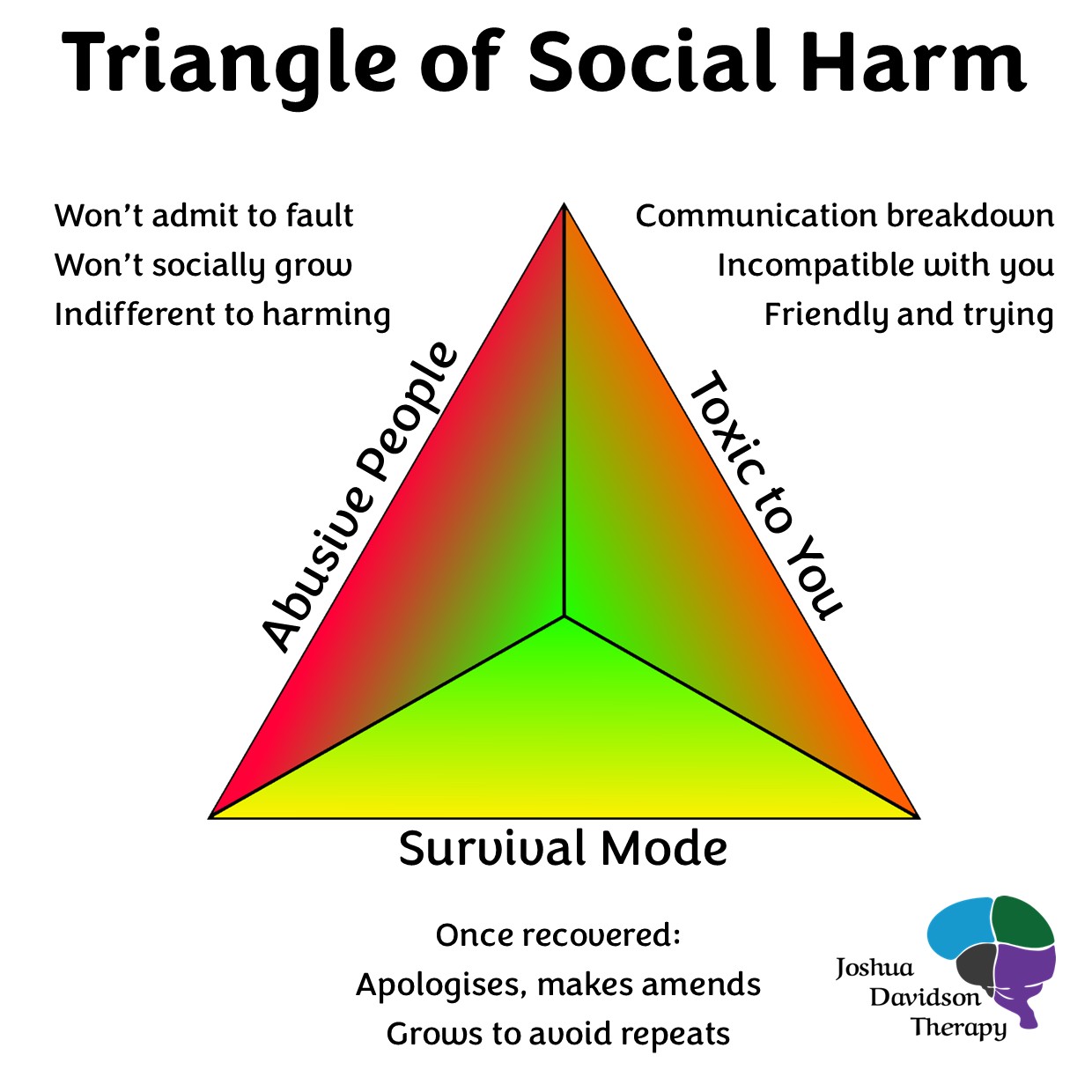
Survival Mode: We can all struggle and slip into Survival Mode. Survival Mode is where we have lowered cognitive capabilities, we are emotionally reactive and our brain pushes us to act in ways that are odd to cooperative civilisation. When we are in Survival Mode, we may be harmful to those around us. The big difference between someone who is in Survival Mode, Abusive and Toxic is that good people who were in Survival Mode apologise, make amends and then make changes to avoid the same problem – they grow.
Toxic to You: People may be toxic to you, without them being inherently abusive per se. This is more about the incompatibility of their world view or ability to you. Being in the environment with them for long will create harm for you or them, but not because either of you seek it or aren’t trying to avoid it – it is just incompatible. The ultimate solution for dealing with people toxic to you is basically the same as abusive people – get away when you can, mitigate when you can’t.
Abusive People: Unfortunately, some people are abusive. Abusive people, by their very nature, are the cause for harm. Abusive people prioritise themselves over others, and do not seem to care enough about the discomfort or problems they cause other people to seek a path that is less harmful. Some abusive people (eg NPD) even seek harm to others as part of their life strategy. Abusive people refuse to acknowledge their own mistakes, and in so doing, don’t learn or grow. Abusive people are inherently unreliable, other than that they will hurt you or generally fail to do as they say. Domestic Violence / Cyclic Violence is a specific subtype
Testing For Toxic
We have a page dedicated to Testing for Toxic. See the article for the full description of each tool.
Testing for Toxic (In brief)
- DARVO – this article.
- Comfort Test:
- Do you feel comfortable with this person, such that you seek their company because it will be good, or
- Are you seeing them because you have to?
- The “No” test:
- Abusive people want to control you. If you say “no” to an ‘option’, they won’t accept it and will have to force you to say “yes”.
- Reflecting on your Limits:
- Abusive people seek to dominate you. How many of your stated limits have you been pushed to cross?
- Trapped Test:
- Abusive people seek to con you into staying. Do you feel trapped, like there is no way out?
- Traffic Light System, mostly Toxic People – Mind Toolset.
- Flag System – How to rate individual behaviours.
- Trust Zones – using the Flags to work out who can be in Green (expect good), Amber (uncertain / testing) or Red (assume malice).
- Toxic People – Mind Toolset – the steps from Expecting Good Behaviours to Expecting Malicious Behaviours, summary below.
- Three Pillars Method – a guideline on how many chances to give someone.
- Schrödinger‘s Douchebag:
- A person who makes offensive or inflammatory remarks and characterizes these statements as either sincere or joking based on the reactions of others.
Hanlon’s Razor warns us to not falsely attribute Malice when a more benign explanation is available – however there are limits to this. We cover this process fully in Toxic People, Mind Toolset, summarised below.

Toxic People – Mind Toolset (In brief)
- Assumption of good:
- Most people are good most of the time. You can count on them being good.
- Principle of Charity:
- When mistakes inevitably happen, assume the best intent of the other person, until they show themselves to be abusive.
- Hanlon’s Razor:
- Don’t jump to the assumption of abusive when they may just be mistaken.
- Ignorance or incapable:
- With a brief to medium length conversation. If the person didn’t know better, now they do. They can no longer claim ignorance or no knowledge of how to do better. A good person will try to make changes.
- People who don’t make changes are concerning – they may be incapable or malicious.
- Grey’s Law:
- “Any sufficiently advanced incompetence is indistinguishable from malice”. They don’t have to understand they are hurting you to hurt you.
- Assumption of Malice:
- They have lost the presumption of goodwill – we must assume they are harmful, whether they understand their actions or not.
- Presumption of malice: you need to make plans as if they are harmful, rather than good.
Mitigating Abusive People
This is a summary, see Managing Toxic People for the full details.
Avoidance
The best strategy for mitigating abusive people is to get away from them. That may mean quitting that job, leaving that relationship, or leaving that social group. You can almost always leave.
Part of the strategy of Abusive People is to convince you that you can’t leave. Often we internalise this and convince ourselves that we can’t leave. This is what allows them to continue to abuse us.
“If a stranger treated you with the same kind of abuse, you’d avoid them and not seek to be their friend.
Why do we allow so called ‘friends’, ‘work colleagues’ and ‘family’ to abuse us, without us walking away?
Stranger, ‘friend’, ‘work colleague’ or ‘family’ – abuse shouldn’t be tolerated without challenge or a management plan.”
Joshua Davidson.
- Social Groups:
- Often we interact in groups of people. If one of them is problematic enough, it can become worthwhile to abandon the group, even if there are people there you like. By accepting the problematic behaviour, or turning a blind eye to it, the people who remain in the group are condoning the behaviour – are they really good friend material if that is the case?
- Work / Organisation:
- Every formal group has someone who is annoying. If the harm to you is great enough, it isn’t worth trying to fix or mitigate, it is worth it to leave.
- Feeling Stuck:
- There is always a cost of leaving. In the short term, it is engineered to seem cheaper to stay, but in the long run, it is more expensive than to leave.
- See Escaping Abuse for more.
Mitigation
We can’t always instantly leave and so we need some strategies to mitigate the harmful behaviour. Mitigate is a key word here as we cannot change them. Abusive people will always be abusive to you. For more on this, see Perpetrator Reformation.
Mitigation is about reducing risk and reducing harm rather than fixing the problem.
- Steering the conversation via:
- Deflecting & distracting,
- Prompting self talk,
- Pregenerated answers to sensitive topics,
- Avoid depth, complexity and fighting.
- You can’t fix or understand them,
- They’ll invite you to try, but it is a trap.
- Grey Stoning:
- Don’t give them emotion.
- Make everything neutral.
- Pedestalling:
- Framing requests in terms of how other people will see them as good.
Knowing When to Leave
When managing abusive people, it is important to know when to leave and how to get out.
- Limiting Time: Pre-choose a time limit (2 hours or less),
- Exit Strategy: Know how to get out,
- Logistical Exit:
- How: Car, public transport, friend, ride/share,
- Communication: Charged phone, phone cable, spare battery.
- Pregenerated Reasons: Have a few phrases to use when you need to leave. Don’t explain or excuse in detail.
- Cues to leave:
- You sense danger,
- You are being pushed to be emotional,
- They are rpetitive and demanding,
- They are becoming or are intoxicated,
- You are fatigued,
- Your Time limit has been reached.
- Logistical Exit: