People can be hard. It can be difficult to work out who to trust and who has lost the right of trust. Some people need special care in handling, some people are incompatible and toxic, some people are just abusive and should be avoided. Here we explore a series of ideas that helps you to get from meeting someone, with the assumption that they are decent, to a potential recognition that this person may need to be treated with lots of caution. The Good to Abusive Scale helps you navigate a way through seeing someone for whom they are really showing you.
This incorporates into the Traffic Light System, where:
- Green = Good,
- Amber = Caution, and
- Red = Concern.
Quick Traffic Light System Review
To maximise cooperation, a functional society prioritises enculturing forgiveness, second chances, assuming that bad behaviours are just a mistake and defining kindness in terms of keeping people in the group, looking after our weak and injured, and letting people grow. Keeping people happy runs the risk of People Pleasing and Conflict Avoidance which we cover in Rejection Sensitivity.
The Traffic Light System uses the standard traffic light colours to help guide our evaluation and management of people.
- Green is what we are looking for. Green is trust, cooperative behaviour, social building trends.
- Amber is unknown, uncertain, be alert but not alarmed.
- Red is caution, problematic, abusive behaviours and trends.
Flag System
The Flag System assesses and individual behaviour a person may display. Their actions speak the loudest – so what are they doing? Does their action warrant a Green (preferred), Amber (caution) or Red (harmful) flag?
Trust Zones
Trust Zones describes how we can place a person’s trending behaviours in one of 3 zones, Green (Presumption of Good), Amber (uncertain, unknown), or Red (Presumption of Harm), which simplifies how we interact with people on a day to day basis.
Good to Abusive Scale
The Good to Abusive Scale is the process we use to evaluate a person’s response to inevitable mistakes and guides us to work out whether we should give them the presumption of good (Green Trust Zone), or the presumption of abusive (Red Trust Zone).
The Three Pillars Method
The Three Pillars Method is used to help guide how many chances we give people to improve, and how to gauge that they are learning (Green), poorly learning (Amber) or abusive / failing to learn (Red). We don’t need to give everyone a second chance.
Understanding the “Good to Abusive Scale“
The Good to Abusive People Scale is a step by step approach to ensure that when a problem occurs:
- You can ensure you have done your part in solving it:
- Assumed their good intent in the absence of evidence of harmful traits,
- Talked to them about it,
- The other person is not ignorant of the problem:
- Allowing for opportunity to collaboratively solve it if needed,
- And monitor their actions:
- Do they make some changes to address the problem (good) where relevant,
- Do they not comprehend the problem, and either,
- Do the suggested non-onerous actions (good),
- Not do the suggested non-onerous actions (concerning),
- Do they not care about or do they enjoy the harmful outcome (bad).
As people do the good outcomes, you can accurately place them in the Green Trust Zone – Assumption of Good, or if they do the concerning or bad outcomes, you can place them in the Red Trust Zone – Assumption of Harm. Trust Zones are a useful way to not overthink about people you interact with often, if they have shown themselves to be generally good.
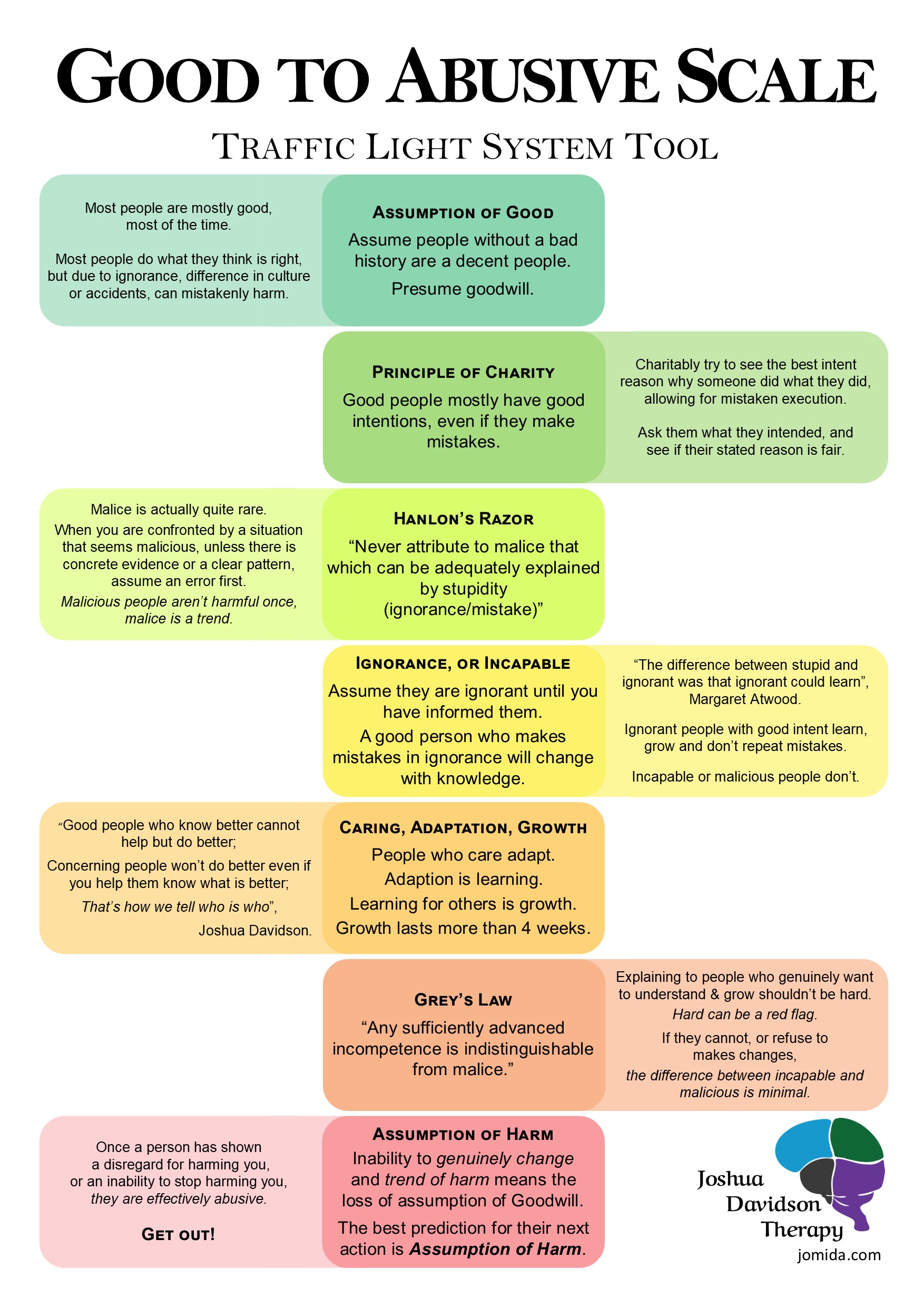
Making Use of the Process
When you meet a new person, we begin by assuming that they are likely good and give them a chance to build trust. So long as things go well (Green Flags), then they earn their way towards the Green Trust Zone (Assumption of Good).
When a problem inevitably occurs (and it isn’t clearly your fault) (amber or red flag), with no evidence of malice (very red flag), we should start with the assumption that this is just a mistake which the other person will notice and do something about. After all, good people fix their problems. If they do so, then they earn their way towards the Green Trust Zone (Assumption of Good).
If they don’t, then before we assign the explanation of malice, we need to see if there is a better explanation. We assume their best intent (Principle of Charity), and ask what they were aiming for (let them explain it, don’t explain it for them). If they made an error due to ignorance, we talk to them so that now they know (both why it was a problem, and what they might do about it; they may chose a different solution, and so long as that is good enough, then that is a green flag).
If the person doesn’t make some positive changes, they cannot rightly claim later that they didn’t know there was a problem, or what they could do about it – because you told them.
“Good people who know better cannot help but do better, concerning people won’t do better even if you help them know what is better – that’s how we tell who is who.”
Joshua Davidson, BSW
If the person doesn’t improve, after being told, and the suggested changes to avoid repeating the harm are not onerous, then we need to change the way we see them. We started with the ‘assumption of good‘. However, they are not doing good things, so we need to start wondering if they now need to be moved to the Red Trust Zone, where ‘assumption of harm‘.
We use the Three Pillars Method to ensure that we give them a reasonable chance to improve and grow, before we shift them to the Red Trust Zone. That is, the person has either done something bad enough that they don’t get a second chance, or they have shown a pattern of harmful behaviour – the prediction for their actions shifts from assuming they are doing good things to assuming they are likely to be harmful.
While it is nice to know if a person is incapable of doing better, or just doesn’t want to due to indifference or malice, it doesn’t really matter (Greys Law). What is predictable is that they are untrustworthy and will do harm. In that case, you must assume they are harmful.
Please feel free to print or distribute,
but please don’t modify it or claim it as your own.Feel free to let us know if you have questions, would like help, or have a suggestion of how we can improve it.
Assumption of Good
Assumption of Good:
When you meet someone, assume they are a decent person.
Most people are good, most of the time.
Most people are mostly good, most of the time. When you do meet a new person, you should assume that they are going to be mostly good, most of the time. For people who have earned their way into the Green Trust Zone, you can also assume they are good and will do good things.
The point of this is that without a reason to distrust people, new or known good people should be presumed to be good.
In the Trust Zones, a new person may start in the Amber Trust Zone, as we don’t know if they are trustworthy or not.
So long as there are no good indicators of risk, we need to give them a chance to earn trust, so that we can assess whether they are trustworthy. We do this by giving them a bit of trust in something that we can afford for for them to fail, such that it won’t cause us harm we can’t manage and shoulder, and see how they do.
If they do well, we can give them some more trust, allowing them to earn their way into the Green Trust Zone, or prove themselves untrustworthy, and Red Trust Zone.
By “won’t cause us harm”, I mean that something you could financially afford to lose, time you can spare to fix things, or other situations that are not critical to you.
For me, that would be losing the equivalent of $20, half an hour and or a task that I can do myself without too much hassle, but it would be convenient not to.
If there are clear signs that you should be cautious (such as warnings from other people, something feels off about them, who they prefer to associate with etc), then the evidence you may need to see to afford them some more trust may be higher, and you by all means should be more cautious and alert while they earn that trust. It is important to protect yourself.
Some people start directly in the Red Zone of Trust (harmful), due to our prior knowledge of them, or what they do in the first meeting – that isn’t a bad thing, or you being judgemental. That is you being smart and safe. Not everyone deserves a second chance (see the Three Pillar Method, Perpetrator Reformation, NPD).
Principle of Charity
Principle of Charity
“Interpreting a speaker’s statements/actions in the most rational way possible and, in the case of any argument, considering its best, strongest possible interpretation.”
[Wikipedia on Principle of Charity]
Effectively, charitably try to give them the best reasonable interpretation – but do check the evidence.
No one is perfect. We are learning, growing and maturing. When we do make a mistake, it is nice to be given a chance to apologise, fix it and where needed, make amends. If we learn from our mistakes, we can become better people.
If it is good for us, it is fair for someone else too.
- Green Flag, Equivalent Standards:
- Where you treat everyone the same and hold them to the same reasonable standards, including yourself.
- Red Flag – Double Standards (the opposite):
- Where there are the rules you expect others to follow, but they don’t apply to you;
- Where this group of people must follow a more restrictive / controlling set of rules than another group of people, without a good individual level reason.
When you meet a person, or are not aware of all of the facts, assume they are trying to do the right thing with the information and abilities they have, that they are trying to say the right thing and don’t know how to say things better, and any ill consequence is hopefully ignorance.
We give to them the Principle of Charity, where we try to see the good intentions they likely meant, even if what they did was a mistake. Additionally, even when mistakes aren’t made per se, we try to see any person’s actions as being of good intent first, and then check for problems only when problems occur.
In the Principle of Charity, we are trying to give the person a bias towards them being good and just making an honest mistake, like how we would like people to assume our mistakes.
However, this does have limits.
Hanlon’s Razor
Hanlon’s Razor
“Never attribute to malice that which is adequately explained by stupidity.”
attributed to Robert J. Hanlon
[Wikipedia Hanlon’s Razor]
Robert J. Hanlon proposed this philosophical razor in his book “Murphy’s Law Book Two: More Reasons Things Go Wrong! (1980)“. While Hanlon has the attribution for this wording, similar statements have been recorded since at least the 18th century.
The core idea is to prioritise the likely reason someone did something wrong as a simple mistake rather than an act of malice. Even if you think that the action and intent seems malicious, without evidence of intended malice, try to see if it was more of a gross error in action or understanding, than a malicious goal.
Most of the time, for most people, really bad actions are just mistakes.
Malice is actually quite rare. When you are confronted by an anomalous (rare) situation that seems malicious, in the absence of concrete evidence, this is likely to be a stupid error.
When someone’s action seems malicious, with this razor in mind, it is time to start to investigate. That generally means, look for evidence over opinion and assumption, and go and talk to the person.
Anomalous is doing some heavy lifting there.
Hanlon’s Razor is useful to remind you that when someone has been generally good (Green Flag behaviours), the out of place and rare odd behaviour is an anomaly. That suggests that using Hanlon’s Razor to avoid misattributing malice is wise.
If the person’s current behaviour is harmful, and it is amongst a trend of harm, then Hanlon’s Razor is not applicable.
Ignorance, or Incapable
Margaret Atwood ‘…the difference between stupid (sic) and ignorant was that ignorant could learn.”
Alias Grace Quotes by Margaret Atwood
‘Stupid’ is an old term for someone who could not learn, aka incapable. People with low intelligence can often learn.
Think of the last time you made an error. It was an error because you didn’t mean to do it.
One of the most common reasons why people make mistakes is ignorance. They either don’t know it went wrong, they don’t know some key information about why what they did ended up wrong, or they don’t know how to do better.
You cannot make a choice that you don’t know you have.
If the person doesn’t know about the problem, doesn’t know what went wrong or doesn’t know what to do about it, then it wasn’t malice.
Abusive people will often take advantage of this basic idea to get out of trouble. That is, they’ll claim ignorance as an excuse to try not be responsible, then they’ll just go and do it again.
Once you have talked to the person and attempted to explore what went wrong and what could change, the potentially abusive person cannot reasonably use the claim of ignorance next time. That won’t stop them from doing it, however, you’ll know that they are falsely claiming.
When talking about what went wrong, begin with the assumption that they are a good person who would like to solve a problem. Good people, even when ignorant or mistaken, are not the problem – the problem is the problem, and together we can solve it.
Abusive people will often enact DARVO – Defend, Attack, Reverse Victim and Offender. They will not discuss in good faith, they’ll try to imply that you or someone else was the cause of the problem.
It is important to note, that someone who is currently distressed may be in survival mode, where they may not be cognitively available and may resemble an abusive person due their emotional state of anger or fear. If you suspect this is the case, ask for a time when you can meet with them to discuss the situation to resolve it. Ask them how to approach you about this to have the best conversation. Good people will help you talk to them, concerning people will avoid this – See below, Grey’s Law.

Caraing, Adaptation, Growth
“People who care adapt.
Adaptation is learning.
Learning for others is growth.
Growth lasts more than 4 weeks.”Joshua Davidson, BSW
If you’ve talked to the person about what went wrong and why that was a problem, then ignorant people will learn and not repeat the rationally explained and reasonably evidenced error.
You shouldn’t have to explain too much or go into too much detail to be able to tell the difference between someone trying to learn what went wrong and someone refusing to engage (likely malice), or incapable of engaging (limited capacity aka stupid) in the process.
The point of this step is to separate out someone who:
- Made an ignorant error,
- Someone who can’t understand the error, and
- Someone who doesn’t care that their action was harmful
A caution does need to be put in for those who are short on resources (Spoon Theory) or
in Survival Mode, and need some time to think about the situation.
Once you know the kind of person you are dealing with, you can make some decisions about how to handle them. If the person is incapable, then you can try to manage their behaviours. That can be by giving them less opportunity to be harmful, stop trying to educate them on the thing they can’t learn, and limit how much time you are around them.
“People who know better cannot help but do better”
Attributed to Socrates.
“Good people who know better cannot help but do better, concerning people won’t do better even if you help them know what is better – that’s how we tell who is who” –
Joshua Davidson, BSW
Grey’s Law
Grey’s Law: “Any sufficiently advanced incompetence is indistinguishable from malice”,
Unknown author
[Gooden, Philip (2015). Skyscrapers, Hemlines and the Eddie Murphy Rule: Life’s Hidden Laws, Rules and Theories. Bloomsbury Publishing. p. 83. ISBN 978-1-47291503-0.]
Grey’s Law is a useful idea. It is a pity that the original author is not known.
It borrows both Arthur C. Clarke’s ‘Three Laws’ regarding ‘sufficiently advanced science being indistinguishable from magic‘, and incorporates a point from Hanlon’s Razor from above.
Grey’s Law points out that it at certain levels of harmfulness, it is no longer important to differentiate between someone who is harmful because they can’t understand that their action is harmful (and thus they won’t adjust), and someone whose goal was to be harmful.
The most important aspect was they they were harmful, and they won’t or can’t make changes to avoid repeatedly hurting you or others. This matters if the person is likely going to be doing the same actions of harm rather than a single disagreement about how and what that is not likely to come up again.
Far too many people get stuck on trying to work out if the person is aware or not of their harmful behaviours, while standing in the place that they are being harmed.
Once you have determined that the person is not ignorant of their actions and their consequences, since you’ve told them, the priority shifts from being charitable and trying to help; to getting safe from harm even if they think it is mean and unfair.
At some point, it doesn’t matter if the person is malicious or stupid (incapable), if they keep hurting you, they are abusive to you.
Get away from them.
Assumption of Malice
At this point they have lost the presumption of good will. They are harmful.
Once a person has shown an inability to stop hurting you, they are abusive to you.
Get Out.
As per Grey’s Law, it doesn’t matter whether someone is unable to not harm you (incapable or indifferent), or whose goal is to harm you, they will harm you.
Waiting until you can prove that they are specifically malicious traps you in being harmed by them, and those who are good at violence will take advantage of your uncertainty, hijacking your generosity and patience, to continue to harm you for their benefit.
Don’t give them that opportunity.
If you do get proof that they know they are hurting you and don’t care, or even enjoy it, then you can adjust your method to become safer. You don’t need that proof to take actions to become safe from them.
Even without proof, if you have down to Grey’s Law:
It is now important to shift your assumption of someone’s behaviour from Mostly Good Most of the Time, to
Likely to be either be Harmful Most of the Time, or Harmful When You Can’t Afford It.
You should now work on the Assumption of Harm.
Abusive People can do occasional acts that seem nice.
Often they do this when they can get Hero Points for it – where someone else will think they are a Good Person for Doing The Thing. Abusive People are almost always the Hero or Victim in their stories of themselves, never the perpetrator of harm. Or they will use the Good Action as a method to push you to do something for them (transactional behaviour).
This plays on our charity and cooperative nature, trying to give a person extra ‘benefits of the doubt‘ and ‘additional chances to prove they can do better‘ than is safe for you.
I reiterate, keeping you confused is part of a Abuive Persons tactics. The stopped watch is right twice a day, but that doesn’t make it a good time piece.
- Take a look at the Three Pillars to understand how many chances to give a person to do better.
Getting Out
Getting out/away sounds easy when we just say those words, but the reality can be very different. The Abusive Person may be your employer, in a social group, a family member, a partner, or a dependent.
We have a series of information on dealing with Abusive People:
If you need some help to navigate if a situation is Abusive or not, speak to a trusted friend, or see a therapist to help get a reality check. Therapists are also generally good at helping you find a way out of messy situations with Abusive People and toxic situations. [Book now if you need help].