Our mental health can vary in time, from very healthy all the way to requiring hospitalisation. Each step of the way there are things we can do to help, maintain or hinder our level of wellbeing. As our mental health progress towards crisis, it becomes harder to know what to do to help ourselves, and very difficult for others to know what to do to support our safety and wellbeing without accidentally hindering us instead. Here we cover the best Safety Plan on the internet, which you can download from the link for your own use, for free.
You may also like:
- Crisis
- Neurology
- Mental Health
- PMDD
- Sleep
Introductory Skills
Affecting Change
We have the power to affect change over some things, while others may be beyond our current capacity, some may be impossible. Some things may make changes, but not affect us in a useful way. We can spend a great deal of energy attempting to change that which is impossible, instead of focusing our energies on the useful things that will make a difference.
Work smarter, not harder.
The Serenity Mantra (often called the Serenity Prayer) recognises the difference between putting our energy into actions that can affect change, rather than wasting that effort on things that won’t make a difference.
The changes we make can be positive and increase wellness and safety. Some actions can mitigate risk, maintaining our wellbeing. Some actions can increase risk and should be avoided or managed carefully. The same action that is safe when we are calm can become unsafe when we are not, and vice versa.
When we are in crisis, it is not uncommon for people to put energy into things that don’t make a difference. This is not the time to try to solve problems. If we can trust our calm self, we can map out what to do and what works when we are calm, and follow those when we are not.
Helpful Actions: Try to identify the things that will affect helpful change, and list them into the “actions” section.
- Music: Music that helps calm or uplift your mood
- Food: If you haven’t eaten in the last 4 to 6 hours, perhaps eating some food will help.

Actions to Avoid: If you can, identify the things that won’t make a real positive difference, put them in the “avoid list” and be patient with them.
- Music: Some people find that particular music can pull their mood down. Is there music you should avoid when you are vulnerable?
- Food: Some people have foods make our moods worse, or create significant problems later, especially if we have an intolerance. What should you avoid?
Interoception
Interoception is the ability to look in at yourself and know how you are feeling. Those feelings could be an emotion like fear or happiness, your level hunger, if you need to go to the toilet, fatigue and so on.
We have many internal signal systems that tell us both about ourselves (interoception) and our environment (perception), and our assessment of our perception (interoception specifically emotional feeling). Far too often, people don’t really know what these signals mean and so don’t recognise the clues that interoception is giving them. If this were a video game, it would be the “character status bars”, like health, fatigue, hunger, mana and so on – your current “state of being”. If you were low on health points, you might avoid that next monster, or if your hunger was also low, you might eat to allow yourself to get more health points before you deal with the monster. Connecting to your interoception allows you to connect to your state of being and make adjustments for what to do to keep it optimised and ensure you have the resources to meet the situation, or back off from it.
When we learn to sense these signals and know what they mean, we can take much wiser decisions so that we can optimise our health in balance to our focus and the environment. That is, not spending too much personal resource (spoons) on our self checking, but trying to be good enough for the environment that you are in, and knowing when you need to make some changes.
Stress Mountain
Stress Mountain is a tool for understanding the general phases of becoming distressed to the point of crisis. The important part is understanding how your ability to make decisions becomes more impaired as your Survival Mode brain takes over, meaning that you can’t think things through, you can’t comprehend what people are saying to you and you become more black and white.
- Baseline
- Calm and fully rational
- Take some actions that maintain your baseline
- Rumble Warnings
- Early signs of agitation, rationality impacted
- Implement Early Interventions Strategies
- Distress Phase
- Either clear signs of distress, or becoming absent, disassociated, rational choices are limited
- Late Intervention Strategies
- If not successful, Harm Minimisation
- Crisis
- No choices
- Also called
- Meltdown (Autism)
- Anxiety or Panic attack (mood disorder)
- Outburst (anger management issues)
- Recovery
- Choices returning
- Beware of being re-triggered
- There are things you can do to speed up or hinder recovery
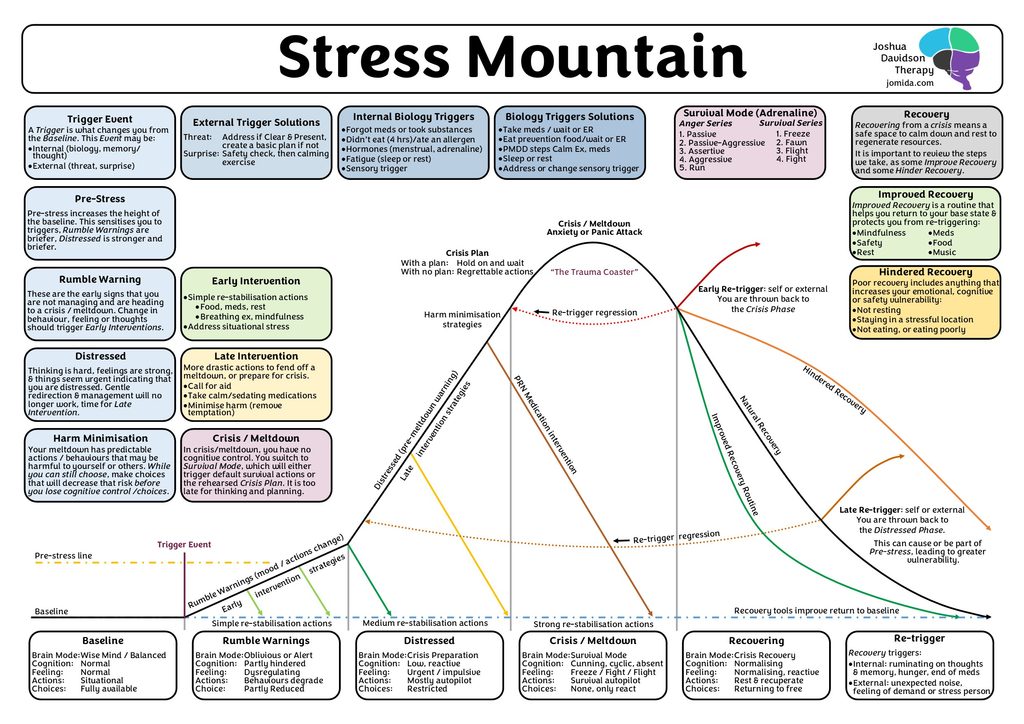
For a full description, see the Stress Mountain Page.
Safety Plan
The “Wellness & Safety Plan” is a formalised system for writing down the most common elements that we come across as our health declines, to remind us what we should do to help ourselves. This is particularly useful when it is hard to think or trust others, which is a common part of switching to Survival Mode. When we are not thinking well, or finding it hard to figure out who to trust, we just have to look at the plan we made and trust ourselves.
Dynamic Document
The Safety Plan is designed as a dynamic document.
That is, it changes over time. After an incident, it is very important to review the Safety Plan and make changes. Remove what clearly doesn’t work, adjust things that didn’t work very well, and add or emphasise things that did work.
The Safety Plan is a two page document to help guide us through from maintaining our Baseline health, mitigating the Crisis and improve our Recovery.
The first layer is about identifying the layer of current health and what to do or avoid for this layer.
Download the 2026 Safety Plan as a PDF
[1.89 MB]
Page 1 – Identifying and Deciding Flowchart
The goal of this page is to identify what part of Stress Mountain we are on, and from that what actions to do and what to avoid.
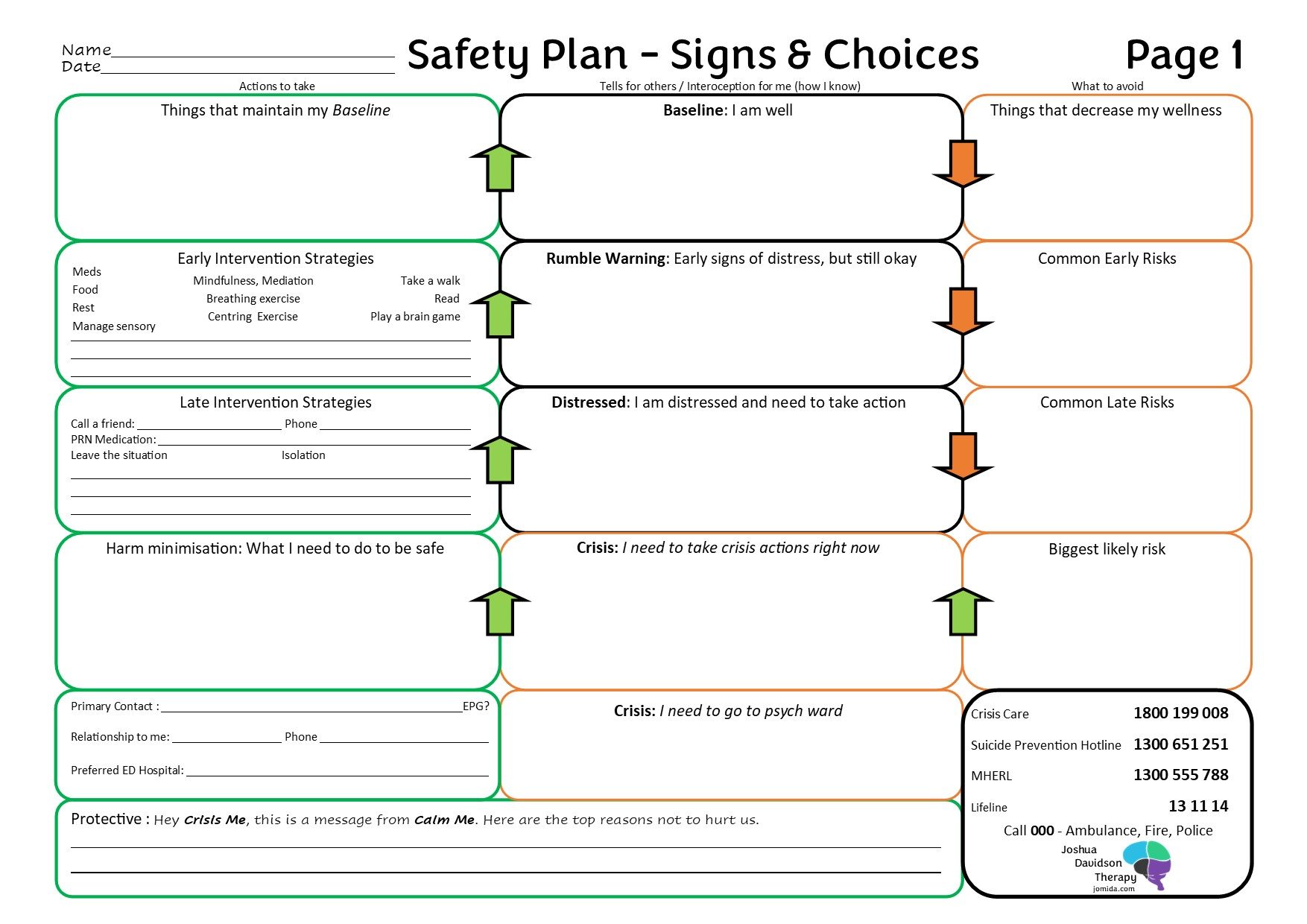
Safety Plan, Page 1 – Signs and Choices, created by Joshua Davidson, BSW
Phase 1 – Identifying My State of Being
The middle column of Page 1 is articulating what behaviours, beliefs and other ‘tells’ inform you that you are doing well at your Baseline, that the you’ve received some Rumble Warnings, when you are Distressed, when you are in manageable Crisis, and when your type of Crisis needs you to go to hospital
List clear signs that indicate to you what your current state is. That can include feelings, behaviours and environments. Also include ways for a trusted observer to tell that you are doing well (Baseline) or that they need to check in on you (Rumble Warnings & Distressed) or that they need to initiate various Crisis actions.
This allows a quick ‘check in’, so that you tell that things are fine and you don’t have to do too much self monitoring, or that perhaps you may need to take some actions. Some of this will be an internal interoception check, some of this will be an external “how am I doing” that others can see.
Baseline, I am well
The Baseline helps you to identify what it looks like (internally via Interoception and externally as observed by other people) when you are well. Beyond a basic check in and routine maintenance (meds, food, rest etc), most of your actions will be on autopilot, defined by the situation or based on your wants.
The ideal time to create this Safety Plan is while you are at Baseline, or close to it. The worst time is while you are in Crisis.
Internal signs may include:
- I feel happy and content
- I am enjoying the things I usually enjoy
- I am eager to do tasks
External signs may include:
- I feel fine to go to work / school / meet up with friendly people
- Eating 3 to 4 meals a day is easy
- I respond appropriately to questions and can solve 2 stage problems
Adjust the above to suit yourself, add in any that aren’t on the list the help you to identify that you are at your Baseline (prior to any Rumble Warnings). We will address maintenance and avoidances in the next major section.
Rumble Warnings, I am beginning to struggle
‘Rumble Warnings‘ helps you to identify what it looks like when you are beginning to struggle and we need to break out of autopilot and consider implementing Early Intervention Strategies. In the Rumble Warning phase, you should be able identify what has changed and take some actions to address that.
This state of being requires more deliberate actions and choices, rather than being on autopilot or hyper focused.
Internal signs may include:
- I’m struggling to feel happy / I am feeling worried / I am feeling anxious / I am feeling angry
- Things I usually enjoy aren’t as much fun
- I want to put things off until later, because I don’t feel like it right now / I am struggling to think / I’m not sure what to do
- I’ve thought about doing some things that I know aren’t good for me, but they are tenuous to moderate thoughts, not commands or fixated.
External signs may include:
- Going to work / school / meeting friendly people is more of a struggle than usual
- I have difficulties eating 3 meals a day
- I am doom scrolling a lot and not wanting to talk to people
- I am finding it hard to answer cognitive questions, or am becoming serly when asked questions about my feelings
- If you are helping someone manage themselves, asking too many times may be the trigger for them not doing well, so wait for another sign before asking the person to do a mood check in.
Adjust the above to suit yourself, add in any that aren’t on the list the help you to identify that you are gettings some Rumble Warnings and may need to take initiate some Early Intervention Strategies. We will address address these strategies and the avoidances in the next major section.
Distressed, I need some help
‘Distressed’ identifies that you are not doing well. Early Intervention Strategies either failed, or are no longer going to work. You are struggling to return to Baseline.
- It is too late to do Early Intervention Strategies
- Early Intervention Strategies are useful for making a small difference and addressing the most likely easy reasons why you aren’t coping.
- Early Intervention Strategies take more cognitive space and greater emotional stability than you have right now.
- It is time to Implement Late Intervention Strategies
- Remove yourself from dangerous situations
- Take PRN Medication scripted for this purpose
- Call a friend, reach out for help, get a body double
- Harm Minimisation
Reaching out for help can mean your primary trust people, and or your therapist (if you have that arrangement). Self checking should be more regular to determine if you are returning towards your Baseline or if you are increasing in distress. Care needs to be made to ensure you don’t slip down to the next layer and not notice.
This state of being requires more deliberate actions, avoidance of stressors, and reaching out for assistance.
You are not a burden, even if you feel like you are, and
the world is actually better off with you in it, even if you don’t feel that this is true.
Internal signs may include:
- My mood is generally angry / sad / scared / down.
- I am not doing any fun things because they aren’t fun.
- I am thinking of hurting myself and thinking about death, I a may even have a plan, but I don’t intend to do it.
- I find it hard not to think about doing things that are bad for me (state what they are).
External signs may include:
- Not leaving the house or avoiding coming home
- Eating too much junk food or avoiding food
- Moody, reactive, and or paranoid
- Self harm
If the Late Intervention Strategies are unavailable or ineffective, you will need to use your last choices to enact Harm Minimisation Strategies.
Crisis
‘Crisis’ identifies what it looks like when you hit the top of Stress Mountain and you don’t have either no longer have good cognition , or lack the emotional capacity, to make wise choices.
Your brain has entered Survival Mode, where it is mostly trying to keep you alive through the perceived threat. Even if there is no actual threat, your brain has been pushed into Survival Mode for some reason (on average biological, sometimes circumstances), so it will either create the illusion of a threat, or find someone or something to fight to justify the Survival Mode. Decision making is compromised and actions taken are often something you will regret later.
I Need to Take Crisis Actions
If you are able to follow your Safety Plan, then you may be able to contain your safety outside of a psych ward. This can be done if you can retain the thought that “this is a Crisis, but I don’t need to do anything but wait”, then so long as you follow the basic Crisis Actions, you should be fine.
Write down what this looks like in very simple terms. Remember, when you are reading this in a Crisis, you can’t do subtle. Things need to be clear and almost Black and White.
Crisis Mantra – If I sit and wait, it will be over and no one will get hurt.
Internal signs may include:
- I am easily confused
- Mood is very dysregulated
- Serious thoughts about serious harm, but no to minimal actions taken
- Serious thoughts about killing yourself, but you are able to choose not to do it
External signs may include:
- No self care
- Non compliant with medication, not eating food, not sleeping
- Overly reactive to everything (without a good context reason for the mood)
- Signs of self harm
- Talk of dying, but no actions taken to do so
I Need to Go to Psych Ward
If you cannot follow your self-containment Safety Plan, then you will need to go to Psych Ward.
Write down how this is different to Crisis – I Need to Take Crisis Actions.
Internal signs may include:
- I am talking in tight circles or repeating the same phrase
- Tight Circles: “I should just die, because I’m useless. I’m just a burden, so I’m going to kill myself.”
- Repeats: “I don’t know what to do, I don’t know what to do, I don’t know what to do…”
- Mood is very dysregulated, reactive
- Often with energy. When people don’t have energy, they often don’t act. Sometimes, though, they do.
- Self harm was not contained to minimal damage.
- Taking action on plans of death.
External signs may include:
- No self care, signs of harm or taking action to greater harm or death
- Wild mood, the person seems very “extra” compared to normal.
- Everything is a reason to either hurt someone or end your life.
- Actions are being implemented to die
- The person won’t firmly agree to a plan to do something in the next few days.
Protective, A message from you
When we are in Crisis, it is very hard to think clearly, trust your feelings, and make wise, rational decisions. It is easy for our normal certainties to erode, distort and become something else.
The most common honest reason people give me for why they tried to die or why they hurt themselves is “I don’t know, it seemed right at the time.” I appreciate there is a certain True Scotsman Logical Fallacy in the way that was phrased. I’m trying to weed out the post rationalisation pop psych automatic attribution to trauma reason.
It can be hard to know who to trust when we are in Crisis.
The Protective bubble is a message to Crisis You from Calm and Rational You. Hopefully, someone that you can trust when you aren’t really sure of who to trust.
This is the place to write down a few good reasons why Calm and Rational You wants to remain unharmed. Aim for reasons that are really important to you, that aren’t too complex.
For example:
- The animals / children need you alive and safe
- It is against your fundamental beliefs
- You promised X that you wouldn’t, and you want to keep that promise
While these are suggestions to give you some ideas, this really had to be something that is fundamental to you.
Phase 2 – Prevention & Improvement
On the left side of Page 1, on each layer, are actions to help you maintain or improve your state of wellbeing. Each layer is likely to be different.
Early Intervention Strategies
In the Rumble, Early Warning phase, we have most of our cognitive faculties and our emotional balance shouldn’t be too disturbed. This allows us to use semi-complex Early Intervention Strategies that minimally interfering with our normal function.
The Safety Plan has pre-populated the most likely causes of a shift from the Baseline to prompt you to consider these first.
- Meds
- Food
- Rest
- Manage Sensory
Pre-populated are some other strategies that can be helpful in this phase.
- Mindfulness
- Meditation
- Breathing Exercise
- Centring Exercise
- Take a walk
- Read
- Play a brain game
Space is left for you to add in any other strategies that work well for you to recover your calm.
Late Intervention Strategies
When you are Distressed, your cognitive ability has been significantly compromised. That means that semi-complex actions like meditation, breathing exercises and brain games are probably beyond your ability. Pushing people to do these at this point often causes meltdowns.
The Safety Plan has pre-populated a few Late Intervention Strategies to consider.
- Call a friend, including who and their number
- This is someone who is usually available and is good at helping you stay in control.
- PRN Medication
- If your doctor or specialist has scripted some medication for you to use in distressing times like these, this is when you should be taking it.
- If you haven’t been scripted medication, don’t take it.
- Leave the situation
- If the factor that is compromising you is situational, it is best to move away from the event, person or thing that is exacerbating your situation.
- Isolation
- If it is safe to do so, decrease social complexity by being alone.
- If this is not good for you, then put a line through this.
Add in other strategies that have worked for you before, or that you would like to try when you are feeling Distressed.
Harm Minimisation
If you have entered into Crisis, then on Stress Mountain you are at the top of the peak. In the time that you have left with any cognitive control, it is time to get safe. That is, minimise harm.
Consider what kinds of physical, bodily or social harm you have done before and work out how to add distance between you in the Crisis state and that thing. Write down how to block or mitigate the risk so that you or your support person can enact these safety protocols.
For example:
- Cutting
- Lock up the sharp objects you tend to use
- Move to a known safe room.
- Hanging
- Lock up the things you might use as cords.
- Move to a known safe room.
- Pills
- Lock the med safe.
- If you don’t have a medication safe, perhaps it is wise to invest in one.
- Calling ex’s
- Block or delete the ex’s number in your phone.
- If safe to do so, turn your phone off.
- Install a “drunk text blocker” app, where you need to solve a problem before you make a call.
Phase 3 – Avoidance
When we are in our right minds, we can often tackle some fairly tricky topics and tasks. As we become less cognitively and emotionally functional, there are things that we can’t handle well without making ourselves worse. These could be memories, photos, songs, people, foods and so on.
As our ability declines, there may be more things that we really should avoid.
The Avoid blocks are to remind ourselves NOT to do these things when we are feeling compromised.
On the right hand side are actions that often decrease your wellbeing and increase your risk. List actions, foods, substances and people that you should avoid doing on your own. If you need to do them (such as contact an ex regarding a child in common), do so with a trusted safe person present to support you.
Listing these when you are at your Baseline will help you do the good things and avoid the bad things when you are not in a good state of mind and it will also help guide other people how to help you. When you are in Crisis and can’t rely on the quality of your decision making, you can trust your younger self, who made wise decisions in calm times.
Page 2 – Allies and Medical
Page 2 is about listing who your allies are, who is not safe to contact when you are dysregulated and information that is helpful if you do need to go to hospital.
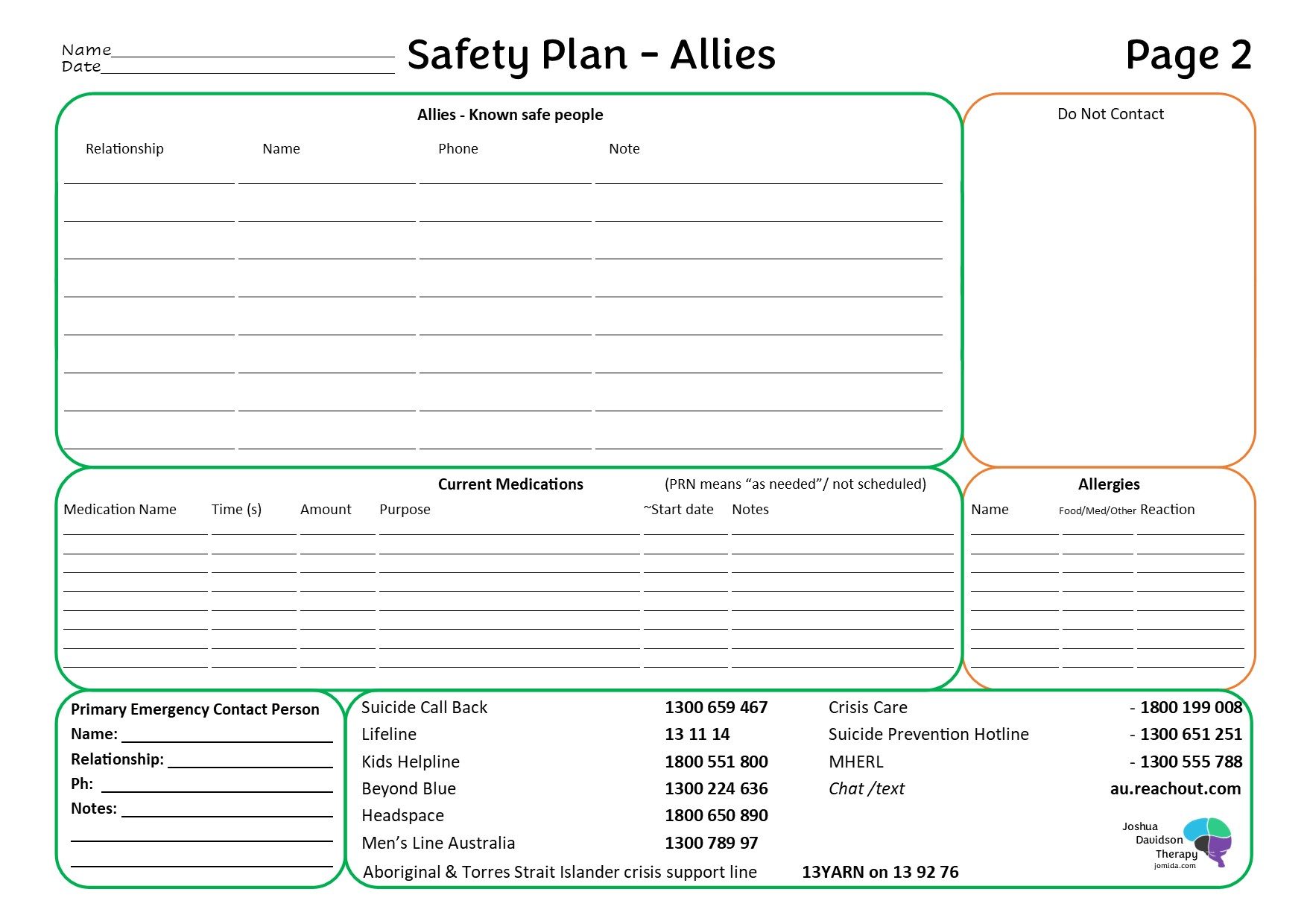
Listing Allies
Allies: Write down who your trusted allies are. These are people that are good at helping you when you are vulnerable, won’t take advantage of you, and know you well enough to advocate on your behalf. By noting their relationship to you, what they are good for helping you with, and what they might not be good for helping you with, you help yourself make better decisions when you aren’t thinking well, and you help to guide those who are assisting you.
Do Not Contact: On the right hand side, list who is not safe for you when you are vulnerable. It is also important to note who is not good for you and who you should avoid. You may list why, or it may be safer not to. Just the fact that they are in the “do not contact” list is enough. For people who are supporting you when you are not at your best, they need to understand that the “Do Not Contact” list is sacrosanct – they must obey the rules around that.
Once you are past the crisis and safe again, then you can consider what to do with people in the “Do Not Contact” list.
Medications and Allergies
Whenever you change your medication, it is important to update your medication list. Your Wellness and Safety Plan is a good place to do that, especially as if you do need to go to hospital or some other health service, you can bring it with you and then they’ll know what you are prescribed.
List the name of your medication, when you take it, how much you take and also list why you take that medication or any other important note about it.
If you are in hospital, then it is also wise to bring your list of allergies – if you have any. List what the allergy or intolerance is, and whether that is a medication, a food or something you may be in contact with. Also list what your known reaction to that is so that the medical staff can ensure you are kept safe.
Date Reveiwed
Providing a date on the document lets you know when you created this version and how old the document is.
If it is too old (perhaps 6 months), check through it and see if the details are still relevant.
All things change in time, and it is important that in a crisis this document is as accurate and useful as possible.
Dynamic Documents Need Review
After you have used this document to improve your health, it is important to make time to review how effective the document was. That use might be a crisis, or just a health check.
This is the dynamic aspect of the document.
What worked? Keep that.
What didn’t work? Modify that.
How would you do things better next time? Make the change, make a new date and try it again.
Beyond This:

Calming Down / Regainig Control
If you have accidentally triggered a fight/flight reaction, or are generally struggling, take a look at how to Calm Down.
This too shall pass – Waiting
Generally, identifying and addressing the list above should help out within about 30 minutes. If it isn’t, then delay things you need to do while you self care and give yourself a half day or so to recover from whatever unidentified thing is affecting you.
If this is uncomon, probably a virus; if common, find out why
If it is uncommon for you to field weird like this, then you are likely coming down with a viral infection. If this is common for you to go through, talk to your GP and get some investigations going to find out why.