To err is human, we all make mistakes, and from recognising those mistakes, we can grow and become better. Mild to moderate feelings of regret and guilt are social neurological mechanisms to encourage learning, which prompts us to grow individually, and thus improve social interaction, since working in cooperative groups is very good for humans. Becoming locked into ruminating on regret, wallowing in remorse and demonising ourselves with guilt is not at all helpful, and often indicates that something else is going on such as anxiety, hunger or an abusive relationship.
Fundamentals
Summary:
- Cooperative groups do better
- Humans evolved the emotional tools of regret and guilt to improve both ourselves and our group cooperation.
- We can have anxieties around how we are doing in a group, and that is often a sign that we have dealt with abusive people.
- Humble Theory is a good way to let go of that anxiety.
- Sometimes we need to recognise and manage abusive people.
- Abusive people don’t feel regret or guilt for their choices to be non-cooperative.
- Abusive people take advantage of reasonable people’s feelings of regret and guilt.
Regret and Guilt: Social Neurological Tools
Humans are individually weak compared to other similar animals. Most of our evolution took place prior to modern civilisation. From when we evolved from the common ancestor we shared with bonobos and chimps, we were not very effective at surviving on our own for long. Our claws and fangs are pretty poor, our physical strength is low, and our dexterity isn’t brilliant. On our own, we are simple food for predators. It is hard to fight off predators or run away when we they attack us in our sleep, and we need to sleep.
What made us good survivors was working in groups. With a group of people, someone can watch while the rest sleep, we can works as a group to hunt big dangerous animals, and we can work together to construct houses and other things. To do this well, we need to be cooperative, which relies on compassion, empathy and learning.
We evolved the social neuronal tools of regret to inform us that our plans failed and thus prompting us to learn from the failure; and guilt to inform us that harm was done as a result of the choices we made, and thus prompt us to reasonably amend, atone and recompense the harmed party. By learning from our mistakes, we do better both as individuals and also as members of the group.
It is fair that we expect that others learn from their mistakes, and on average they do. Unfortunately, there are some who have either an inability to connect their actions to bad outcomes, or the bad outcome was their goal. More about that below in Toxic People.
The fundamental idea of regret and guilt is to help us be better humans, both individually and communally.
Mistakes and Accidents
As stated earlier, to err is human. We all make mistakes as were are not born with perfect knowledge and skill – the only way to get good at something is to start off terrible and through learning from our mistakes, get better.
By definition, a mistake is an act or judgement that is misguided or wrong. That is, it is an accident. With the best intent, something went wrong and the outcome is bad. That bad outcome can include just inconvenience, or it may also include harm.
Making a mistake is not an indicator of fault in a person, it is an indicator of insufficient knowledge (ignorance), low resources (I know how to do it, I just can’t due to a lack of something else), or skill (my ability was not yet sufficient). All of these can be improved, so long as we can identify that we goal failed, and we can see where we can improve to get the goal you want.
A mistake is different from malice.
Malice is where someone intends a bad outcome.
Remember Hanlon’s Razor:
“Never attribute to malice that which is adequately explained by stupidity”
attributed to Robert J. Hanlon[Wikipedia Hanlon’s Razor]
Toxic People Only Regret Getting Caught
Toxic People only regret getting caught. People who do not regret making mistakes also do not feel remorse or guilt.
They only feel regret that they got caught knowingly doing things that hurt or inconvenience others when they didn’t have to.
They will use these words (regret, remorse, guilt etc) when necessary to decrease the perceived threat once caught and pushe d, but they are like a person blind from birth describing why the colours of the sunset make them feel happy – it fundamentally does not mean anything to them, it is just hollow words. They use words without real meaning to them, because they are words that have real meaning to you, and in that meaning to you, they aim to manipulate you into giving them another chance and get them out of trouble. These people are toxic/abusive, and we have an entire section dedicated to exploring them. For the rest of this, we are assuming that you can feel regret, and that in so doing, you strive for different outcomes.
Am I a Baddy?
Mind Exercise:
Review your past. How often have you weighed up two or more courses of action, and decided on the harmful one instead of the one which benefits everyone?
Most people who experience the regret emotion struggle to think of more than 5 times where they have knowingly made a decision to do what they think is the wrong thing at the time.
If you have learned from actions that you regret, then you are a good person who is learning and growing, not a malicious / bad / toxic / abusive person.
Anxiety
Often a driver of feeling too much regret or guilt is the fear that we are a bad person and meant malice, or that someone else will interpret our mistake as malice. This anxiousness is often driven by biology, but can also be due to cognitive errors. The biological aspects are covered in our Anxiety summary page. We will cover the three most common cognitive errors regarding anxiety and mistakes below.
- Comfort in our present choices
- Humble Theory
- Hindsight Bias
Comfort in Our Present Choices
When we make a decision, we generally weigh up different possible choices, and depending on the reasonable knowledge we have at the time, the reasonable resources that we can apply to the action, and the reasonable skills we have at the time, we try to choose the option that has the best outcome in the time we have available. Sometimes all the options we know about are bad, so we choose the least bad option.
“Reasonable” is doing a bit of heavy lifting there. We can always know a bit more about the choice, but doing that for every option becomes a major resource hog, which means you can’t do as much, and is often not needed. At some point in the research you do prior to making a decision, the additional knowledge doesn’t really change your mind about the thing, and it reduces the time you have before the action needs to be done in. If you take too long, you miss the time to act, so your choice becomes a default inaction, which while sometimes that can be good, it often isn’t. To be a bit pedantic here, to actively decide to do nothing is often a good choice in some situations such as conflict, but to default to no action is often not good.
For example, I could put all of my financial resources to the next decision, and that might get me a slightly better outcome. However, that will mean that my next choice has no resources, so the default for that become no action, and that is, on average, bad. Similarly, I could spend time learning new skills to give new options for this decision, but does that really help right now, and what risk to the timeline and thus default “no action”?
We often feel like we could have put more to a decision when it goes poorly. When you made the decision, you don’t know ahead of time that the choice you are making will have a bad outcome, or you didn’t have the resources at the time to do better even if you knew it was likely to go bad. If you apply 5% more to each decisions, you can make 25%-50% less actions (this is an estimate), and that is, on average, suboptimal. There are times, such as when medication has finished for the day, when it is wise to do less.
If only we knew at the time which decisions needed extra effort!
Here is a heuristic to guess which ones need more investment:
- The things we are less sure of
- The things that have gone wrong in the past
- The things that have a predictable significant serious outcome
The point of this is, trust that your past self made the best choice they could at the time.
Humble Theory
A strong driver for social anxiety is the fear of judgement and negative reactions from others. To avoid their deserved judgement, we often try to avoid the risk of making mistakes by people pleasing, perfectionism and task avoidance / procrastination.
Humble Theory is using the idea of being humble to counteract this fear. In owning our mistakes; in trying to interpret someone else’s statements about our real errors as their desire to help us to improve and learn; and being able to tell when someone abusive is misusing these social protocols to try to control us, we can let go of the anxiety of judgement.
We cover this in the full description of Beating Social Anxiety, Humble Theory.
The Hindsight Bias
Often, when things have gone wrong, we review our decisions and criticise our past self for not having the special knowledge that time has given us. We judge our ignorant past self as if they chose to have this bad outcome.
Time for another thought experiment.
Thought Experiment
Let us say that we are going to watch some sportsball. At the beginning of the match, we are going to lay down some hypothetical bets on the outcome of the match – who will win, and for bonus points, by how much and who will be the final person to get the final point.
At the end of the game, when we look at who won the bets, most people should have lost. Even so, many people will say something like “I knew it, I knew they were going to win, and I knew that X was going to get the final point! I just knew it!” If that were the case, why didn’t they put that down in their bet? They did no know. It was one of the things they thought might happen, but it had no higher apparent likelihood than several other possible outcomes. After the fact, where we know who won, by how much and who got the final point, our earlier speculation seems like a sure fire knowledge.
We can see it in hindsight, because we know the outcome now.
However, we didn’t know it before it happened.
When you catch yourself doing this, try to recall that while you may have been concerned that something might go wrong, you didn’t know this was going to be the outcome, otherwise you would have chosen a different set of actions to get a different better outcomes.
Don’t blame your past self for being ignorant of the knowledge you just learned.
We may also find we have more resources now than then, or have since learned new skills that we didn’t have previously. We can, similarly, use these new assets to blame our past selves for making the decision we did, as if we had that knowledge, resource or skill then – which we didn’t.
Be kind to your younger self, and trust that they made the best choice at the time.
Regret = Need to Learning
Regret is an emotional neurological tool to prompt us to cognitively recognise when actions don’t lead to positive outcomes. It prompts us to investigate what went wrong, and to hopefully figure out how to make it better.
If you have learned from the bad outcome, then the regret has done its job.
Lingering regret prompts us to recall the bad outcome and what we should do differently next time so that when that comes up, we try the new solution. That is how regret fosters growth.
Recognising A Bad Outcome
We don’t regret good outcomes. If you do regret a good outcome, then the odds are high that you have a toxic/abusive person in your life. We aren’t going into that here, but follow the link and learn more about how to recognise toxic people and how to deal with them.
Regret tells you that something went wrong between you making a plan and the outcome you got. If the outcome was “good enough”, just not what you planned, then while a small version of the next parts may help, you also may need to be careful about perfectionism.
Problematic Perfectionism Primer
- Perfect is an illusion. You can aim for it, but never achieve it.
- Don’t let perfect get in the way of good enough
- Progress, not perfection
- The closer to perfection you get, the higher the cost. What are you losing in chasing perfection? Are you willing to pay that cost?
Investigating Your Part
Regret should prompt you to review what your intention was versus the outcome you got. The purpose of this feeling is to recognise why the outcome was not good, and what our part was in the outcome reaching this bad outcome. That is, regret should prompt us to investigate how our plan got derailed and ended up with the bad outcome.
It may have been:
- Ignorance of some key knowledge that we now know means this outcome is likely.
- An inaction – something we should have done that we didn’t.
- Lack of skill – something we should get someone else to do, or learn how to do it better ourselves.
- Accident – an outside unpredictable influence that we can’t control.
If you compare this to when you made the decision, this is all knowledge. Regret isn’t a tool to beat up your younger self, it is a tool to prompt growth.
Making a Better Plan
Part of the review of the bad outcome is working out, know that you know it went bad and what went wrong, how you would change your plan to determine the point that you could know that the prior plan will fail and thus you need a better plan, and what that better plan is. Feel free to have a few variants.
If you can’t determine a way to tell that the plan would fail in real time, then you may be falling into the hindsight bias. If you can only know whether to use Plan A or Plan B after the results are in, then you aren’t responsible for trying to make the best out of an unpredictable situation. If there is a way to determine which plan to use, or when to switch plans part way through, then this is the skill that you have learned going forwards.
Guilt = Harm Happend
Guilt is a weird concept. Legally, to be found guilty means that you either wilfully intentionally harmed someone when you didn’t have to, or that through criminal negligence (turning a blind eye despite reasonable expectation) allowed harm to occur. That is, there is some level of intent of harm due to malice.
Recall that earlier in Comfort in Our Present Choices we established that the vast majority of your choices, you made the best decision you could at the time to get a good outcome, or when there are no good choices, the least bad outcome. That means that you did not intentionally mean for harm to occur, nor were you wilfully negligent in preventing harm. If you had planned for malice, you’d specifically recall doing so.
If you did not intend malice, why do you feel guilty?
Because someone got hurt.
Either directly physically, or indirectly through loss of a resource (time, money, asset). The feeling of guilt is a neurological emotional tool that we use to prompt us to check if our decision and action led to the harm, and if we should do something to compensate for the adverse outcome of our choices, even though they were mistakes / an accident.
This is part of how the mechanism for cooperative social dynamics with humans.
Cooperative social dynamics is reciprocal. That is, it is expected the I will feel guilt for the harm that my decision and actions / inactions caused another, prompting me to do something reasonable about that harm; and it is fair that I expect someone else whose decisions and actions / inactions led to my harm doing something reasonable about the harm I received.
There are some who do not reciprocate these, and that is a red flag that may indicate the person is toxic / abusive. There are also those who falsely claim harm, or overblow the harm they may have experienced to hijack this cooperative social dynamic heuristic.
Making Amends
Amends is an effort to compensate for the unfortunate unforseen or uncontrolled consequences of decisions. Remember, you didn’t make the decision maliciously.
Making Amends Heuristic
If someone claims harm:
- Offer sympathy while you investigate to see if you are responsible / partly responsible
- Review your actions and recall what you have done.
- Ask them to explain to you how they got harmed.
- If their explanation mostly lines up with what you know happened, own it and make fair amends (below).
- If their explanation does not line up with what you know happened, investigate third party witnesses in case this is due to a hallucination, false claims, or your ignorance. If their claims are supported, own it and make amends (below). If not, red flag.
- If your choices did reasonably lead to harm:
- Work out internally what would be fair amends if the positions were reversed (factoring in privilege).
- Ask them what they would like to help out.
- Compare what they ask for to what you have estimated:
- If it is greater than 2 times then say “no”
- If it is unfeasible, apologise that you can’t help, but you do sympathise.
- Offer to make amends (if all has gone well so far)
- If they refuse, then the matter is ended. You offered, they refused a reasonable amends.
- If they accept, then do it.
- If a person tries to hold you accountable for the harm later:
- If you offered amends and they refused, then this is a red flag.
- If you did the reasonable and agreed upon actions, then this is a red flag.
- If they ask for more compensation, then this is a red flag.
Weirdness Behind Guilt
Decent, reasonable people often feel guilt for the bad outcomes of mistakes and accidents. Our brains try to check if our actions may have been a part of the harm, and in so doing, we often consider that we knowing caused the harm. With the Hindsight Bias (covered above), we mistakenly think that we knew that would be the result, even though it was only a possibility. This leads us to feel guilty, that is, responsible. That is what prompts us to do something about our community member who has been harmed.
Referring back to the legal interpretation of guilt, decent people who make honest decisions that accidentally cause harm feel guilty, but they don’t deserve to per se, because they are not guilty of mallicious intent.
Abusive and Toxic People who do maliciously intend harm to people (eg NPD) do not feel guilt for their actions. We covered above that they also don’t feel regret.
The irony here is, the people who are legally guilty (malicious intent) of harm don’t feel guilt, while those who aren’t legally guilty (mistake, accident) do feel guilt.
The benefit of this is that if you are feeling regrets and guilt, then at least you know you aren’t an abusive / toxic person – so long as you learn from the experience and do better.
Summary: Growth and Learning
If you have regret or guilt over an action you did due to the choices you made, and it was a poor outcome:
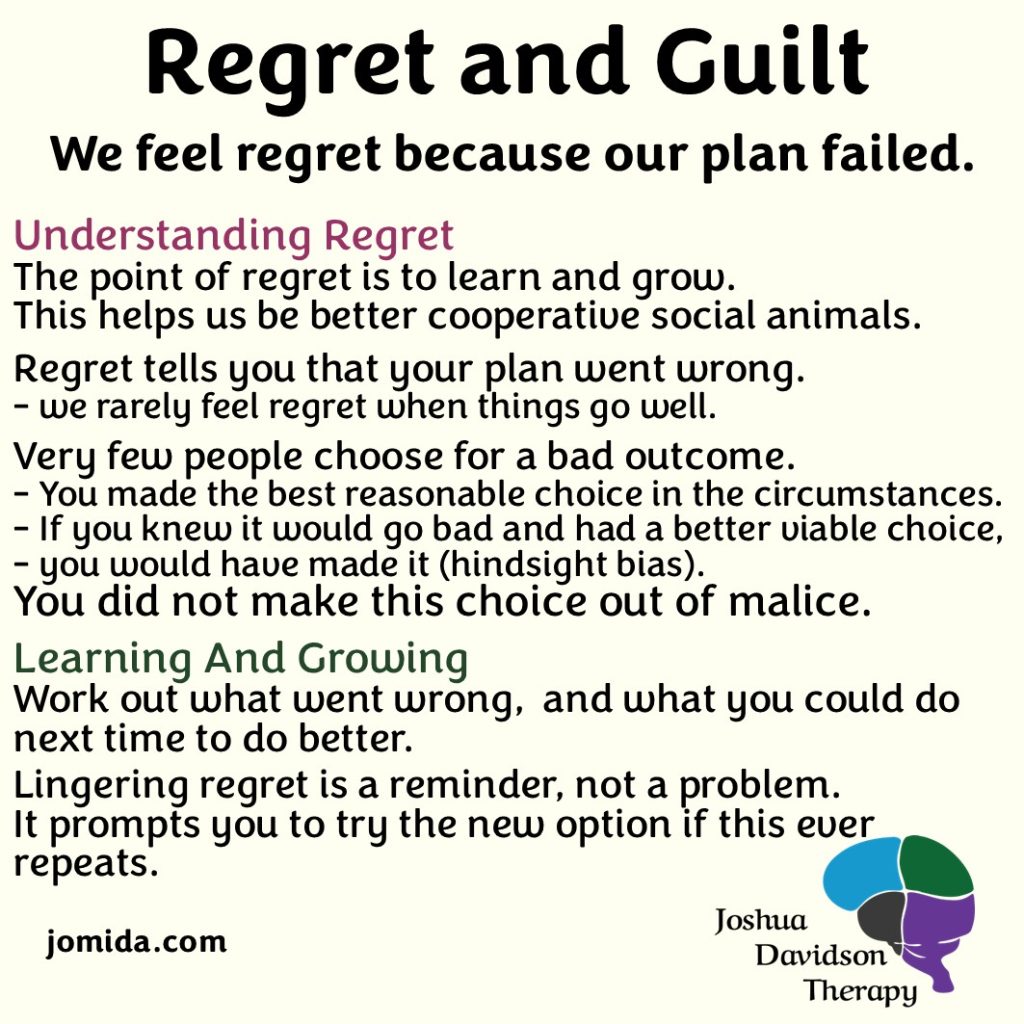
- The point of regret is to learn and grow. The point of guilt it to identify responsibility for harm and do something about it.
- Regret tells you something went wrong, that is, you made a choice and there were bad consequences.
- Remember that you made the best choice you could in the circumstances.
- You did not make this choice out of malice.
- Work out what went wrong, and what you could do next time to do better.
- Beware of the hindsight bias, where you think you knew then what you’ve just learned now.
- If you knew it would go like this, and you were confidence you could get a better outcome through another reasonable choice, you’d have done that instead.
- Lingering is a reminder, not a problem.
- Linger regret reminds you to try the new option if this ever repeats.
- Remember that you made the best choice you could in the circumstances.
- Guilt tells you someone got hurt as a result of your choices.
- Work through the regret section above first.
- If someone was harmed:
- Check that they were harmed, and that the mechanism of their harm was reasonably connected to you.
- Own your part of the outcome.
- Offer reasonable amends, and if accepted, do it.
- Check that they were harmed, and that the mechanism of their harm was reasonably connected to you.
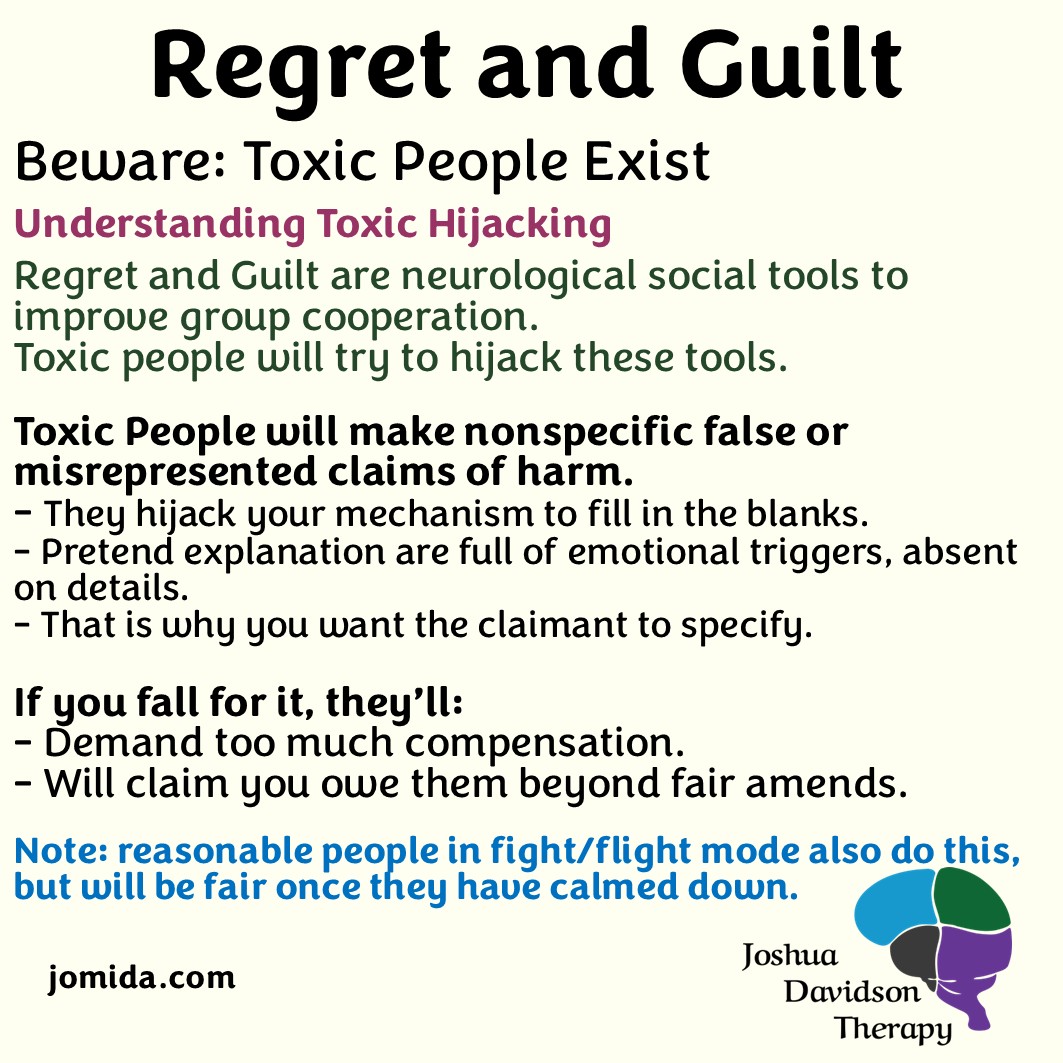
- Toxic people exist:
- Toxic people will make false claims, misrepresent the harm or misrepresent how it is connected to your choice.
- Toxic people will try to take advantage of you and:
- Demand too much compensation.
- Will keep asking for it even after reasonable recompense has been met.
- Will state you owe them even though they have refused a reasonable offer.
- Toxic people will not accept reasonable evidence, reason, or logic, preferring their emotional justification.
- Warning: people who are still in fight / flight mode will do this too, but will be fair once they have calmed down.
- Too much Feels:
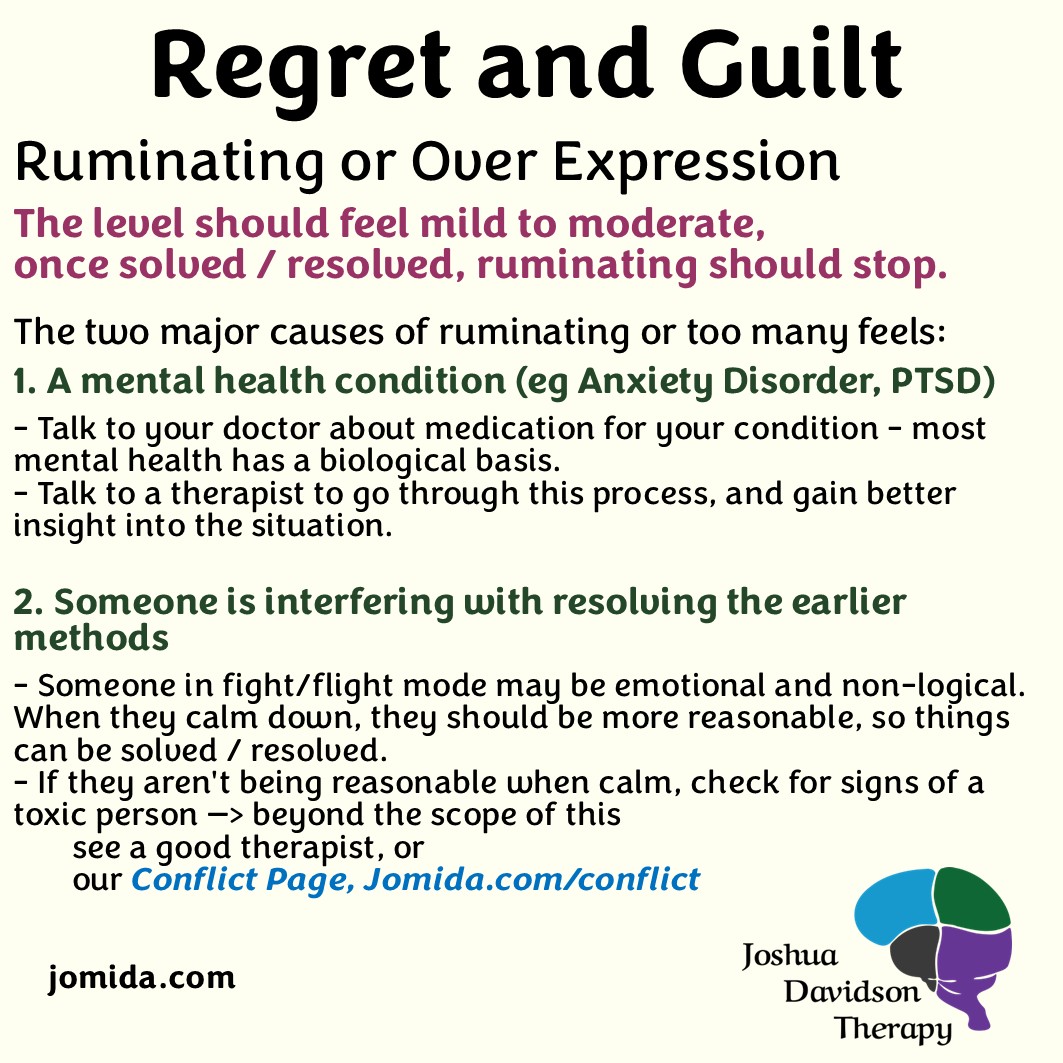
- If you are feeling too much regret or guilt (above moderate) despite the steps above:
- Do you have another condition that is interfering with processing this (such as Anxiety Disorder)?
- Talk to your doctor about medication for your condition – most mental health has a biological basis.
- Talk to a therapist to go through this process, and gain better insight into the situation.
- Are you dealing with someone currently in fight / flight mode, or someone toxic?
- Fight / flight mode takes some time to calm down, then try being reasonable at them again.
- If they aren’t being reasonable later, check for signs that they are a toxic person.
- Do you have another condition that is interfering with processing this (such as Anxiety Disorder)?
- If you are feeling too much regret or guilt (above moderate) despite the steps above: