- The second batch of ADHD GPs have been released
- AND we have the list (click on ‘Who and where are they‘ in Quick Contents to jump straight there).
- Regular GPs can now issue repeat ADHD Scripts
- For up to 3 years, without the review of an ADHD Psychiatrist, ADHD Paediatrician or ADHD GP
- Interstate ADHD Diagnosis is now accepted in Western Australia
- Interstate ADHD Scripts are now accepted in Western Australia
Purpose
- Regular GPs writing ADHD Scripts:
- The purpose of this page is to make it easier for GPs and patients to find the details and understand what this all means. This is about GPs being able to repeat scripts made by a psychiatrist or paediatrician in the recent past – specific details are below.
- ADHD GPs:
- Understanding why some GPs can now diagnose and treat ADHD without a ADHD Paediatrician or ADHD Psychiatrist.
- Interstate:
- Summarise that interstate ADHD Diagnosis and ADHD Medication Scripts are now accepted in WA.
Regular GPs can repeat an ADHD script
Summary of Inclusion / Eligibility
- If you are continuing an existing medication at the same dose,
- And the patient doesn’t have a few specific other conditions such as:
- Bipolar,
- Psychosis,
- Substance abuse,
- The Patient isn’t also prescribed opioid pain medications,
- The medication is one or more of:
- Dexamfetamine (‘Dex’) .
- Methylphenidate (Ritalin).
- Lisdexamfetamine (Vyvanse).
- The medication has been reviewed by a specialist (psychiatrist or paediatrician):
- Adults 18+, within the last 3 years
- Minors
- Within the last 12 months if the case is complex,
- Within the last 3 years if the case is simple (not defined well).
See the summaries below for more information.
Is it really that simple?
Mostly yes.
There are some specific cases where it is more complex.
The new Monitored Medicines Prescribing Code is 51 pages. The summary above is a rough guide to the most common circumstances. Snippet summaries are provided in the next section to help find likely information quickly.
How does the GP do this?
Quick How To information for GPs
- Direct your GP to the following Summary of Changes if they haven’t been made aware of them.
- Your GP likely also needs to review the full criteria to check you are eligible, including checking for any restrictions listed on ScriptCheckWA.
- Summary versions of this are provided below for your convenience.
- Your GP can then prescribe continuing stimulant medication of the same type and dose without further authorisation.
- Co-scripter is no longer needed. Prior to October 2024, a GP could only continue a script with the explicit written permission and agreement from the relevant specialist (psychiatrist or paediatrician).

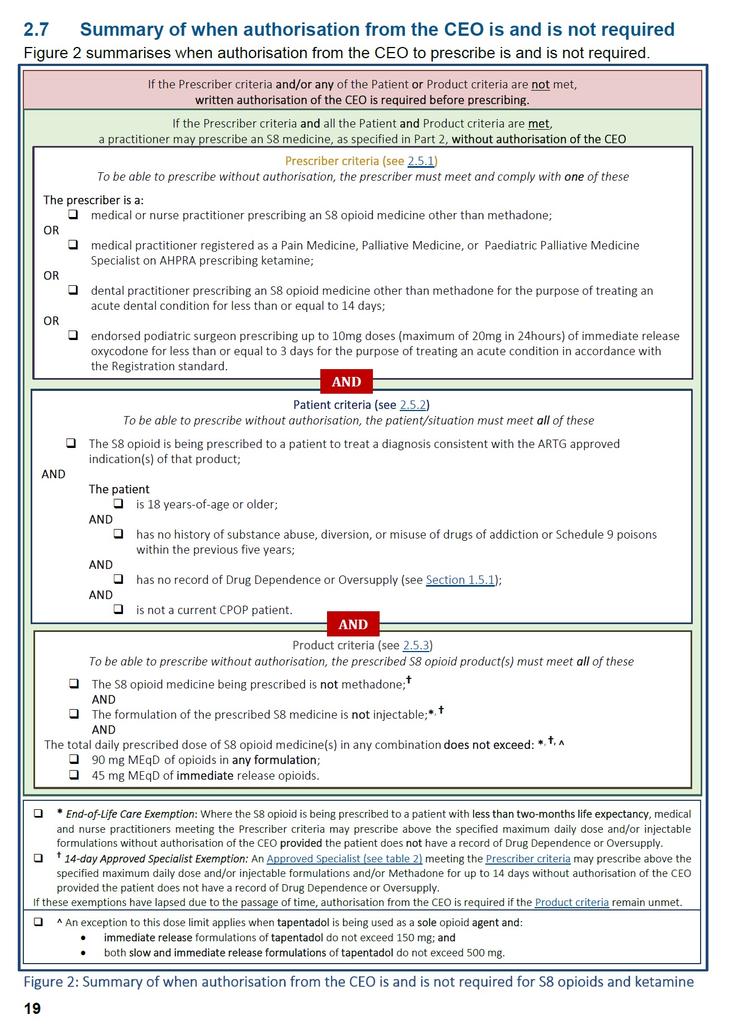
Summary for when Authorisation IS and IS NOT Required
Adult Summary
- For people over 18 years of age,
- If no drug history of (last 5 years)
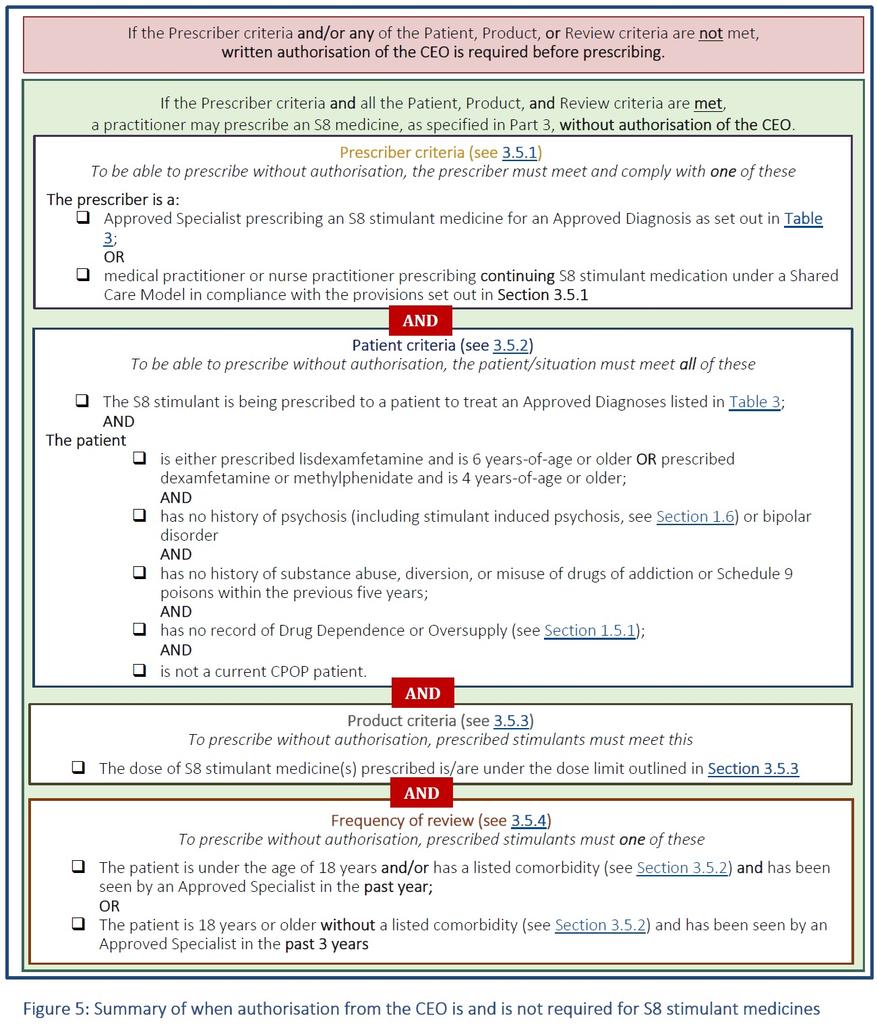
[Source for below graphics Monitored Medicines Prescribing Code, December 2024 ]
Click to see graphic summary:
Youth
- If the case is simple, you can prescribe for up to 3 years without a review.
- If the case is complex, then they must be reviewed annually by the relevant specialist.
Click to see graphic summary:
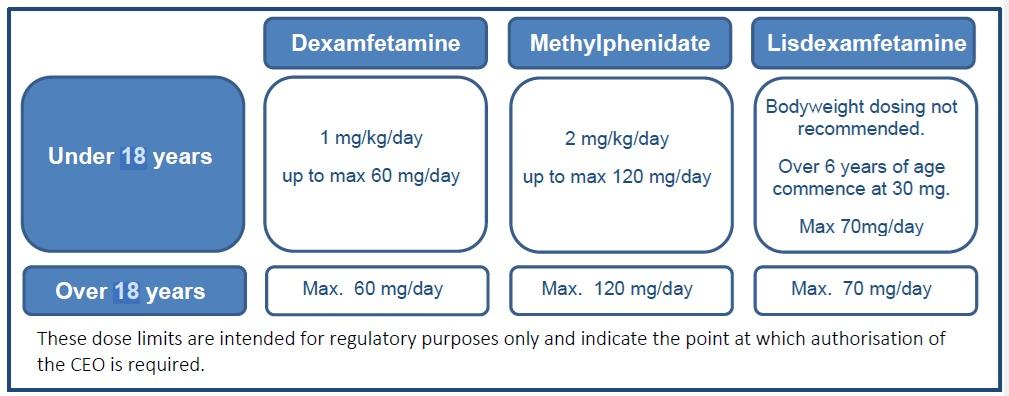
Dosing Guide
FAQ
Q: Will this Cause Problems with my Psychiatrist / Paediatrician?
A: If you are actively seeing a psychiatrist (or paediatrician) for your ADHD, then they might discharge you if they do not see you often enough.
- Most psychiatrists and paediatricians like to check in once per 6 months, to ensure that there is no significant change or problem.
- This is also how long an ADHD superscript (repeat script) lasts.
- If the gap is too large since your last visit (generally more than 1 year)
- Book well in advance:
- Prepare for your appointment to be delayed.
- May be delayed as you may be treated as a new patient rather than an ongoing patient.
- You may need to find a new psychiatrist or paediatrician if they are full.
- Prepare for your appointment to be delayed.
- It is likely more expensive than usual.
- Your psychiatrist (or paediatrician) is likely to do a full assessment (45 minutes consultation / session), so it is likely to be more expensive than usual.
- The assessment should not be the cost of a diagnosis.
- This helps ensure that nothing significant has changed in the last few years, or if they have, what to do about it.
- Book well in advance:
- Pro Tip:
- If your last script has elapsed and you don’t yet have an appointment with your current psychiatrist / paediatrician, this new system is excellent for you to see GP for a single repeat script.
- Pro Tip:
- Note: If you are between psychiatrist / paediatrician
- You may be between psychiatrists, transitioning from one to another. Finding a new psychiatrist can take time, which can often leave us vulnerable when it comes to ensuring good maintenance of medications. In this circumstance, seeing your GP for repeat scripts is excellent.
Q: When is this a Bad Idea?
A: There are a few reasons why it might be a bad idea. We have listed a few to consider:
- Meds Change:
- The last medications from your psychiatrist / paediatrician are not working well for you.
- The GP can’t vary the script.
- Time Limit:
- If it the time required for a review has elapsed.
- Generally 3 years, or 1 year of complex youth.
- Poor GP relationship:
- If your relationship with your GP is not good:
- If this is a new GP, they may not feel confident to do this.
- If your GP is not supportive of your mental health and ADHD diagnosis.
ADHD GPs: Diagnosing and Treating
History: Why this is happening
Click to expand for the full history.
As part of fulfilling the Labor Party’s 2025 election promise, GPs can now enrol into training to diagnose and treat ADHD. The first batch are expected to be ready to work with ADHD in early 2026 (RACGP) with at least one more batch of GPs being ready mid year.
- The first batch is 15 doctors.
- The second batch is 50 doctors.
The WA Labor Party are fulfilling their election promise to allow GPs to diagnosed and prescribe medications for ADHD. To do this, GPs need to enroll in to relevant training and get approval to diagnose and prescribe medications for ADHD. The first batch of doctors began around March 2026 and the second batch began mid August 2026.
Is this a good thing?
Here is my opinion. TLDR: Yes.
GPs are General Practitioners, which means they are generalists, not specialists. GPs can diagnosed and treat many common conditions that don’t involve specialist complexity. When a GP recognises a condition or category of condition that requires a professional who specialises in that condition, they should refer you to that specialist. Traditionally, this is what happens with ADHD. Consider, though, that ADHD is considered to be present in 5% of the population (according to the ABS), which is more common than red hair, and more common than blue eyes. Dr Karl Kruszelnicki says “any condition that is more than 1% of the population is considered common”.
ADHD Medications are categorised as restricted – that is, scheduled medications. Scheduled medications are classified this way because they are either very deadly if handled slightly inaccurately, but mostly due to the risk of addiction. ADHD medications do run the risk of being a bit addictive. ADHD medications at scripted levels are not biologically addictive. People can mistake the ADHDer now becoming functional and wanting to stay functional and thus insisting that they need their medication to live instead of exist as an addiction. If you compare ADHD medication to glasses, you may be able to understand this difference. Imagine if the government banned glasses – you can’t wear them, sell them or buy them. Not having glasses won’t kill you, and most people will be fine without using glasses. There are many people that become functionally disabled if you stop them from being able to use their ability aids – the glasses. If you ban ADHD medication from ADHDers, some may manage with difficulty, many will become functionally disabled.
A counter to the scheduled medication issue is that GPs often prescribe scheduled medications for patients who have been diagnosed by a specialist – why not for ADHD? GPs can prescribe amphetamines for a number of conditions, just not for ADHD. Once client I saw was diagnosed by the sleep clinic with narcolepsy. He responded positively to around 30 mg of dex daily. Once that was established, his GP took over managing his medication with no end point or review scheduled by the sleep clinic. Daily 30 mg of dex is a common dose for managing ADHD. This shows that it isn’t about the medication itself – it is about discriminating against ADHD.
A WA ADHD psychiatrist I talked to about this shared with me his concerns. He said that ADHD is a complex condition that often requires nuance to treat well and he fears that this is beyond the time available for many GPs and their knowledge. I said that people who have relatively simple to diagnosed and treat ADHD could see the GP and the more complex cases can be referred to ADHD psychiatrists, to which he responded to me (a therapists who specialises in ADHD) “how many ADHDers do you know that are relatively simple?” – fair point, not many. But then again, I specialise in complex cases, so my sample is likely to be biased.
Some counterpoints.
- Once an ADHDer has a stable dose, they don’t need that specialist level intervention. Most stable ADHDers only see their psychiatrist for 10 minutes every 6 months to get a new script. Surely a GP can do this, and for much cheaper.
- Many ADHDers present fairly typically and a GP can diagnose this just as easily as an ADHD Psychiatrist, but for much cheaper.
- Many newly diagnosed ADHDers respond positively to the common ADHD medications without serious complication, and surely the GP can do this too.
In Summary:
There is no good reason why GPs couldn’t diagnosed and treat relatively straight forward ADHD, or continue to treat stable ADHD, much like how they manage other common conditions that you can be referred to a specialist for, such as reproductive system (gynaecology for example). If the GP feels that the presentation requires a specialist, then they can refer that person to the ADHD Psychiatrist for specialist help, or if you have good reason to think you have ADHD but your GP isn’t specialised enough to recognise this, you can ask for a referral to an ADHD Psychiatrist who can then diagnosed your a-typical presentation.
ADHD GP Diagnosis Cost
TLDR: We don’t know.
We are guessing between $200-$800 out of pocket with a Medicare rebate helping afterwards.
ADHD Diagnosis Structure
A proper ADHD diagnosis should be done over 2 sessions of approximately 45 minutes.
- The first session is confirming that you have suitable ADHD traits currently, and if an adult, that you also had suitable traits as a child
- Adult traits can be different to child traits.
- Generally, some pathology is done to ensure you are not taking illicit substances.
- This is despite the Federal Guidelines for ADHD recommending that he best way to treat Substance Use Disorder for people that test positive for ADHD is to give them ADHD medication, so that they can cease the self-medication.
- The second session is to discuss and prescribe medication.
- What you will take, how to take it and what to watch out for.
Private: The Gap Fee
Many doctors are charging a gap fee for their service.
The current estimate is around $200-$800 out of pocket with a portion of that being rebated to you via Medicare.
Keep in mind:
- the average ADHD Psychiatrist charges $1500-$2000 for the assessment and prescription sessions.
- the average private ADHD Paediatrician charges $1500-$2500 for the assessment and prescription sessions.
$200 – $800 kind of seems like a bargain now.
Bulk Bill: Possible, not expected
Will ADHD GPs bulk bill?
It is possible that these sessions can be bulk billed, if the doctor is a bulk billing doctor – but that is not required, and doctors are likely to be charging you a gap fee – call the doctor (clinic) you would like to see and find out what they will charge you.
Who and where are they?
Perth Metro
| Name | Notes | Practice | Phone | Address |
| Dr Amr Diab | Jupiter Health Lakelands | (08) 6169 3900 | Shop 18/49 Banksiadale Gate, Lakelands WA 6180 | |
| Dr Andrew Leech | The Garden Family Medical Centre | (08) 6186 7992 | Unit 9/170 Murdoch Dr, Murdoch WA 6150 | |
| Dr Ashwini Baskaran | Applecross Medical Group | (08) 9364 6444 | 764 Canning Hwy, Applecross WA 6153 | |
| Dr Cassandra Collyer | Paeds Plus Currambine | (08) 6388 4422 | 13 Hobsons Gate, Currambine WA 6028 | |
| Dr Christabel Samy | Samy Medical Practice | (08) 9557 2600 | 6a/280 Bannister Rd, Canning Vale WA 6155 | |
| Dr Christabel Samy | Samy Medical Practice | (08) 9557 2600 | 17 Attwood Way, Rockingham WA 6168 | |
| Dr Claus Bloecker | Ranford Medical Centre | (08) 9456 0800 | Ranford Rd &, 214 Campbell Rd, Canning Vale WA 6155 | |
| Dr Eboney Staker | North Street Medical Centre | (08) 9274 2456 | 40 Great Northern Hwy, Midland WA 6056 | |
| Dr Hochee Wong | Aboriginal and Torres Strait Islander People only | Derbarl Yerrigan Health Service | 1800 311 888 | 156 Wittenoom St, East Perth WA 6004 |
| Dr Jaw Lee | Aubin Grove Medical Centre | (08) 9499 4099 | Unit 2/370 Lyon Rd, Aubin Grove WA 6164 | |
| Dr Lewis Mackinnon | Skye Medical | (08) 9399 5311 | 11 Prospect Rd, Armadale WA 6112 | |
| Dr Mark Mellor | Butler Family Practice | (08) 9563 1480 | Central, Shop 2/150 Camborne Pkwy, Butler WA 6036 | |
| Dr Michael Gendy | Jupiter Health Beechboro | (08) 9378 9111 | 11/161 Amazon Dr, Beechboro WA 6063 | |
| Dr Michael Patton | Perth Home GP | 1300 815 321 | Perth metropolitan area | |
| Dr Rafal Francikiewicz | Bullsbrook Medical Centre | (08) 9543 1800 | 4/2529 Great Northern Hwy, Bullsbrook WA 6084 | |
| Dr Robert Allen | St John Medical Joondalup | (08) 9400 7000 | 21 Joondalup Dr, Edgewater WA 6027 | |
| Dr Sarah Devereux | Services for children and adolescents only | Peads Plus | (08) 6388 4422 | 13 Hobsons Gate, Currambine WA 6028 |
| Dr Sean Stevens | Grove Medical Cockburn | (08) 6285 8190 | 798 N Lake Rd, Cockburn Central WA 6164 | |
| Dr Stuart Arbuckle | Located in the village | The Village Medical Practice | (08) 6285 0999 | 35 Wright Rd, Harrisdale WA 6112 |
| Dr Toni Law | Services for patients aged 10-25 years only | Glen Forrest Medical Practice | (08) 9298 8555 | 4 Hardey Rd, Glen Forrest WA 6071 |
| Dr Updesh Dhillon | Kingsley Family Practice | (08) 9342 0471 | 3/116 Cockman Rd, Greenwood WA 6024 |
Rural
| Name | Notes | Practice | Phone | Address |
| Dr Ajit Chaurasia | Wongan Hills Medical Centre | (08) 9671 1000 | 35/37 Mitchell St, Wongan Hills WA 6603 | |
| Dr Atif Khan | Forrest Family Practice | (08) 9711 1500 | 122 Spencer St, Bunbury WA 6230 | |
| Dr Bruno Kalu | Wheatbelt Health Network | (08) 9621 4444 | 25 Holtfreter Avenue, Northam WA 6401 | |
| Dr Callum Peet | Margaret River Medical Centre | (08) 9757 2733 | 148 Bussell Hwy, Margaret River WA 6285 | |
| Dr Chung Tan | Derby GP Clinic | (08) 9193 3263 | Clarendon St, Derby WA 6728 | |
| Dr David Tadj | Pioneer Health | (08) 9842 2822 | 2 Pioneer Rd, Centennial Park, Albany, WA 6330 | |
| Dr Emma Marshall | Dynamic Doctors | (08) 9535 3244 | 55 Murdoch Dr, Greenfields WA 6210 | |
| Dr Kayla Mizzi | Praxis Medical | (08) 9772 1108 | 122 Giblett St, Manjimup WA 6258 | |
| Dr Mohamed Almarzooqi | Plaza Medical Centre Kalgoorlie | (08) 9021 3988 | 335 Hannan St, Kalgoorlie WA 6430 | |
| Dr Muhammad Ahmed | Iluka Medical Centre | (08) 6119 4700 | Plaza Shopping Centre, 1st Floor/98 O’Mara Blvd, Iluka WA 6028 | |
| Dr Olatoye Lotsu | Three Springs Medical Centre | (08) 9557 2600 | 12 Thomas St, Three Springs WA 6519 | |
| Dr Olufemi Onikola | Dalwallinu Medical Centre | (08) 9661 1203 | 19 Myers St, Dalwallinu WA 6609 | |
| Dr Ruth Campbell | Health by Nurture | (08) 9778 0052 | 7E Homemaker Centre, 42 Strickland St, Bunbury WA 6230 | |
| Dr Stephanie Choularton | Sunshine Medical Centre | (08) 9751 4500 | 198 Bussell Hwy, Busselton WA 6280 |
[Source]
Interstate Diagnosis and Scripts
Previous to the October 2024 update, if you were diagnosed interstate for your ADHD, or you had an ADHD medication script for your ADHD medication, they were not considered valid in Western Australia.
The recent changes included in October 2024 update allow scripts for stimulant medications issued via telehealth or from other states of Australia to be accepted by WA pharmacists, and for an ADHD Diagnosis from intersrate to be considered valid in Western Australia.
This brings in some interesting options.
Interstate Online Diagnosis – Fast tracking
If you’ve been struggling to get an appointment for an ADHD diagnosis, you can now check for online Australian ADHD psychiatrists who may be more available.
Waitlists for ADHD diagnosis by psychiatrists and paediatricians have been exceeding 9-12 months.
- These changes are made to hopefully free up a lot of appointments and cut those waiting times.
- Call your specialist in a few weeks and see if you can get an earlier appointment.
- Ask if you can be put on to the cancellation list (where someone cancels and they’d like to fill that appointment with someone else).
- Or try one of the newer national telehealth providers.
As with any provider, make sure they have the correct registrations to diagnose and to prescribe medication.
- There are some companies that will charge you a great deal of money and take months of time to assess that you should indeed go and get a formal diagnosis and medication.
- To call this a scam is a strong word, but it isn’t very honest if they haven’t made it clear that they cannot prescribe medications on a positive assessment / diagnosis.
- To check
- See if the website does not make it clear that the diagnosis is made by a relevant paediatrician or psychiatrist
- If the website of the company does not make it clear that this is true, then email them and ask them specifically:
If under 18 years of age:
“Is my assessment made by a relavently qualified paediatrician who can prescribe ADHD stimulant medication?”
If over 18 years of age:
“Is my assessment made by a relavently qualified psychiatrist who can prescribe ADHD stimulant medication?”
- A psychiatrist is a specialist medical doctor who prescribes psychiatric medication.
- They do the formal diagnosis
- They write scripts for medication treatment
- A psychologist is a talking therapist.
- They may do some diagnoses, but not of ADHD
- They don’t generally write scripts
- They do the talking therapy (CBT, DBT etc)