Trauma is a term that is often very misunderstood in Mental Health. While PTSD (Post Traumatic Stress Disorder) is a serious condition, far too many people misdiagnose PTSD when in reality the situation was merely uncomfortable, regretful, confusing or better attributed to another condition rather than trauma. Trauma is often uttered as an explanation for odd cognition or behaviours, without either an investigation of whether a traumatic experience truly is the source of these thoughts or behaviours, or any attempt being made to do something about the cognition or behaviours.
You may also be interested in
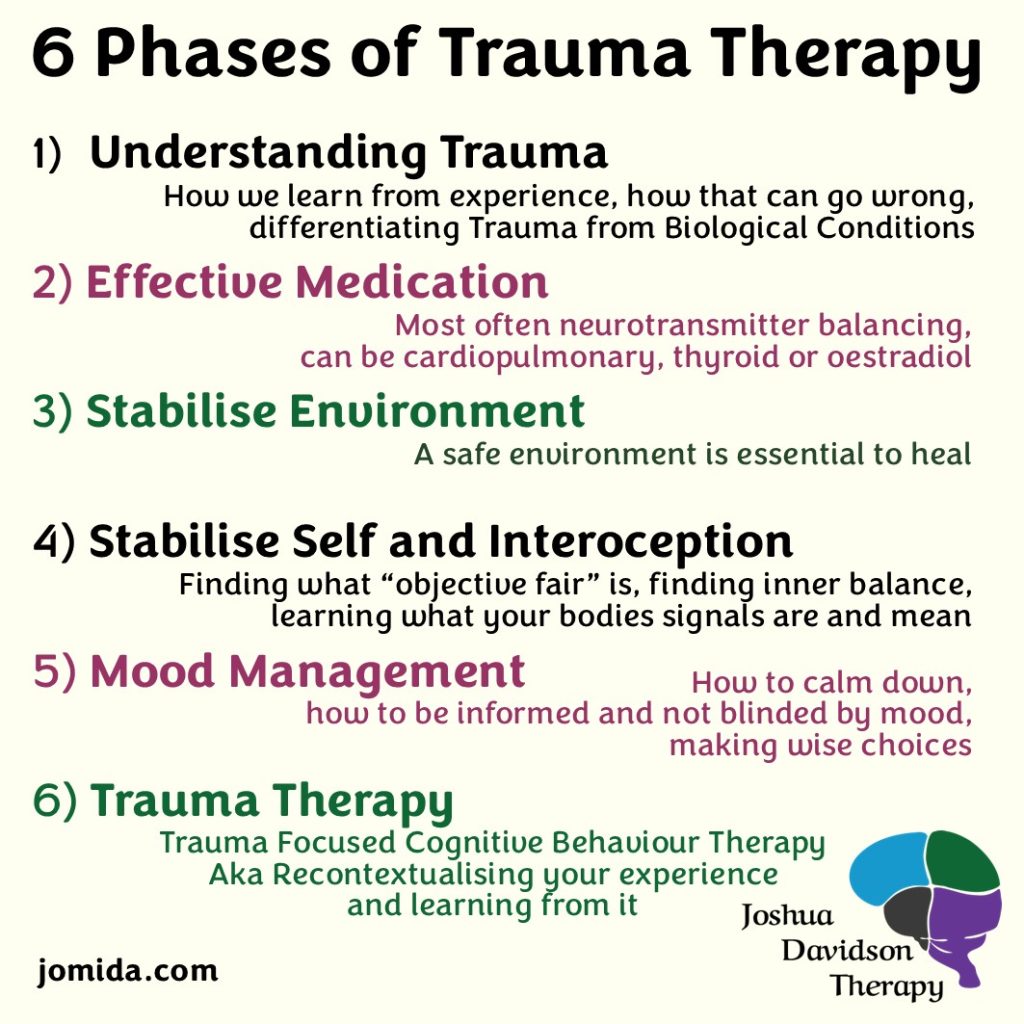

Phase 1 – Understanding Trauma
Phase 1 is understanding what Trauma is, and more importantly, what it isn’t.
Trauma is a medical term that refers to the damage left after an incident has occurred. A doctor might describe that their patient has “a rupture caused by blunt force trauma”, where “blunt force” is the cause of the “trauma”, and the “rupture” is the damage to the body from that blunt force trauma aka damage. Body trauma can have a range of consequences, from short term to long term. Most trauma will heal in a short amount of time, often tracelessly. Sometimes there are some signs of healed damage that linger such as a scar – importantly, this minor does not cause any serious long term consequences. Sometimes the consequences of the traumatic incident affect a person for the remainder of their life, some in minor ways and some profound.
We are not just physical beings.
A traumatic incident that affects our bodies can also affect our minds, both the hardware of the brain and the wetware of the thoughts and behaviours we exhibit. This can be brief, such as a minor burn to your hand on some cooking equipment prompting you to be cautious of how hot the kitchen ware is; moderate such as a romantic break up prompting you to grieve, or long term which can lead to PTSD.
PTSD is an initialism for Post Traumatic Stress Disorder. Initially PTSD was known by other names, such as shell shock, or post war syndrome. This origin leads many people to erroneously think PTSD is only about war, however it is also applies to any person who is having a range of specific ongoing consequences 4 weeks or more after an incident that they define as strongly traumatic. These consequences are often nightmares, over reaction to certain related triggers and reminiscing on the event. It is important to understand that other things can cause these same symptoms, which can lead to a misdiagnosis.
Even if your experience isn’t technically PTSD, some experiences can be very unsettling. We can experience lesser traumatic events, which can be a single incident or a series of linked or semi-linked events. Talking to a therapist can be helpful to understand what has occurred, what was fair, what is within the range of “normal” (even if it is unusual), and how to adjust to that and similar situations. Ideally you will exit the therapy with a greater understanding of the incident, some positive changes you can make from something that was likely out of your control, and a useful plan for if such a thing were to happen again.
It is important to note that the above is important if the behaviours and stress are only due to the incident identified as traumatising (little t). I would estimate that upon proper investigation, around 80-90% of the people that come to see me for their Trauma (big T) discover that their behaviours and distress (most often anxiety) pre-date the incident/event identified.
“If all you have is a hammer, everything looks like a nail”, attributed to Abraham Maslow
Too often people and therapists decide that this series of behaviours must be a trauma based response. When I point out that the behaviours in question existed prior to that trauma event, they go looking for another trauma to heal, even going as far as “repressed memories” and “early childhood trauma”. We have excellent evidence where people suffering from clinically diagnosed and in-the-process of being treated for PTSD have had an accident that has caused a retrograde amnesia (loss of memory) that includes the traumatic events. These people have stopped experiencing the PTSD symptoms and no further treatment for PTSD was needed. What we have learned from this is, if you can’t remember the incident, you aren’t traumatised by it (ongoing psychological effects from the incident).
This does not give you leave to go out and try to get amnesia! 😉
In the cases where the problems that have brought a client to therapy predate the hypothetical incident, and no actual triggering traumatic event appears to be a starting point to the symptoms, we need to consider that we are dealing with a mental health or neurodivergent situation and shift gears to deal with that instead.
If your symptoms predate the trauma incident, then those traits aren’t PTSD.
It is time to Put the Hammer Down.
Not everything is trauma.
Where the situation is either clearly (or ambiguous) Trauma related, we need to look at Trauma Therapy.
The gold standard for Trauma Therapy is a modified Cognitive Behaviour Therapy – Trauma CBT (sometimes tCBT, or TF-CBT [Trauma Focused CBT]). This should be in conjunction with other therapies for a holistic treatment plan. Specifically, a medical expert who can prescribe relevant medications, the therapist performing the Trauma Therapy on the backbone of CBT, other therapies to help target specific maladapted behaviours and or neurodivergent traits that are uncovered, potentially a relationship counsellor, domestic violence counsellor, home support and so on depending on what may be de-stabilising the client. In my case, I do all of the bits listed after the medication and I’m not shy about making recommendations for which medications types I think are most likely to help, which is often useful as many doctors are not well versed in which medications actually help PTSD (often not SSRI).
Phase 2 – Medication, mostly balancing Neurotransmitters
Many of my clients come to me either self medicating (aka substance misuse), on the wrong medication (for their symptoms) or using no medication. While not all people require medication, most do – either short term or long term.
It is rare for someone who is affected by a traumatic event and needing Trauma Therapy to not have co-occurring biological issues. Often much of their current struggle is an exacerbation of lifelong conditions, often undiagnosed. It is hard to think clearly and behave as you want when your brain is misfiring, and hard to know what to do if your brain is misinforming you, and or pushing you towards certain behaviours.
This needs to be stable enough for phase 5 and 6 to be possible.
(More on Medication and Talking Therapy)
Phase 3 – Stabilise Environment
While Maslow meant for all of his hierarchy of needs to be met, the baseline housing, nutrition, physical health and social safety are fundamental to good mental health and having the basic stabilised environment to look into the traumatic events you’ve experienced.
Before you begin to explore a complex Traumatising situation, you need to have a safe place to call home. This means having a home, nutritious food, having safe social at home, and having a reliable support network.
This needs to be stable enough for phases 4 and 5 to be possible.
Phase 4 – Stabilise Self and Interoception
Many people who need Trauma Therapy have lost their sense of self, that is, their boundaries.
- What is your responsibility versus other peoples?
- What is objectively fair and reasonable?
- When do you need to accommodate another person?
- When is it fair to say yes, no and rack off?
The most common trauma that I see is relationship violence. This leaves the client with a destabilised sense of self, feeling over responsible for everyone and everything, and poor to no personal boundary definition or defence. People who have had non-relationship trauma (for example, a motor car accident) can lose these as they try to survive their understandable reaction to a traumatic event.
As the medication side is being explored, the therapist begins to rebuild the person’s core principles and helps build a scaffold for the person’s identity and boundaries to be tied to. This needs to be self-referential rather than tied to an external person, as if that person is no longer available, the scaffolding will fall, leaving the client even more lost.
Interconception is the ability to look inwards and see what your body is telling you. Frequently we received updates about our thermal comfort, hunger, need to go to the toilet, emotional state, cognitive state and so on. People often mistake the signals as meaning something else, leading to bizarre behaviours to rectify simple problems.
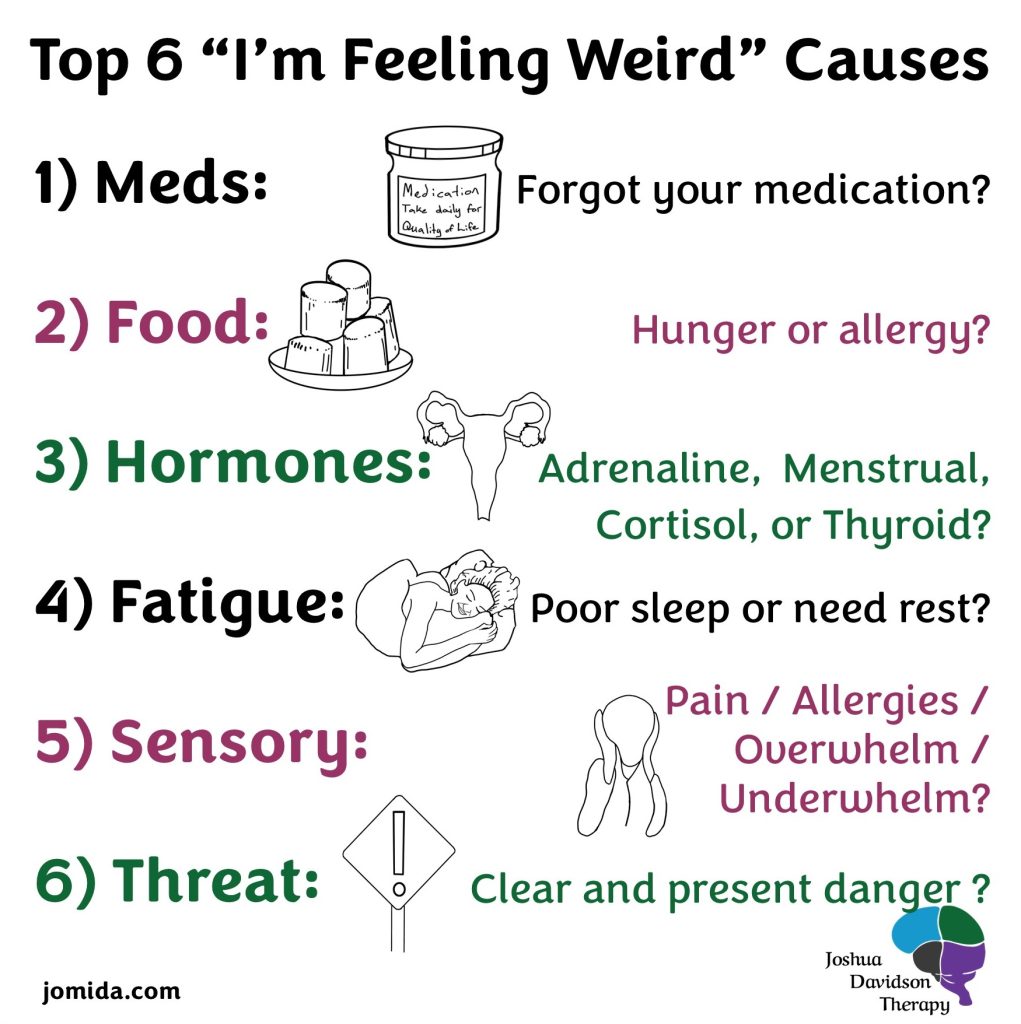
Top 6 “I’m Feeling Weird” Causes:
- Medication – did you take them, or did you take something that was wrong for you?
- Food – did you eat in the last 4-6 hours, or did you eat something that you react poorly too?
- Hormones – these can cause lots of complex problems (adrenaline, menstrual, cortisol or thyroid)
- Fatigue – if you are tired, you need to rest not keep going
- Sensory – Pain, allergies (hayfever etc), overwhelm, underwhelm
- Threat – clear and present danger needs to be addressed.
- If the thing you think you are reacting to was more than 6 hours ago, and now you are reacting… it isn’t that.
While progress will seem slow in the absence of medication (if needed) or environment stabilisation (if needed), once these previous two phases have progressed enough, the client will begin to enact the new core ideas and behaviours.
Phase 5 – Mood Management
This begins with some education on identifying what it feels like to have each of the major mood categories, and how to correctly assess the levels of those moods. This will then progress through to understanding the biological and social purpose of moods and how to tell if your emotional reaction matches the environmental cue. Checking on this is learning to note when your mood exceeds a mild level, giving you time to make decisions rather than just reacting.
A choice that is important to be able to make is to calm your mood back down. You can’t make a choice if you don’t know you have a choice to make, nor the skill to implement it. This leads to upskilling on how to manage your mood – but remember, this can only work temporarily to get you through a short term interaction. Long term mood dysregulation often points back to phase 2, stabilising the neurotransmitters (medication).
Phase 6 – Trauma Therapy
While it may seem like a great deal of pre-work to get to the actual therapy for the trauma, without a properly (or as best as we can manage) working brain to comprehend and make wise choices, without a stable environment to go to after therapy, without a sense of who you are and growing to be; and without the skills to recognise your mood and stabilise that – it is very dangerous to explore an event that was so traumatic that it damaged all of these things.
It is not uncommon that my clients don’t actually need this final step. What they thought was trauma related mental ill health was actually their brain using a traumatic memory to drive the mood to produce neurotransmitters to try to balance their brain, frequently on a background of unstable home life. When these are stabilised, it becomes apparent this was the actual problem.
If it is still relevant to continue with trauma therapy, a range of techniques are employed, depending on the nature of the trauma, the nature of the effect of the trauma and most importantly the individual client. The most common elements are:
- Unpacking the trauma, noting falsely conflated events, facts vs assumption
- Unpacking the narrative, seeking the best objective reality understanding
- Desensitisation to specific triggers
- Regaining Power and Choice