Stress is the body and minds natural preparation response to perceived demands, threats, or challenging situation. If stress rises high enough, the peak can trigger the Freeze, Fawn, Flight, Fight Emergency Protocol, which can strongly affect cognition (thinking), mood and behaviour. We can refer to this peak as a Crisis, Meltdown, Anxiety Attack or a Panic Attack. It can also be the point of Self-Harm or Suicidal Ideation. Short-term stress can be helpful in motivating actions, however, chronic or overwhelming stress can be problematic. Stress Mountain is a visual metaphor for tracking the process of overwhelming stress – from the Trigger Event changing your Baseline, through the Rumble Warning phase for Early Intervention, to the Distressed phase which indicates Late Intervention ending in Harm Minimisation if the peak Crisis / Meltdown phase can’t be averted, and then the Recovery phase, which is vulnerable to being Re-Triggered. Being able to visualise the phases and responses of Stress Mountain enables you to better determine what you can do for each phase to either return you to your Baseline quickest, or at the least minimise the harm.
At the end of this we have a brief rundown on the Wellness and Safety Plan, which can be used in conjunction with Stress Mountain.
You may also like
- Anxiety
- Other Mental Health
- Neurology
- Nutrition and Diet
- Sleep
What is a Meltdown?
TLDR: Meltdown is a term that is often used to describe a point of acopia (literally not coping), almost always as a somewhat derogatory term for the neurodivergent group known as Autistic. The mechanism is essentially the Freeze, Fawn, Flight and or Fight reflex kicking in to help the person who is out of sufficient neurotransmitters to handle the situation survive. It is synonymous with other survival modes such as Anxiety Attack, Panic Attack, and so on. There are ways to decrease the likelihood and things you can do about it other than mistaking it as a trauma response or naughty behaviour.
“Meltdown” is the common term used to describe the Freeze, Fawn, Flight and or Fight response neurodivergent people, such as Autistic, Intellectually Disabled or ADHD people have to a situation where neurotypical people would feel at most discomfort. Internally, it can feel like an anxiety attack, panic attack, freeze (physical and or verbal), fawning behaviours (people pleasing) or a time of disassociation and blank memory. Meltdown more refers to the external observer, noting what it looks like for someone who is going through this Stress Mountain peak, and generally applied only to people who are neurodivergent to minimise their distress and frequently reframe it to naughty behaviour – people don’t choose to have a Meltdown.
Behind the Meltdown are background factors that are generally misunderstood and thus not factored in to the overall stress and ability of the neurodivergent person. A common factor that many neurodivergent people experience is insufficient energy (Spoons) to maintain a positive present experience and preferred behaviours in complex scenarios (such as socialising) – We cover this in more detail below Understanding Neurodivergent Energy. The early warning that you are about to have an “out of spoon error” (the Meltdown) is called a Rumble Warning. Meltdown’s don’t just happen – they are the result of the environment energy demands exceeding the resources of the person. The Meltdown is the result of not managing that difference in supply versus demand early enough and thus your brain switches to Survival Mode, generally via the Freeze, Fawn, Flight, Fight Emergency Protocols.
Meltdowns Causes
Factors that can influence this balance of energy are insufficient body functions to manage the current unchanged situational demands, or an increase in energy demands due to a change in the current situation, or both.
Internal reasons why your energy may now be insufficient to an unchanging situational demand include:
- Meds – did not take medication
- Hunger – not eating recently enough (often the last 4 hours)
- Hormones – menstrual and or adrenaline etc
- Fatigue – poor sleep, or recent over exertion
Situational change is about how you perceive consciously, or subconsciously, the cost of the
Reasons why a situation can change to be more demanding include:
- Derailed: when needing to switch from one task to another, but the time given is insufficient
- More tasks: someone or something asks more of us, tipping the energy demand over what is in supply
- Incompatible method: someone asks you to do a thing that is not compatible with your efficient for you method, thus it costs more, beyond what you have available
Understanding Neurodivergent Energy
TLDR: Spoon Theory helps us understand what resources we can bring to any task. All tasks cost spoons. Neurodivergent people are often low on Spoons. This is often due to misdiagnosis, insufficient medication, poor skills in managing resources, inefficient skills, too many demands. Running out of Spoons leads to an Adrenaline surge which triggers Survival Mode, which alters our feelings and behaviours.
A common factor for Neurodivergent neurology is insufficient resources, aka Spoons. Spoon Theory helps us to understand how all tasks require the use of resources (internal energy, finances, time, friends, knowledge etc), and if we don’t have those resources, we are out of Spoons, and thus can’t do the thing (demand for the resource exceed the supply). Knowing that different tasks cost different Spoons for different people and circumstances helps us better understand why other’s may find your task easier or harder to do than you and sometimes you can do a thing, sometimes you can’t do a thing, and what you might do to change that.
While neurodivergent often means Autistic, it can also be many other neurodiverse cohorts. Most Neurodivergent people have co-morbidities (cooccurring) diagnoses with other neurological, psychiatric and or biological conditions (eg ADHD [Attention Deficit Hyperactivity Disorder]) or Chronic Pain. It is fairly rare to have these co-occurring condition recognised and diagnosed, leading to many Neurodivergent people not having useful medication, supports and or strategies in place. A common experience in ADHD, for example, is fatigue, simply because your Dopaminergic System is struggling. ADHD medications typical support this, however if you have not been diagnosed, your medication is inadequate, or you have another confounding condition, it won’t address that fatigue even if you look energetic. That is, you may have a diagnosis of Autism, which helps explain certain chunks of your life experience, but if the diagnostician missed (or wasn’t qualified to notice) your ADHD, you are probably struggling just because of inadequate medication. My my experience as a therapist, almost all people diagnosed with Autism benefit from a diagnosis of ADHD and the ADHD medication that helps the dopaminergic system. Low amounts of neuronal Dopamine, Noradrenaline and Adrenaline lead to increased difficulties thinking, feeling and acting, which leads to exhaustion and chronic low Spoons.
Neurotypical life strategies work well for neurologically typical people doing typical things in this society that is evolved for Neurotypical people. Unfortunately, there is a fair chance that most of these strategies are more difficult for a Neurodivergent (neurologically divergent) person to use, that is it costs more Spoons (internal resources) to enact. Developing improved strategies takes time to personalise, and a safe environment to develop those improved strategies. Neurodivergent people can often find themselves in a-typical situations, which mean that those neurotypical strategies are even more expensive to try to use with often neutral to negative results, leading to even greater loss of available Spoons.
What this amounts to is, if you are a Neurodivergent Person, you are probably confused, tired, and out of Spoons. A standard solution to this is to start substituting Adrenaline via Stress to compensate for that fatigue. When Adrenaline levels get high enough, people stitch to Survival Mode. There are two major presentations for this: the Anger series, and the Fear Survival Series.

Anger Series
Anger is a primary feeling that informs you that something is wrong, and if you don’t address it (when it doesn’t resolve itself), it will cause you problems (probably harm) later. It’s job is to inform you of problems so that you can assess whether to wait for it to resolve (passive, passive aggressive), do something to fix it (assertive or aggressive), or to get away (run). The idea is to alert you, not alarm you – but sometimes being alarmed is the right solution. If you can’t trust your own anger response, check to see what trusted people around you are feeling.
- Passive
- This is tied to the freeze survival mechanism.
- The characteristic of Passive is that you are not addressing the cause of the problem.
- Helpful: That can be the right response if it will resolve itself, or you don’t have the resources right now to address that without a greater cost than putting up with it.
- Unhelpful: It becomes a problem when you could solve the problem and you didn’t.
- Passive-Aggressive
- This is straddling the freeze and fight survival mechanism.
- The characteristic of Passive-Aggressive is that you are acting aggressively to something that is not the actual cause of the stress.
- This helps vent adrenaline led feeling that push you to do something, but you feel (perhaps unconsciously) that you can’t fix the cause of stress at this point.
- Helpful: This is useful when this is not the right time to address solving the problem.
- Unhelpful: This can cause problems in other areas that you may need to address later, especially if it hurts other people or damages objects.
- Assertive
- There is no specific match in the survival series as this is a human evolved social solution.
- The characteristics of Assertive are strongly stating and protecting your healthy boundaries. This can involve communicating with someone what the boundaries are and challenging them if they cross those boundaries. Think of it like a classic fight scene where the hero draws a line on the ground – if the opponent stays on the other side, nothing will happen beyond possible glaring, while if the opponent crosses the line, they are going to receive aggression.
- Helpful: Lets the other person know what the rules are and the probable consequences for breaking those.
- Unhelpful: So long as assertion is done correctly, there is no unhelpful aspect.
- Aggressive
- This ties to the Fight reflex.
- The characteristic of aggression is verbal violence, physical body language posturing or physical violence (to an object, attacking animal or person).
- Helpful: Sometimes violence is needed to protect your boundaries (10%). If this happens frequently with some people, you may have an Abusive Person problem. If it happens with most people, you may have an Anger / adrenaline problem. It is possible to be surrounded by abusive people.
- Unhelpful: Violence is generally the wrong thing to do (90%) and causes other problems that need to be fixed, leading to a long term deficit in spoons.
- Run
- This ties to the Flight reflex.
- The run characteristic is approximately when you figure out that you cannot win this fight, nor can you afford to be hurt, so you get out.
- Helpful: It is better to run away and survive so you can fight another day in most situations. This also negates the problem of violence not helping the problem, decreasing the loss of spoons later.
- For example, if you are trying to have a rational discussion with someone but your mood keeps getting heated, go and take a break. Have a snack and a drink, and once that settles, come back and resume your discussion. This is the right tactic in this case – so long as you are both trying to solve the problem.
- Unhelpful: Abusive people need to be confronted and boundaries need to be asserted. If you don’t confront them at some point, or do something strong to resolve the situation, you will always be a victim.
There is no perfect answer for all situations, as the context and your own abilities are key to deciding which strategy is going to work for you in this case.
Survival Fear Series
We evolved to survive predators with by utilising Fear. To understand this, we will look at the Survival Series in terms of how we would respond to a predator in the wild.
In our modern context, we almost never deal with predator animals in the wild – the predators are now other humans, or sometimes ourselves…
- Freeze
- Evolution: As you become aware of a predator, it may not be aware of you. The Freeze Reflex prompts you not to draw attention to yourself. If the predator doesn’t see you, then you can’t be targeted by it.
- Appearance: You may become still, non-verbal, or muted in some other way. You may become indecisive, or just ramble to avoid a commitment.
- Helpful: Sometimes the best thing to do is not draw attention to yourself. If you can’t do something about the problem, wait a bit and see if the problem (predator) removes or resolves itself. Why fight off the predator if it is just going to walk away?
- Unhelpful: If the Freeze Reflex is too strong, you may not be able to switch to one of the other actions and become helpless. Predators are not going to be kinder to you just because you aren’t fighting back.
- Fawn
- Evolution: The predator has noticed you. Perhaps if you feed the predator, it won’t think of you as food. You try to please the predator.
- Appearance: People Pleasing
- Helpful: If it is unusual for this person to be upset, then doing things to help them feel better will resolve this situation and then hopefully they will self manage, or perhaps you can help them with the actual problem.
- Unhelpful: Many abusive people take advantage of people with People Pleasing reflexes.
- Flight
- Evolution: The predator has noticed you. Before it can attack, you back off and get out of its range. Most animals the predate on humans are ambush or pounce predators. Humans have a better ability to maintain a run than most predatory animals, so if we get out of range, the predator won’t bother and will look for other food. It can’t hurt you if you aren’t there.
- Appearance: Anxiety, Fear, exiting the situation early, not going outside, agoraphobia
- Helpful: Often the situation is best avoided by not being there. When someone tries to entice you into a fight, the best option is not to reward them with a fight. If the same person keeps enticing you to fight, they are someone you probably don’t want in your social group.
- Unhelpful: Abusive humans will go out of their way to find victims. Exiting early is often not helpful in asserting good boundaries and defeating predator humans.
- Fight
- Evolution: The predator has noticed you and is coming in to attack. You can’t turn and run, it is too late, it would just attack your back, making you more vulnerable. It is now time to choose to fight or get hurt. If you can defeat or hurt the predator, the rest of your tribe will be safer.
- Appearance: Aggression, either verbally or physically
- Helpful: Sometimes it is necessary to fight. This should be a rare exception.
- If you decide that this is the right call, then win.
- Most fights don’t need to be violent. Work out the way to take action to defend yourself and your loved ones that is non-violent. For example, court, police, peer group agreements, using the rules etc.
- If you are being physically attacked, then physically defend yourself. Then call the police.
- Unhelpful: Often this is the wrong call to make.
- In the absence of a direct physical assault, you had best be very sure that it is the right call to make.
- Physical violence is best only if you need to physically defend yourself from a clear and present physical attack. In all other instances, a non-violent fight (as outlined above) is the better solution.
These are our primary feeling default actions. We should progress through these in order. Because these are primary, they are also basic. That means that it doesn’t include nuanced decisions and reasoning. For most people, by the time this is needed, the threat is big and clear enough that it needs a basic solution and you’ve run out of time to think of something more complex.
Stress Mountain
Stress Mountain is the very human process of struggling in adversity, failing to accommodate, and having a Meltdown of Normal Functions aka freezing, anxiety attack, panic attack, aggressive behaviours, self harm, suicide attempt or some other stress response. Stress Moundatin has a number of phases, most we can act on if we identify them correctly and avoid the Meltdown and return to the Baseline.
Summary of Stress Mountain
Stress Mountain has 5 distinct phases.
- Baseline: Where we mostly live
- Rumble Warnings: The early warnings that we are not coping
- Distressed: The late warnings that we are not coping
- Crisis / Meltdown: The temporary time we are unable to function, often with behaviours that are not desirable
- Recovery: the post peak return to the baseline state
- There is a high risk of re-triggering another Crisis / Meltdown while recovering
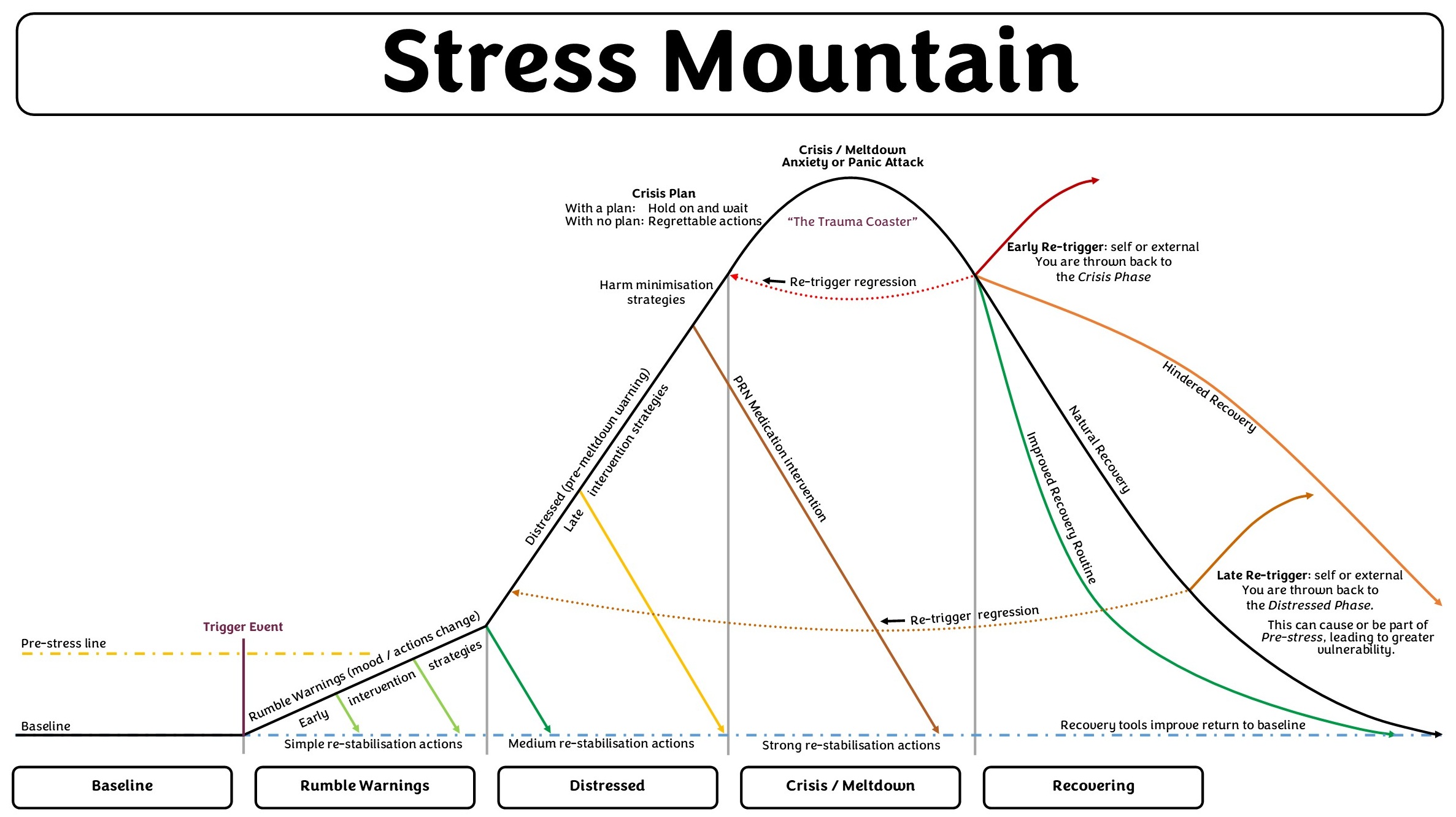
The Baseline is our basic normal functioning level. It can be elevated by a pre-existing stress that often results in us getting less Rumble Warnings before we go into the Distressed Phase.
While in the Baseline phase (most of our experience), we can do some things to ensure our best odds of remaining in a good functional state. We will cover that few times as it is a common theme. Our first warning of running out of resources is the Rumble Warnings Phase. This allows us to enact Early Intervention Strategies to return to the Base State quickly. If we miss these warning signs and don’t enact the strategies, or they fail, we will next move to the Distressed Phase, where we have the opportunity to enact our stronger re-stabilisation actions, escalating in strength as we near the Crisis / Meltdown Phase.
The goal of the early and late interventions is to avoid having to go up the mountain and end up in the Crisis / Meltdown Phase.
If we can see that we are headed to the Crisis / Meltdown Phase and no intervention is working, then we must enact Harm Minimisation to do what the label says – minimise harm. It is a good idea to have a Crisis Plan or Safety Plan to help you or others know what to do at this point. People are not very good at thinking well when either in this state, or helping someone in this state, so it helps to have this pre-prepared and easily available.
Following the Crisis / Meltdown Phase, we will need to self-care and return to our Base State. This can be done with just Natural Recovery, or we can get better and faster results with an Improved Recovery Routine. It is important to assess how our Recovery Routine works, as it is impossible to accidentally do actions that hinder our recovery, mistaking them as things that help.
After a Crisis / Meltdown, we are vulnerable to being easily Re-Triggered, returning us to an elevated earlier stage of Stress Mountain, making it harder to avoid another Crisis / Meltdown.
For full details of every Phase, read below. At the end is a full version of Stress Mountain with additional information.
Phase 1 – The Baseline
Our Baseline is our general capable well functioning self. That is, we can mostly do what we want to do, and we are able to use the behaviours we like to use. Some people may find that this is a rare state to be in, and that indicates that something is wrong in either your environment and or your medication – poor medication may indicate an erroneous or missing diagnosis.
When we are in our Baseline, we are able to use our Wise Mind. Wise Mind is a good blend of being in tune with what your feelings are telling you about a situation, and being able to decide if those feelings are correct and thus doing the default feeling led actions, or not correct (either too strong or misaligned [wrong feeling]) and so choosing an action / behaviour that is better. We call it Wise Mind, because you make wise choices – good decisions based on the information you have, the understanding you have, and the available resources you have (Problem Solving, Retraining the Brain).
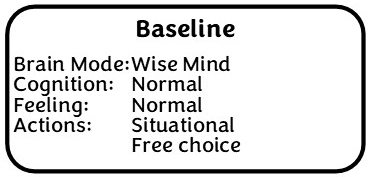
Our cognition is at its good normal ability when we are in our baseline and not compromised in any noticeable way. Our feelings are generally mild and suitable to the situation. People with a mood disorder may feel some anxiety or anger, but this is usually at a controllable level.
In our Baseline state, we are free to make any choices we want to, given the situation and our wants.
Pre-Stree Line
If we are dealing with a previous stressor, whether we hit the peak of Stress Mountain or not, we will have fewer internal resources to manage ourselves, and so our Baseline will be elevated. This results in us having compromised Rumble Warning Phase. That means reduced time to act (Early Intervention Strategies), less resources to act, and likely a stronger Distressed Phase experience with similar problems with Late Intervention Strategies.

Pre-Emptive Actions
TLDR: Take your meds, eat food, get rest, exercise; have a healthy social circle; have enough money to handle most things; have reason in and for your life. AKA the Bios-Psycho-Social Plus model.
I was talking to a psychiatrist about 30 years ago about what can be done to minimise the effects of mental illness. He pointed me to the Bio-Psycho-Social model, pointing out that all 3 of these fields affect our ability to function (I’m saying this far more concisely than he did), and that if we look after those fields ‘health’, then at least those aren’t making our symptoms worse. I’ve expanded on the model (in the link).
In my experience, often what triggers people to have experiences like Stress Mountain in the absence of a specific external trigger is not managing the biological aspect of their body. That is, not taking medication (as prescribed), or medications that aren’t actually treating the cause of the problem; not eating regularly or well, and or not knowing the foods that we react poorly to; hormones; and fatigue. There is huge benefit to being fit over being sedentary.
External stressors increase the likelihood of an external trigger sendings us up Stress Mountain. When we manage our social circles well, then we are generally around positive and supportive people who inspire us to better growth. We can rely on our friends and family (when we have good family) to give us support – we don’t have to do all of this alone.
Having some level of financial safety is also important. It is hard to feel safe and able when we don’t have any financial resources to put towards problems. Financial stress easily pushes our stress levels up so that we are on the Pre-stress Baseline instead, increasing our reactivity and increasing the odds of having a Metldown.
Having no goals in life can indicate that we are in a general default Survival Mode. It is hard to Thrive without a future goal, or having reasons behind what we are doing now.
With these things being maintained, you will find the number of times that you travel up Stress Mountain decreases.
Trigger Event
A Trigger Event is the point at which you have switched from normal responses to your environment in the Baseline Phase to starting the Rumble Warning Phase.
An event can be an Internal or an External Event.

Internal Event
Internal can be a biological shift or an internal thought or memory. Psychological experiments have demonstrated how choosing to think specific kinds of thoughts can change our level of emotional arousal up or down. This is the essence of how calming exercises such as mindfulness work – we deliberately bring to mind the kinds of thoughts that brings our emotional arousal state down. The reverse can be applied to hype ourselves up.

We can often accidentally think certain kinds of thoughts which have a physiological response, either rousing us up, or down. If we are in a higher Baseline state due to a Pre-Stress situation, then we are more prone to get stuck in these thoughts or to have a stronger reaction to them.
The most common kind of internal thought or memory that can affect us is Negative Self Talk. This is where we say to ourselves, either in our own voice, someone else’s voice, or just a feeling that reflects, a very negative impression of ourselves or the situation. Self talk is natural. It helps us to highlight to our conscious brain what is going on. What isn’t helpful is if that is biased and worse, uselessly repetitive. For that, it is important to consciously change the internal dialogue narrative via mindful counter messages, challenging the essence of the negative self talk.
An Internal Biological Shift can be due to
- Forgot to take medications or took a substance that isn’t helpful:
- Meds: Take your meds if safe to do so.
- Substance misuse: Depending on the situation, either wait for the substance to stop affecting you – while you do nothing! – or go to the Emergency Department of your local hospital to get help.
- Didn’t eat food in the last 4 hours, or you ate an allergen / food you’re intolerant to:
- Forgot to eat: Eat safe Crisis / Meltdown prevention foods.
- If you have an Eating Disorder that has affected this, take the specific steps needed to manage that.
- Allergen / Intolerance: Either wait for the effects of the bad food to pass (while doing very little), or go to the ER if needed.
- Forgot to eat: Eat safe Crisis / Meltdown prevention foods.
- Hormones such as menstruation, an adrenaline surge, cortisol or thyroid problem:
- Menstrual: if you have active ovaries, check out our PMDD page for lots of discussion on this.
- Adrenaline: if you have had an adrenaline surge, we have discussed most of that above in Understanding Neurodivergent Energy, and that section has links for further reading.
- Cortisol and Thyroid: talk to your GP.
- Fatigue from poor sleep and or having completed a hard task (for you):
- Poor sleep: go to sleep if you can. If you have sleep problems, check out Beating Insomnia and Beating Pre-Sleep Anxiety.
- Sensory trigger, such as:
- The environment has become too loud,
- Touch irritants (surfaces that you need to touch feel bad),
- Hay fever style ongoing allergens,
- Bad smells,
- Changing lights,
- etc
- Most of these can be managed if you have identified what the irritant is.
External Event
In our attempt to balance our current internal resources and situational demands, a change in the situational demand can trigger Stress Mountain.

- Threat:
- The external change may be due to a Clear and Present Danger:
- Clear and Present means that you can both see it and it is obvious. Threats are not generally subtle, and if it is subtle, then usually a subtle solution is warranted.
- Danger means inaction will lead to you, or someone else, being physically hurt.
- Moderate risk:
- This means that a fair chance of physical, cognitive or emotional harm is likely to occur.
- The external change may be due to a Clear and Present Danger:
- Additional task requirements:
- If we are at our resource limits, then we may not be able to cope with additional demands on our resources. This could be:
- Additional sensory stimuli (music, people talking, lights, smells etc).
- People.
- New task parameters (which leads to the next category about derailment)
- If we are at our resource limits, then we may not be able to cope with additional demands on our resources. This could be:
- Derailment due to change / switching tasks:
- Derailment is to do with how we have optimised our resources to deal with this situation, not the new one, and the struggle to switch tasks. We discuss it in more detail here.
Phase 2 – Rumble Warnings
The Rumble Warnings Phase tells us that our situation has changed and we no longer have the resources to deal with the upcoming demands – demand exceeds supply. If we missed the transition (the Trigger Event above), we should notice our change in interoception state (feeling strong emotions) and or behaviour (pacing, repetitive questioning, rocking, aggression, clumsiness or suddenly becoming still).

Not all Rumble Warnings are a promise of a Crisis / Meltdown if you don’t act. Sometimes we do some of these actions for self comfort without it being an early signs of trouble. The Rumble Warning may be only an indicator for you to check your internal state to check on biological internal causes and to address that, or to monitor more consciously for the next few minutes (up to 15 minutes) to see if there are other signs. As you experience more signs that this is a proper Rumble Warning, then it is time to implement some Early Interventions Strategies.

A good tell that you are experiencing Rumble Warning signs is that you feel like you are struggling.
That struggle will look different for different people. These warning signs are called the Rumble Stage. Stereotypical Autistic cues for the Rumble are:
- Direct observable behaviour cues:
- Pacing.
- Rocking.
- A significant fidget increase.
- Sudden stillness.
- Withdrawing from.
- Clearing through or echolalia.
- Verbal and non-verbal expressions of discomfort.
- Internal Cues:
- Feelings shift significantly (dysregulation).
- Hunger or Medication wears off:
- Anxiety increase.
- Aggression increase.
- Feeling disturbance.
- Noting an unexpected action behaviour change.
- Finding yourself avoidant of new tasks or continuing the current activity.
- Cognitive Cues:
- Struggling to comprehend things you normally would.
- Forgetting things faster than normal.
- Mood behaviour shift.
- Making 3 minor errors in quick succession.
- Finding it hard to make choices.
Early Interventions
The most common reason why we have Rumble Warnings is that we are low on Spoons, that is demand for your resources outstrips your supply of resources. The most common reason we are low on Spoons and what to do about them are covered in Weird Mood or Thoughts – Top 6 Causes. You will note that most of these are to do with biology, not trauma or external threats, and that is because most of why we have run out of cope is due to insufficient energy due to biological problems. These are numbered in the order of most likely to the least likely.

It is important to note when the circumstances has changed drastically and we have struggles coping in that situation. We may not have realised how low we were on our internal resources, or the demands just generally exceeded our abilities.
If you have done all of these checks and are still struggling, it is time to have some quiet time and do some calming exercises.
Top 6 “I’m Feeling Weird” causes and what to do about them:
- Medications
- Did you forget to take them, or are they wearing off? Can you take them now?
- A change in your usual medications may be affecting you.
- You may have taken a substance that has a medication like effect, such as caffeine, tobacco, nicotine or something else.
- If this is the case:
- How long should you expect it to last for?
- How will you be safe while that is happening?
- Should you seek aid?
- If this is the case:
- Food
- If you haven’t eaten in the last 4 hours, you are likely hungry and this is what hunger feels like to you.
- If you have eaten recently, did you eat something that you have a food allergy or intolerance to?
- Hormones
- Is this an adrenaline reaction? If yes:
- Medical condition: Do you have a medication or calming method to manage that, and if so, do it.
- Otherwise: Is the Adrenaline compensating for something? Often we feel Anxiety or Anger as an Emergency Response to the Adrenaline we are using to try to compensate for exhaustion or medications wearing off.
- Menstrual
- Take a look at our PMDD section for PMT, mid cycle crash and other related sex-hormone effects.
- Cortisol and Thyroid
- These are often long term and typically very rare, but in neurodivergent people it can be the case. Neurodivergent people often present atypically. If you have frequent mood issues, get these checked via your GP to ensure they aren’t an issue.
- Is this an adrenaline reaction? If yes:
- Fatigue
- Sleep
- Many neurodivergent people don’t sleep well due to Pre-Sleep Anxiety Insomnia and or Chronic Pain.
- Exhaustion
- If you have just done a task that exhausts you, you may need to rest. Often Adrenaline is used to compensate… see above.
- Sleep
- Sensory
- Pain
- Allergies such as hay fever (and other background irritants)
- Overwhelm (too much stimuli for the amount of Spoons you have)
- Underwhelm (too little stimuli to keep you engaged)
- Threat, Clear and Present
- We often think we are responding to a threat when we begin to act out, but often this is a mistake. To tell the difference, if the threat is not Clear and Present, that is, right there with you and very obvious, then you probably not responding to a Threat – you are actually experiencing one of the above causes.

Phase 3 – Distressed
We enter the Distressed Phase if we either did not notice the Rumble Warnings, or the Early Interventions Strategies did not work.
The Distressed Phase is mostly characterised by very strong urgent feelings, often mostly based on Adrenaline. This is triggering our Freeze, Fawn, Flight and Fight Emergency Response, which we covered above. The stronger that our feelings are, the harder it is for us to think clearly. Generally, there is a lack of a Clear and Present Danger to justify the Adrenaline explosion, so we find it hard to make wise decisions against an identified threat.

To re-state that, making this distinct from just a fear response, if there were a visible active threat, we would be having a justifiable fear response, rather than in the absence of that Clear and Present Danger, we are having an unjustifiable feeling response (which might be fear, or anger or something else). If there was a Clear and Present Danger, we would be doing something about that threat (even if that is freezing or running), and we would know why we are distressed. In the absence of a clear cause, we are distressed for no good apparent external reason, thus this is a part of the Stress Mountain. If you cannot identify a Clear and Present Danger, then the problem is most likely an internal biological problem – see the section on Tigger Events above.

When we are in the Distressed Phase, thinking is hard. We find it hard to understand things, hard to work out what to do and very difficult to solve problems. Our brain is gearing up to survive anything, as it is sure that some crisis is on the way – aka Crisis Preparation. Your brain can’t load any particular action because you can’t identify what the problem actually is (see the paragraph above), so our actions are whatever our autopilot thinks will keep you safe and our ability to choose is severely limited. We are very reactive to anything that might give us a reason why we feel like we do, mistaking any clue as the natural reason why we are distressed. This difficulty to think and rationalise is why it is important to have a good plan of what to do when we are distressed, where our choices are fairly easy to make based on easy to identify markers of distress. If you are helping someone who is distressed, then you need to give gentle redirection to help them manage this, prompting for what is in the Crisis section of their Safety Plan (covered in brief below).
Late Intervention
When we recognise that we have reached the Distressed Phase, due to the decreased cognition it is hard to make plans to solve the problem(s) of this situation, we need to simplify. We don’t have the ability to look after adults (who aren’t dying), instead we need to focus on our own needs. This is when we enact Late Intervention Strategies from our Safety Plan. Each plan is going to have a different strategy that is tailored to your specific symptoms, likely experience and preferred outcomes.

Common themes to consider are:
- Who you can call for support.
- Clear markers to indicate which particular plan you may need to use, for example:
- If aggressive, calming medications.
- If looping, Beta Blocker.
- If migraine, sleep.
- Note: These are just samples, not what you should have.
- PRN Medication:
- PRN medication prescribed by your GP or psychiatrist.
- PRN stands for Pro Rata Nata, which means “as you need it”.
- This should be something that addresses distress, is safe to use, unlikely to be misused.
- PRN medication prescribed by your GP or psychiatrist.
- Minimising harm in case you cannot head of the Crisis / Meltdown (see the following sections).
- Do you need to go to hospital?
Harm Minimisation
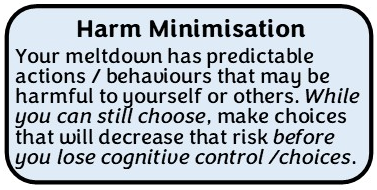
Harm Minimisation is about reducing risk. Risk can never be completed eliminated, but it can be reduced and mitigated. Harm could be to yourself or to another person / object.
Based on prior Meltdowns, identify what the likely harms are and make a plan for how to decrease those risks. For example, if you are likely to self harm by cutting, before you get to the peak of Distressed, remove yourself from blades, or put the blades in a timer box that won’t open for 1 hour.
Because the types of harm we may enact or varied, you will need to work out what your risks are and how to mitigate those. Work with a trusted friend or therapist to help brainstorm what those are and what the minimisation strategies look like.
Phase 4 – Crisis / Meltdown, The Trauma Coaster
During the Crisis / Meltdown, your brain has switched to Survival Mode. In Survival Mode, your autopilot kicks in and bypasses your prefrontal cortex (the bit of your brain that holds the “I think I will do this” or “I understand that” part of your awareness), and will do whatever your autonomous reflexive brain thinks will help you survive this moment (based on either a plan you’ve made or defaulting to the Survival Mode reflexes). That survival part isn’t concerned with good outcomes, it just wants you to be alive a bit longer. That means that any solutions that doesn’t actually kill you is good enough for your Survival Mode Brain, and by you being alive later, you can fix anything that it has messed up for you.

It is very hard to think clearly at this time. We default to things that worked in the past to keep us alive, even if that wasn’t a happy alive. We can train into ourselves Crisis Safety Action plans, so that we do these actions instead. It is too late to try to train these in to ourselves in the middle of a crisis, so we have to plan and practice them when we are feeling safe, and then practice them again when we feel stressed but haven’t hit Distressed yet. With the loss of cognitive ability, in Crisis / Meltdown we don’t have much if any decision making ability – we have no choices.

Our emotion centre has switched to Freeze, Fawn (rare), Flight and or Fight. We can start at one and move to another of these feelings. As we have no real cognitive ability, we will act on these feelings without critical thought or any wise plan. We assume the feeling is real and that because it is such a strong feeling, we feel like we have no time to think, check or plan – so we trust our Autopilot reflexive action (the Freeze, Fawn, Flight or Fight) and just do that. Our actions are all Survival Mode autopilot because we can’t really think, so we can’t choose our actions – just react as our Survival Mode autopilot selects, based on our emotional feeling.

Crisis Neurology and Survival Mode
Why is it so hard to think in this state of mind?
Our Prefrontal Cortex, the bit of our brain just behind our forehead, evolved for higher thinking. It is quite slow compared to our autonomous thinking, but far more creative. We use this part of our brain to gain deeper understandings of situations, and from that we can create much better solutions. So long as we have the time to do so. In the long run, using our Prefrontal Cortex saves us time and energy because of how much better our solutions are compared to our autonomous ones. This is what gave us our modern living compared to hiding in caves.
In the middle of our brain is our Amygdala. It is part of the limbic system, which includes the thalamus and the hypothalamus, which contain the template for being able to tell if this situation is “safe” or “not safe”. The Amygdala is closely connected to our cerebellum, which is what all of our sensory system reports to. The Amygdala compares our sensory perception to our memories and works out if it matches “safe” or “not safe”. If we are “safe”, we feel comfort, happy, content or other helpful feelings, and suggests that we either “rest”, “recover”, “repair”, or “prepare”. If we are “not safe”, we feel fear (a Clear and Present Danger; triggers the Survival Fear Series), anger (something needs attention or it likely will get worse; triggers the Anger Series), or disgust (something will make you sickened; triggers repulsion or hate) if it can, or just anxiety or aggression if it can’t. The Amygdala doesn’t tell your Prefrontal Cortex what is wrong, just what it feels like, and your Prefrontal Cortex uses that clue to find out what it is itself. This system is very fast, but not creative.
When we are switched to Survival Mode, resources are diverted from our slow Prefrontal Cortex to our fast Amygdala, because we are more likely to survive then. That means our responses are faster to actual threats, and likely to keep us alive. They are awful when we don’t know what the problem is.
Dopamine and other necessary neurotransmitters are no longer enabling the prefrontal cortex to be able to solve what to do and take intelligent actions. When you talk to someone in this state, they often can’t give you answers, or the answers are very simple.
Some actions are seeking to trigger additional emergency neurotransmitters to shock the system back into some form of balance. This can lead to self-harmful / suicidal behaviours.
Shutdown
Both the Anger Series and Survival Fear Series have shut-down modes: either Passive (watching) or Freeze (non-action, often with non-thought).
Internal experience:
- Disassociation: feeling absent, unplugged, blacking out, unable to act
- Looping thoughts: “I don’t know what to do”
External appearance:
- Going non-verbal, or paucity of words
- Rocking, pacing, small repetitive action loops
- Being very still and non-responsive
- Weeping or keening
Flight / Run aka Anxiety / Panic Attack
Both the Anger Series and Survival Fear Series have avoidant modes: either Run (Anger – “I can’t win this battle”) or Flight (“It can’t hurt me if I’m not here” / “I’ve got to get out of here”).
Internal experience:
- Run (Anger)
- I can’t win this battle
- Flight (Fear)
- “It can’t hurt me if I’m not here”
- “I’ve got to get out of here”
- Fixation on the assumed cause of the fear or anger.
- It is almost always focused on a thing that is not actually a current problem, because that wasn’t the cause, it is what your brain has latched on to that might explain this feeling.
External appearance:
- The person wants to leave immediately
- The person is distressed if they can’t leave
- The person seems to be having an anxiety attack (they think things are getting worse, they have some but very limited cognitive function)
- The person seems to be having a panic attack (they are not cognitive, just actions of panic)
Fight aka Aggressive Behaviours
Both the Anger Series and Survival Fear Series have agressive modes: Fight
The Fight aggression can be verbal or physical, to the self, objects or to another person.
Internal experience:
- I am a terrible person and I need to be punished. If no one else will do that punishment, then I will.
- This person is a direct threat and I have to stop them, or let everyone else know that they are a direct threat
External appearance:
- The person is aggressive in their spoken words or harmful actions, to themself, objects or people.
- Spoken words
- Self: “you fat stupid b*tch”.
- Others: saying whatever the cunning brain thinks will hurt them the most, regardless of if it is true or false.
- Harmful actions
- Self harm / suicidal actions
- Flipping tables, wrecking furniture
- Attacking a person / picking a fight
- Spoken words
The Trauma Coaster
Having a Meltdown is hugely disempowering. While here, you have not real choices. To make a choice, you need to have the awareness of the choices you can choose and the resources and skills to enact that choice. When we are in Crisis, we don’t have much if any cognitive ability. Our brain has surrendered to our Survival reflex. Without cognitive ability, we don’t have skill or cognitive awareness, so choices are gone. We are just reacting however our Survival Brain thinks we keep us alive.
We have lost the power of choice.
Many of us have been put into situations where our choices were taken from us by abusive people. Having a Crisis of circumstances push us into Survival Mode feels very similar to when we were abused. That similarly to a prior trauma situation can be traumatising all over again. Worse, carers and staff often try to make us feel bad for having a Meltdown and any of the actions we took when we were in Survival Mode. Too little attention is traditionally spent on looking at why we had a Meltdown and thus prevention, and focusing on what we did when we had no choice. That adds salt to that re-opened wound. A standard tactic of abusive people is to blame the victim for what the abuser did, that is, blaming the victim for what was out of their control.
After a Crisis, especially when we have had a Meltdown, what we need is comfort and support. Later, when we are more stable, we need to analyse what went wrong and how to prevent that and was our Safety Plan and Harm Minimisation Strategies adequate.
Phase 6 – Recovery, or …
The Crisis phase has passed and the Meltdown has happened. As cognition returns, choices are becoming possible again. We are still not at the Baseline and it is important to recognise that we are in a vulnerable state where we can Re-trigger. Abusive people love to re-trigger us, so it is important to have a plan for how to get away from them since we won’t have the cognitive resources to manage them.

In the Recovery Phase, the adrenaline is decreasing which is allowing our cognitive functions to begin to work again. This is also known as Let Down in some circles. Our Feelings are beginning to become more accurate to the circumstances, but we are still reactive and easily Re-Triggered. It takes some time to recover to the Baseline, so we need to allow ourselves time to rest and recuperate.

Natural Recovery
We will have a default system in place to return to Baseline which we will refer to as Natural Recovery. Unfortunately, some of us have developed bad habits that lead to Hindered Recovery. If we are thoughtful, ahead of time, we can systematically work out what gives us Improved Recovery.
For most people, Natural Recovery is having some quiet time to rest, contemplate and recuperate. This should be done in a quiet environment with only supportive safe people around.
Improved Recovery Routine
Improving on the default can get us to the Baseline faster and better.
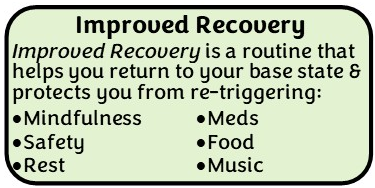
Step 1: Get Safe
We entered Survival Mode because we felt unsafe. If you feel unsafe after you have exited the Meltdown, then it is important to change for safety. That can include asking people to move away, or moving yourself to a safe location. It should be somewhere that you feel safe. Often that includes more enclosed, darker and quieter, but your personal needs may be different. Move away from likely triggers and or dangers.
Step 2: Recuperate Resources
We rose up Stress Mountain because our internal resources didn’t match the actual or perceived demands of the situation, prompting us to switch to Survival Mode to get through the actual or perceived Crisis. Survival Mode actions likely burned up even more resources.
To restore those resources may include medication, food and drink. Food should include a small amount of fat, sugar and carbohydrates and a moderate amount of general nutrition. Ideally you are including a food ingredient that has Tyrosine, which is vital for being able to make the Dopaminergic Neurotransmitters, which you are likely very low on right now. Your body can extract Tyrosine from any meat and many soy products. Many people can get Tyrosine or a more developed version (it changes a few times on the way to becoming Dopamine) called phenylethylamine in chocolate, aspartame (a sugar substitute), or from protein powder supplements (beware of too much caffeine in those powders).
Some people benefit from some caffeine, while some become more anxious. Choose this based on whether caffeine usually helps you feel calmer or more agitated. Drinking anything non-alcoholic is helpful for helping your brain recognise that the crisis is over. Sip slowly.
Step 3: Recover Calm
Once we have some food and safety, then calm is a state of mind. Our mind is in our brain, and our brain is in our body. We need to send some signals to our brain that we are now safe and it is time to step down from Survival Mode.
Calming Down is a specialty in and of itself, covered in the linked page.
- Controlling Breath
- ie Breathing Exercises
- Controlling Thoughts
- Distracting from Negative Thoughts
- ie Mindfulness
- Choosing Deliberate Thoughts
- ie Guided (& self guided) Meditation
- ie Mantras / Affirming Phrases
- Distracting from Negative Thoughts
- Controlling Feelings
- ie Music
- ie Mantras / Affirming Phrases
Breathing exercises can also speed up cognitive recovery.
1) take a medium speed deep breath in via your mouth, then breath out firmly and slowly through pursed lips, almost as if you were whistling.
– Breathe out along your extended arm and see how far down your arm you can feel the wind you generate.
– See how long you can go before you need to take a breath in again.
– Say to yourself, in your head, “This is a false alarm; There is no clear and present danger and no one is clearly hurt or in harm’s way; There is no action that needs to be taken” while you are doing the exhalation.
This breath method is the one that your cerebellum responds to most for decreasing the rate or your heart and feeling of anxiety.
Hindered Recovery Routine
Sometimes we expect too much from ourselves. We think that we can immediately get up after a Meltdown and immediately return to our normal level of functioning. This is just physiologically not accurate and is setting ourselves up for becoming Re-triggered and worse, increases our default paths to self-sabotage.
While the things that can self sabotage are many, there are a few common features I see.

Mistake 1: Not resting
As outlined above in Improved Recovery, we climbed Stress Mountain because we didn’t have enough resources, and then we expended even more in the Meltdown. We need to rest to recover, and not letting ourselves rest is anathema to recovery. If you feel the need to not rest, here are two questions that are worth considering:
- Who is pushing us to go straight back to being “functional”.
- If it is someone else, they are either
- misinformed about what is needed (educate them later), or
- abusive (they won’t listen to the education – check out the Toxic People Mind Toolset and keep in mind Grey’s Law)
- If it is yourself, why are you being mean to yourself?
- If it is someone else, they are either
- Who will need emergency hospital care if you rest?
- If you can identify someone, then yes, this sacrifice may be worthwhile.
- Should you call the emergency number for Fire, Police and Ambulance? If not, then this may not be an actual emergency.
- If no, then you are being mean to yourself, or someone else is (see above).
- If you can identify someone, then yes, this sacrifice may be worthwhile.
Mistake 2: Staying in a stressful location
Our Amygdala does its best to work out if we are “safe” or “not safe”. If you have an anxiety disorder, then it already struggles to figure this out. What doesn’t help is staying around people who are stressful, or an environment that is triggering to you. Triggering environments can be due to lighting, sound, reminders of tasks, or bad memories.
Mistake 3: Not eating, or eating poorly
We’ve covered food a few times. We need to eat something to help us recover some biological resources. See above for what to try to eat.
What we should avoid are things that are not compatible with us. For example, I personally react poorly to chocolate and gluten. For many years, my recovery food included chocolate. I didn’t know at the time that I respond poorly to chocolate, so it took a while to figure out that this food should be avoided, especially after I am trying to recover from a Meltdown.
A large proportion of Neurodivergent people have a food allergy or intolerance (estimates are around 30%). If you experience intestinal pain, IBS, or strange moods / energy levels that begin up to an hour after you ate, then you likely have something you should investigate.
Phase 7 – Re-trigger
Re-triggering is where you perceive another threat or another demand while you are still vulnerable while you are Recovering back to the Baseline.
The Recovery Triggers can be Internal and or External. We’ll cover a few of the common ones here.

- Internal
- Ruminating on thoughts and memories
- See Controlling Thoughts in Recover Calm above.
- Hunger
- See Recuperate Resources above
- Medication has reached the end of its effect
- Can you take your next dose? Or is this the end of the day for that medication for you? Talk to your script writer if this is a frequent problem, or therapist for strategies if you cannot modify your medication to address this.
- Ruminating on thoughts and memories
- External
- Unexpected noise
- Actual or perceived demand beyond your current ability to manage
- Actual or perceived stressful person

Wellness and Safety Plan
If we frequently struggle to manage our mood and behaviours, then it is a great idea to have a developed Safety Plan that can help us maintain our Wellness and guide us through recognising the various stages of Stress Mountain. For that, we have a Wellness and Safety Plan. While we have aimed to make the use of it fairly intuitive, in my opinion it becomes intuitive once you understand how it is supposed to be used.
In short, the top row is how you can tell that you are currently at Baseline, aka Well. Signs that you are doing well are important for you to know that these signs mean I am well. Often my clients don’t know how to tell, and figuring these signals out for you helps your enteroception (ability to look within and know your inner state). On the left is what you can do to maintain this (pre-emptive steps) and on the right is what is likely to decrease your wellness, aka avoid.
The second line is your Rumble Warnings. What warns you that things have got to this stage. On the left is how to get back to being Well, aka Early Intervention Strategies. On the right are the things to avoid so that you do not become worse.
The third line is your Distressed phase. List what are the indicators for you and or someone else that you are now needing help, but we aren’t at Crisis yet. On the left are the things you can do to improve, aka Late Intervention Strategies. On the right are the things you should definitely avoid, aka the opposite of Harm Minimisation.
Last of all is the plan for when you are in Crisis / Meltdown and who you should contact if you can’t keep yourself safe.
On the reverse side are your contacts, including who is good for what kind of support, and who you shouldn’t contact when you are in this state. Additionally, instructions for current medication in case you need to get someone else’s support, need to go to hospital, or you are struggling to know what to do. Allergens are listed so that other people can avoid those too.
All of this is covered in detail on the Wellness and Safety Plan page. Below is the front and back of the Wellness and Safety Plan.

